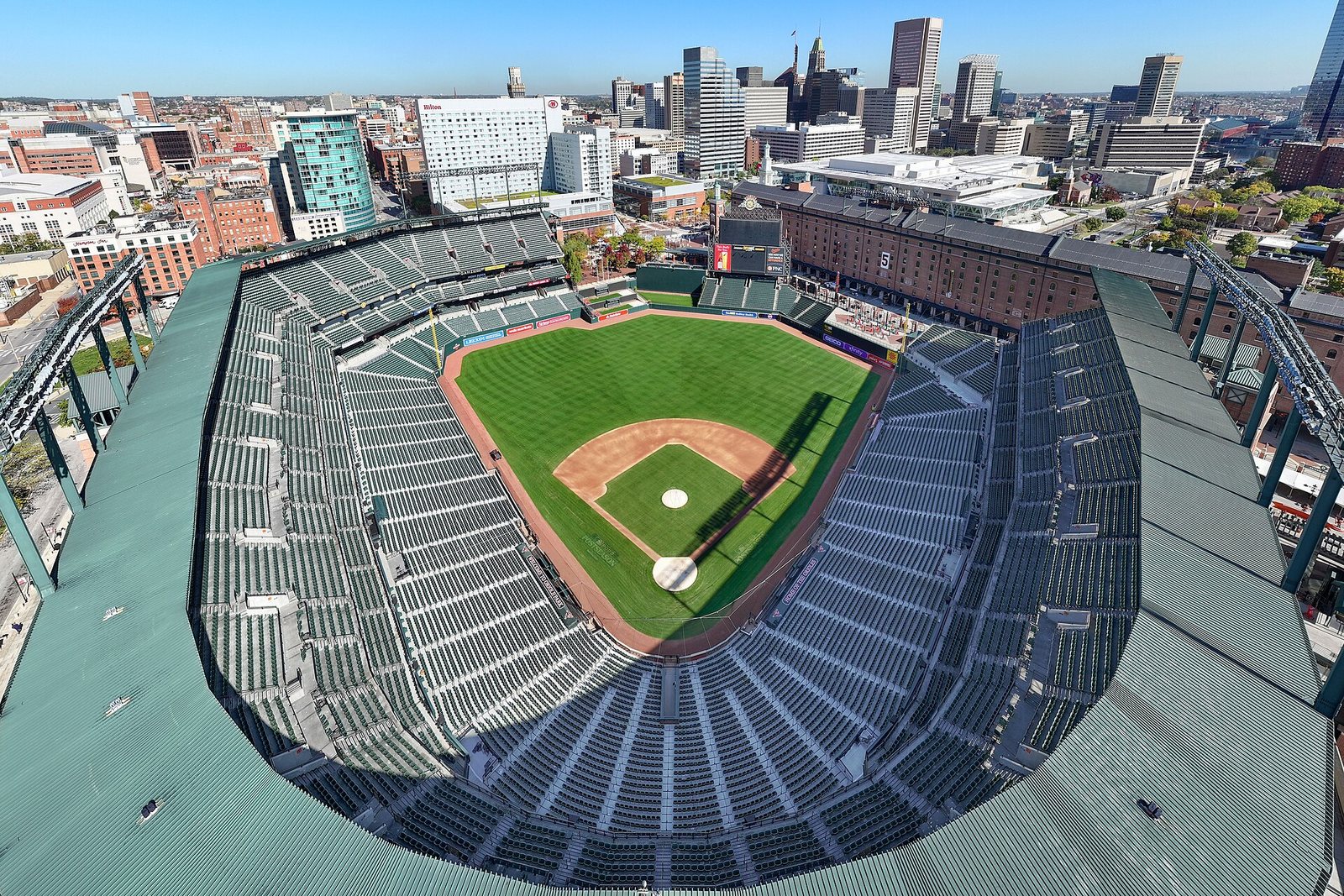
Walk down Eutaw Street inside Oriole Park at Camden Yards and you step over small bronze baseballs set into the pavement, each one marking where a home run landed. On one side stands the long brick wall of the old B&O warehouse; on the other, the ballpark that started a generation of retro stadiums. That’s Baltimore in miniature: a working city that keeps its history underfoot and within walking distance. The best things to do in Baltimore are spread across a dozen neighborhoods, and the visitors who enjoy the city most are the ones who leave the Inner Harbor to find them.
The short answer: give Baltimore two or three days. See the National Aquarium ($49.95 for adults in 2026) and Fort McHenry ($15) on the harbor, then spend the rest of your time in the neighborhoods: cobblestoned Fells Point, Federal Hill’s view, Mount Vernon’s free art museums, Hampden’s quirky Avenue, and a ball game at Camden Yards. Eat a crab cake at Lexington Market. You can do almost all of it without a car, using the free Charm City Circulator, the water taxi and your feet. The city drew 28.7 million visitors in 2025, and most of them stayed downtown; the smart ones branched out.
Every price, date and rule on this page was checked on September 23, 2026 against the operators’ and agencies’ own websites. Three recent changes still trip up visitors and older guides. The B&O Railroad Museum is now the National Museum of Railroad History & Innovation, renamed on July 14, 2026. The Key Bridge is gone until a replacement opens, targeted for late 2030, so part of the I-695 Beltway is closed. And Harborplace’s pavilions are still standing, with local tenants, while redevelopment waits to begin.
On this page: At a glance · Is it worth it? · Neighborhoods · Top 25 · Aquarium and Fort McHenry · Museums · Food · Camden Yards and game days · Parks and water · Getting around · Getting there · Nightlife and shopping · Where to stay · Safety · Seasonal events · When to go · Free things · Rainy days · With kids · How many days · Cruises · Day trips · Local language · What to skip · FAQ
Baltimore at a glance
| Question | Answer (checked September 2026) |
|---|---|
| How long to spend? | Two to three days for the harbor plus the neighborhoods; one day covers the Inner Harbor and Fort McHenry. |
| Biggest ticket | National Aquarium: $49.95 adults, $39.95 ages 5 to 20 and 70+, under 5 free; half-price Friday nights $24.95 (5 to 9 p.m.). |
| Free big-name sights | Baltimore Museum of Art and the Walters Art Museum (both closed Monday and Tuesday); Fort McHenry’s grounds and visitor center. |
| Getting around | The Charm City Circulator is free; bus, light rail and Metro cost $2 one way or $4.60 for a day pass. |
| Getting there | Amtrak and MARC to Penn Station; BWI Marshall Airport by light rail or MARC; about 45 minutes to an hour from Washington by car. |
| Hotel taxes | 9.5% Baltimore City room tax plus Maryland’s 6% sales tax. |
| Safety trend | 133 homicides in 2025, the fewest in about 50 years; visitor areas are busy and patrolled, but use big-city sense at night. |
| Recent changes | Railroad museum renamed (July 2026); Key Bridge gone until late 2030; Harborplace pavilions still open. |
| Coming up | Baltimore Running Festival Oct 17, 2026; Christmas Village Nov 21 to Dec 27, 2026; Preakness at Pimlico, Sunday May 23, 2027. |
Is Baltimore worth visiting?
Yes, and more than its reputation suggests. Baltimore is a real port city of rowhouses and corner bars, with a first-rate art collection that costs nothing to see, the fort that inspired the national anthem, the ballpark that changed baseball, and crab cakes that other cities imitate. It’s also affordable by East Coast standards, compact enough to cover on foot and transit, and an easy train ride from Washington, Philadelphia and New York.
The honest caveats: the city has struggled with crime and vacant housing for decades, and it shows in places. Violence has fallen sharply, to 133 homicides in 2025, the fewest in about half a century, but the numbers are still higher than many visitors are used to, and some blocks feel empty after dark. The Inner Harbor, long the city’s front door, is between eras, with Harborplace awaiting redevelopment. None of that makes Baltimore a bad trip. It makes it a trip that rewards planning: pick your neighborhoods, move between them by Circulator, water taxi or ride-share, and you’ll find a city with more character than most.
Verdict: worth two or three days, especially if you like museums, food, baseball or history. It’s also one of the best-value city breaks on the East Coast, with free art museums and cheap transit.
Go if you want the Aquarium and Fort McHenry with kids, a weekend of museums and restaurants, an Orioles game, or a base for Annapolis and the Chesapeake.
Stay in the neighborhoods if you want the real city: Fells Point and Mount Vernon have the character; the Inner Harbor and Harbor East have the convenience.
Skip it if you want a polished, tourist-first downtown or a beach. Baltimore is a working city, and the Chesapeake’s beaches are elsewhere.
Baltimore by neighborhood
Baltimore calls itself a city of neighborhoods, and for visitors that’s literally true: the things to do cluster in a ring of districts around the harbor, most within 20 minutes of each other by Circulator, water taxi or ride-share. Here they are, roughly clockwise from the Inner Harbor.
Inner Harbor
The city’s waterfront showpiece holds the National Aquarium, the Maryland Science Center, the historic ships and the harbor promenade. Harborplace’s two pavilions are still standing with about 30 local tenants while their redevelopment waits to begin; construction was expected to start before the end of 2026, but residents sued in September 2026, and the pavilions are expected to stay open at least into January 2027. Christmas Village sets up at West Shore Park in winter. The waterfront’s attractions deserve a guide of their own; here, it’s the hub you’ll pass through.
Harbor East and Little Italy
East of the Inner Harbor, Harbor East is the newest part of downtown: glassy towers, upscale hotels, restaurants and shops along the water. Next door, Little Italy keeps its rowhouses, red-sauce restaurants and bakeries within a few blocks. Come for dinner, cannoli and a walk along the promenade toward Fells Point.
Fells Point
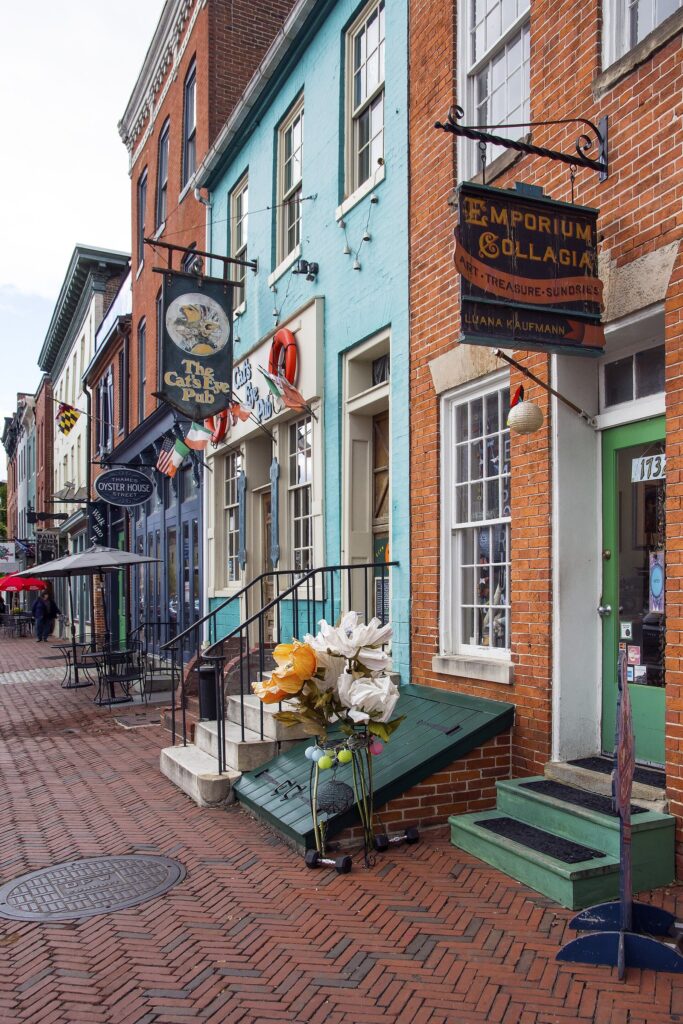
Fells Point is Baltimore’s old maritime neighborhood, with cobblestone streets, 18th- and 19th-century brick buildings, a waterfront square and a famously dense cluster of bars. By day it’s shops, cafes and history; by night it’s the city’s liveliest bar district. The Broadway market square, Thames Street and the water taxi landing are the heart of it.
Canton and Patterson Park
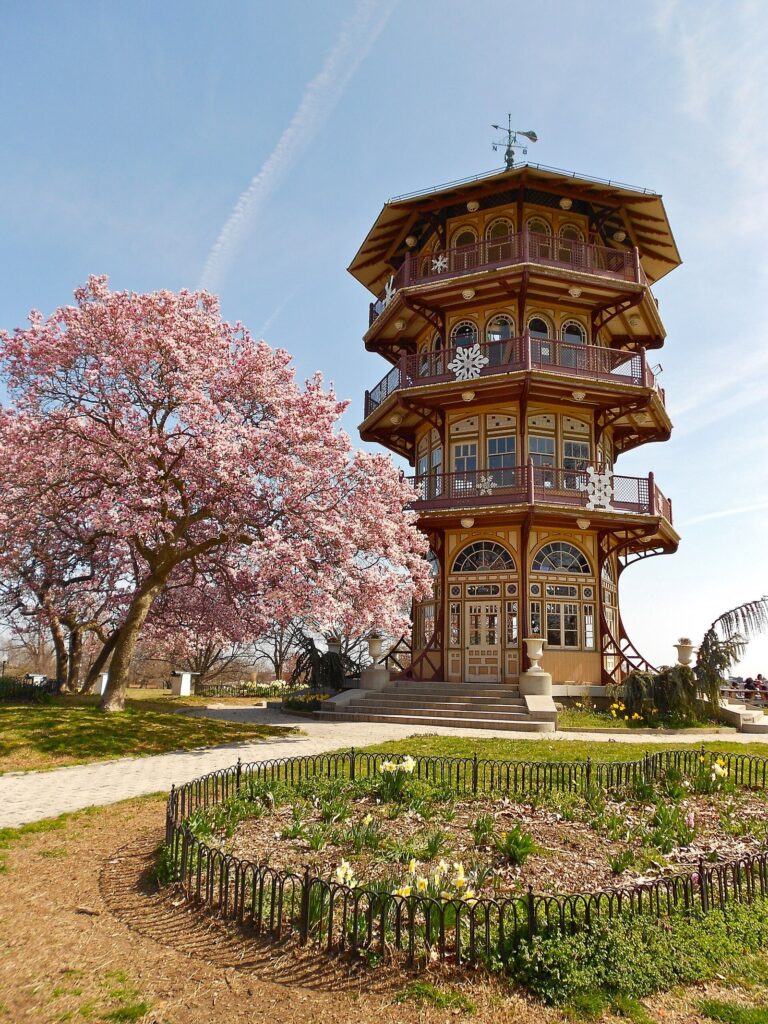
Canton, east of Fells Point, is a residential neighborhood of rowhouses, a waterfront park and a square of bars and restaurants around O’Donnell Street. Just north, Patterson Park is Baltimore’s big backyard, with a lake, playgrounds, ball fields and the Victorian pagoda on the hill, one of the city’s odder landmarks.
Federal Hill
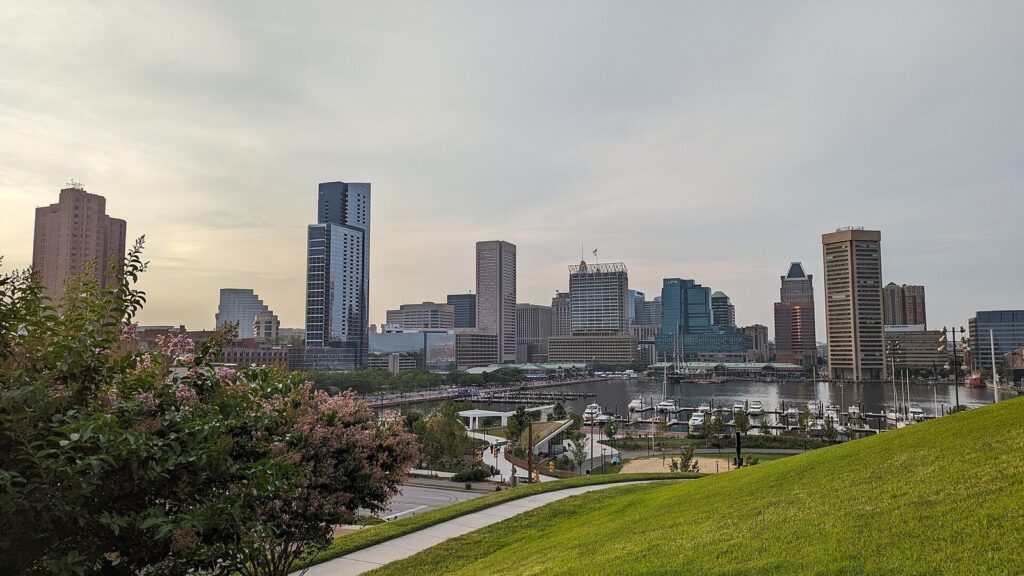
Across the harbor from downtown, Federal Hill rises to a park with the best free view of the Inner Harbor skyline. Around it, the neighborhood’s rowhouse streets hold bars, restaurants, Cross Street Market and, at the foot of the hill, the American Visionary Art Museum. It’s a 10-minute walk from the Inner Harbor’s south side.
Locust Point and Fort McHenry
South of Federal Hill, Locust Point is a quieter peninsula of rowhouses that ends at Fort McHenry, where the 1814 bombardment inspired “The Star-Spangled Banner.” The Baltimore Museum of Industry sits on the waterfront on the way. The fort deserves a half day of its own, and it’s reachable by water taxi or the Circulator’s Banner route.
Downtown West: Lexington Market and Camden Yards
West of the harbor, downtown’s older commercial district holds Lexington Market, in a new market hall since 2022-23, and the stadium complex of Oriole Park at Camden Yards and M&T Bank Stadium. Nearby are the Babe Ruth Birthplace and Edgar Allan Poe’s grave at Westminster Hall. Parts of this area are quiet outside business hours and game days.
Mount Vernon
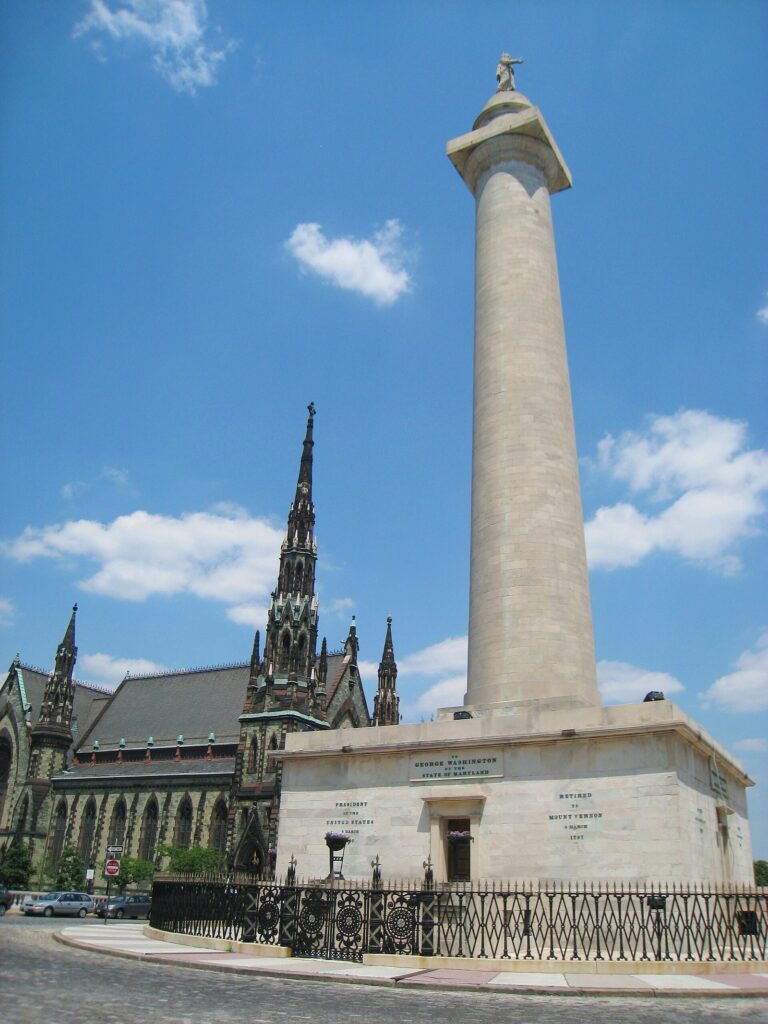
North of downtown, Mount Vernon is Baltimore’s grand 19th-century neighborhood, built around Mount Vernon Place and the original Washington Monument, begun in 1815. The Walters Art Museum, the George Peabody Library, the Peabody Institute and some of the city’s finest townhouses and churches are within a few blocks. It’s walkable, leafy and full of restaurants.
Station North
Just north of Mount Vernon, around Penn Station, Station North is the city’s arts district: galleries, studios, murals, small music venues and an independent cinema. It’s at its best on event nights and less polished than its neighbors by day.
Charles Village, Hampden and Remington
Farther north, Charles Village is home to Johns Hopkins University’s main campus and the Baltimore Museum of Art. West of it, Hampden’s main street, West 36th Street, known locally as the Avenue, is a stretch of vintage shops, bars and restaurants with an old mill-town soul, and in December, the 700 block of West 34th Street becomes the Miracle on 34th Street light display. Remington, between Hampden and the museum, has some of the city’s most talked-about restaurants.
Plan it: pair neighborhoods by geography. Fells Point with Canton and Little Italy; Federal Hill with Fort McHenry and Locust Point; Mount Vernon with Station North; Hampden with the Baltimore Museum of Art and the zoo.
The top 25 things to do in Baltimore, with 2026 prices
Our list, in rough order of priority for a first visit, with the price checked in September 2026, the time to allow and how to get there without a car.
| # | Attraction | Area | Price (2026) | Allow | Car-free access |
|---|---|---|---|---|---|
| 1 | National Aquarium | Inner Harbor | $49.95 adult; $24.95 Friday 5 to 9 p.m. | 2.5 to 3 hours | Walk, Circulator |
| 2 | Fort McHenry | Locust Point | $15 ages 16+; grounds free | 2 hours | Water taxi, Circulator |
| 3 | Fells Point | Fells Point | Free to wander | Half a day | Water taxi, Circulator |
| 4 | Baltimore Museum of Art | Charles Village | Free | 2 to 3 hours | Circulator, bus |
| 5 | Walters Art Museum | Mount Vernon | Free | 2 hours | Circulator |
| 6 | National Museum of Railroad History & Innovation | Southwest Baltimore | $20 adult, $12 ages 2 to 12 | 2 to 3 hours | Bus or ride-share |
| 7 | An Orioles game at Camden Yards | Downtown West | Varies by game | 3 to 4 hours | Walk, light rail |
| 8 | Historic Ships in Baltimore | Inner Harbor | $21.95 adult, $9.95 ages 6 to 14 | 1.5 to 2 hours | Walk |
| 9 | Federal Hill Park | Federal Hill | Free | 45 minutes | Walk |
| 10 | Washington Monument and Mount Vernon Place | Mount Vernon | Gallery free; climb $6 adult | 1 hour | Circulator |
| 11 | Lexington Market | Downtown West | Free to enter | 1 hour | Light rail, Metro |
| 12 | American Visionary Art Museum | Federal Hill | $20 adult | 2 hours | Walk |
| 13 | Maryland Zoo | Druid Hill Park | $33 ages 2 to 64; free parking | 3 hours | Car or ride-share |
| 14 | Hampden and the Avenue | Hampden | Free to wander | 2 hours | Bus, ride-share |
| 15 | Canton and Patterson Park | East Baltimore | Free | 2 hours | Water taxi, bus |
| 16 | Little Italy and Harbor East | Harbor East | Free to wander | An evening | Walk |
| 17 | Reginald F. Lewis Museum | Harbor East | $15 adult | 1.5 hours | Walk |
| 18 | George Peabody Library | Mount Vernon | Free (limited hours) | 30 minutes | Circulator |
| 19 | Edgar Allan Poe House and grave | West Baltimore, Downtown | House $25 per private visit; grave free | 1.5 hours | Ride-share |
| 20 | Babe Ruth Birthplace | Near Camden Yards | $15 adult | 1 hour | Walk |
| 21 | Baltimore Museum of Industry | Locust Point | $15 adult | 1.5 hours | Water taxi, Circulator |
| 22 | National Great Blacks in Wax Museum | East North Avenue | $15 adult, $10 children | 1.5 hours | Ride-share |
| 23 | Star-Spangled Banner Flag House | Jonestown | $9 adult | 1 hour | Walk |
| 24 | Port Discovery Children’s Museum | Downtown | $25.95 | 2 to 3 hours | Walk |
| 25 | A harbor Water Trolley ride | Inner Harbor | $20 adult, $10 ages 3 to 12 (seasonal weekends) | 1 to 2 hours | Walk to a landing |
Prices are adult general admission unless noted, and several museums offer lower prices for seniors, students, military and children. Days and hours vary, and a surprising number of Baltimore museums close on Mondays and Tuesdays, so check before you plan a day around one.
The two harbor headliners, briefly
National Aquarium
The Aquarium drew about 1.1 million guests in 2025 and is still the city’s biggest single draw. Tickets cost $49.95 for adults (21 to 69), $39.95 for ages 5 to 20 and for seniors 70 and over, and nothing for children 4 and under, and the half-price Friday night session, from 5 to 9 p.m., costs $24.95. The dolphins are still in Baltimore; the long-discussed move to an ocean sanctuary hasn’t named a site. Check the Aquarium’s visit page for timed tickets and hours, and go first thing or on a Friday evening to avoid the midday crush.
Fort McHenry
Fort McHenry National Monument and Historic Shrine charges $15 for visitors 16 and older to enter the historic fort, good for seven days, while the grounds, visitor center and film are free, and under-16s pay nothing. Payment is cashless. It’s open year-round except Thanksgiving, December 25 and January 1, and its grounds hours change with the season, so check the Park Service’s fee and hours pages. Plan on two hours, including the film, and time your visit for a morning or late afternoon, when the light over the Patapsco is best.
Museums beyond the harbor
Baltimore Museum of Art
The BMA, beside Johns Hopkins’s Homewood campus, is one of the best free art museums in the country. Its Cone Collection holds one of the world’s largest groups of works by Henri Matisse, alongside modern and contemporary galleries, American and European art, and two sculpture gardens. General admission is free. It’s closed Monday and Tuesday and stays open until 9 p.m. on Thursdays.
The Walters Art Museum
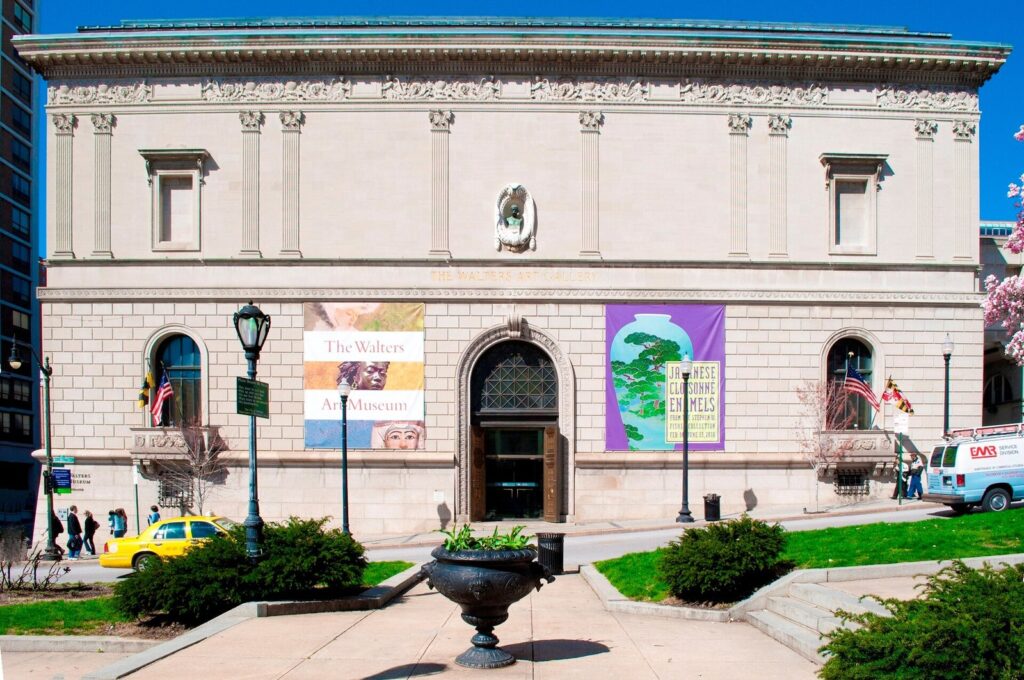
The Walters, on Mount Vernon Place, spans thousands of years of art, from ancient Egypt and Rome to medieval manuscripts, arms and armor, and 19th-century painting, in a set of connected buildings. It’s free, closed Monday and Tuesday, and open from 1 to 8 p.m. on Thursdays.
National Museum of Railroad History & Innovation
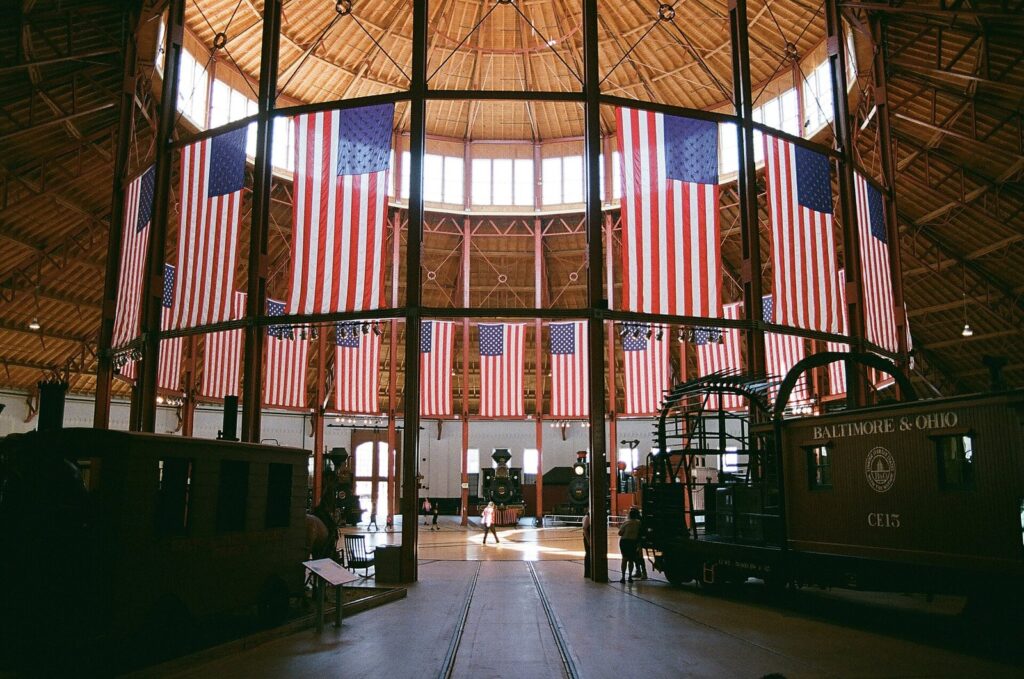
The museum that most people still call the B&O Railroad Museum was renamed on July 14, 2026. It occupies the Mount Clare shops, where the Baltimore and Ohio, chartered in 1827 as America’s first common-carrier railroad, built its early locomotives, and its 1884 roundhouse is filled with historic engines under a soaring wooden roof. Admission is $20 for adults, $17 for seniors and $12 for children 2 to 12, and it’s open daily from 10 a.m. to 4 p.m. A new Innovation Hall is due in 2027, and February 28, 2027 marks 200 years since the railroad’s charter.
More museums worth the trip
- American Visionary Art Museum ($20 adults): self-taught and outsider art in Federal Hill, as strange and joyful as the mosaic-covered building it lives in.
- Reginald F. Lewis Museum ($15 adults): Maryland’s African American history and culture, in Harbor East.
- National Great Blacks in Wax Museum ($15 adults, $12 seniors, $10 children): wax figures of Black history’s leaders on East North Avenue, including an unflinching exhibit on the slave trade.
- Babe Ruth Birthplace ($15 adults): the rowhouse where the slugger was born, a few blocks from Camden Yards.
- Baltimore Museum of Industry ($15 adults): the city’s factories, canneries and port, on the Locust Point waterfront.
- Star-Spangled Banner Flag House ($9 adults): the home of Mary Pickersgill, who sewed the flag that flew over Fort McHenry.
- Edgar Allan Poe House and Museum: the small West Baltimore house where Poe lived in the 1830s, open Thursday to Sunday for private self-guided visits of up to six people ($25). His grave, at Westminster Hall downtown, is free.
- George Peabody Library: free, and one of the most photographed rooms in the city, with five tiers of iron balconies around a skylit atrium. Hours are limited and it closes for events, so check before you go.
What to eat in Baltimore
Baltimore food is unpretentious, crab-centric and cheaper than it should be.
- Crab cakes: the city’s signature. Faidley’s Seafood at Lexington Market has made lump crab cakes since 1886 and is the classic stop. Everywhere else, judge by the ratio of crab to filler.
- Steamed crabs: by the dozen, dusted in spice, at a paper-covered table. Crab houses around the city and county sell them from spring into fall, priced by size and that day’s market.
- Pit beef: thin-sliced, charcoal-grilled top round on a roll with raw onion and horseradish sauce. Chaps Pit Beef on Pulaski Highway is the best-known stand.
- Berger cookies: soft cake-like cookies under a thick cap of fudge icing, sold at the Berger’s stall in Lexington Market and in grocery stores.
- Lake trout: despite the name, fried whiting on white bread with hot sauce, a Baltimore carryout staple.
- Snowballs: shaved ice with syrup, and in Baltimore often topped with marshmallow, sold from summer stands.
- Smith Island cake: Maryland’s official state dessert, thin layers stacked with fudge icing.
Markets
Lexington Market, founded in the 18th century, reopened in a new 60,000-square-foot hall with more than 45 merchants; go at lunchtime for crab cakes and Berger cookies. Cross Street Market in Federal Hill and Broadway Market in Fells Point are smaller halls with food stalls and bars.
Where to eat
For dinner, Harbor East and Fells Point have the most variety, Little Italy has the red-sauce classics, Federal Hill and Canton have the bar-restaurants, and Hampden and Remington have the adventurous kitchens. Mount Vernon suits a pre-theater or museum dinner. On game days, restaurants near Camden Yards fill early.
Plan it: do Lexington Market at lunch on a weekday, when the stalls are busiest, and book dinner in Fells Point or Harbor East on weekends.
Camden Yards and game days
Oriole Park at Camden Yards opened in 1992 and changed ballpark design, trading the concrete bowls of the era for brick, steel and the old B&O warehouse beyond right field. Even if you’re not a baseball fan, a summer evening game is one of the best things to do in Baltimore: tickets for many games are affordable, the downtown skyline rises over the outfield, and Eutaw Street, the pedestrian street between the warehouse and the stands, is lined with food stands and those bronze home-run markers. On non-game days, ballpark tours run from the main box office, reported at $9 for adults and $6 for seniors and children; check the Orioles’ site for tour days.
Next door, M&T Bank Stadium is home to the NFL’s Ravens, and fall Sundays turn downtown purple. Both stadiums are a short walk from the Inner Harbor and have light rail stops, which beat driving and parking on game days. Expect heavy traffic on Russell Street and I-395 before and after games, and higher hotel rates downtown on Ravens weekends.
Plan it: for a first visit, pick a weeknight Orioles game, walk from your hotel, eat on Eutaw Street and stay for the view of the skyline at dusk. For the Ravens, book hotels early and take light rail.
Parks, trails and time on the water
Baltimore has more green space and waterfront than its reputation suggests.
- The waterfront promenade: a paved path runs along the water for miles, from Canton through Fells Point, Harbor East and the Inner Harbor toward Federal Hill and Locust Point. It’s the best free walk in the city, and flat.
- Patterson Park: the east side’s big park, with a boat lake, ball fields, playgrounds and the pagoda on the hill.
- Druid Hill Park: one of the country’s older large urban parks, home to the Maryland Zoo, a reservoir loop that’s popular with runners and cyclists, and wide lawns.
- Cylburn Arboretum: free gardens and woodland paths in the north of the city, good in spring and fall.
- Federal Hill Park: small, steep and worth it for the view, especially at sunset.
- Trails: the Jones Falls and Gwynns Falls trails run for miles through stream valleys, useful for a long run or bike ride away from traffic.
On the water, the water taxi and the weekend Water Trolley are the easy options, and in warm months you can rent kayaks or paddleboats around the harbor. The harbor is a working port, so stay clear of commercial traffic and stick to the Inner Harbor’s sheltered basins if you’re paddling.
Getting around Baltimore without a car
You can see most of Baltimore without driving, and in the busiest areas you’ll want to, because parking is expensive and traffic is slow.
- Charm City Circulator: free buses on five routes linking the Inner Harbor, Fells Point, Mount Vernon, Federal Hill, Fort McHenry and more. They run Monday to Thursday 7 a.m. to 8 p.m., Friday 7 a.m. to midnight, Saturday 9 a.m. to midnight and Sunday 9 a.m. to 7 p.m.
- Water taxi: the Baltimore Water Taxi now runs on demand, booked through the TransiGo app, and a seasonal weekend hop-on Water Trolley costs $20 for adults and $10 for children 3 to 12. It’s the most enjoyable way between the Inner Harbor, Fells Point, Canton and Fort McHenry.
- Harbor Connector: free commuter boats cross the harbor, but on weekdays only.
- Light rail, Metro and buses: $2 one way or $4.60 for a day pass. Light rail runs north-south through downtown to Camden Yards, Lexington Market, Penn Station and BWI Airport; the Metro subway runs northwest from downtown.
- Walking: Harbor East, Little Italy, Fells Point and Federal Hill are all within about a 20-minute walk of the Inner Harbor. Mount Vernon is about 20 minutes north of the harbor on foot, uphill.
- Ride-share: the easy option for Hampden, the zoo, the railroad museum and late nights.
Getting to Baltimore
By train
Baltimore’s Penn Station, north of Mount Vernon, is Maryland’s busiest Amtrak stop, with more than 1.3 million riders in fiscal 2025, and it’s served by Amtrak’s Northeast Corridor trains and MARC’s Penn Line. MARC is the budget option: $9 one way between Baltimore Penn and Washington, $8 from BWI to Washington and $6 from Penn to BWI. On weekends, only the Penn Line runs, with fewer trains; the Camden Line, which ends at Camden Yards, is weekday-only.
By air
BWI Marshall Airport is about 10 miles south of downtown, linked by light rail, MARC and Amtrak from BWI’s rail station. Its airline lineup has shifted: Spirit Airlines stopped flying on May 2, 2026, and JetBlue returned on July 9, 2026, so check who flies your route.
By car
| From | Distance to the Inner Harbor | Drive, no traffic |
|---|---|---|
| Washington, DC | 37 to 39 miles | About 45 minutes to an hour |
| Wilmington, DE | 73 miles | About 1 hour 20 minutes to 1 hour 30 minutes |
| Harrisburg, PA | 80 miles | About 1 hour 30 minutes to 1 hour 45 minutes |
| Philadelphia | 101 to 104 miles | About 1 hour 50 minutes to 2 hours 10 minutes |
| Richmond, VA | 146 to 154 miles | About 2 hours 35 minutes to 3 hours 5 minutes |
| New York City | 192 miles | About 3 hours 15 minutes to 4 hours |
| Pittsburgh | 247 miles | About 4 hours to 4 hours 50 minutes |
The Key Bridge and the harbor tunnels
The Francis Scott Key Bridge collapsed on March 26, 2024, when the container ship Dali struck it, killing six workers. Its cable-stayed replacement is budgeted at $4.3 billion to $5.2 billion and targeted to open to traffic in late 2030. Until then, I-695 is closed between exit 1 (MD 173) and exit 43 (MD 157), and traffic across the harbor uses the Fort McHenry (I-95) and Harbor (I-895) tunnels. Vehicles carrying hazardous materials, including bulk gasoline and propane in containers over 10 pounds, are banned from both tunnels and must detour around the western Beltway, which matters if you’re towing an RV or camper with propane tanks.
Nightlife, live music and shopping
Nightlife
Baltimore nights are neighborhood nights. Fells Point is the classic bar crawl, with pubs, live-music rooms and waterfront bars along Thames Street and around the Broadway square. Federal Hill’s bars fill with young professionals and sports crowds, especially on game days. Canton’s square around O’Donnell Street is a little calmer. Station North and Mount Vernon have the small music venues, galleries and later-night art crowd, and Hampden and Remington mix neighborhood bars with cocktail rooms and restaurants. Maryland bars close by 2 a.m.; plan your ride home before last call.
Shopping
Hampden’s Avenue is the best shopping street for visitors, with vintage clothing, gifts, books and Baltimore-themed souvenirs. Fells Point has boutiques, antiques and record shops in old storefronts, and Harbor East has the upscale brands. For edible souvenirs, pick up Berger cookies at Lexington Market or a tin of crab seasoning anywhere. Mount Vernon’s side streets hide antique and design shops for browsers.
Where to stay in Baltimore
Overnight visitors average 2.7 nights in Baltimore, and where you stay shapes how you’ll get around.
- Inner Harbor and Harbor East: the most hotels, the easiest walking access to the Aquarium, the ballparks and the water taxi, and the priciest parking. Harbor East’s newer hotels are the most polished.
- Fells Point: a handful of boutique hotels and inns in historic buildings, steps from bars and restaurants. Lively and noisy on weekend nights.
- Mount Vernon: historic hotels near the museums and the Circulator, a little quieter, and a short walk or ride from Penn Station.
- Federal Hill and Canton: mostly rowhouses, with short-term rentals rather than hotels. Good for a residential feel.
- Near BWI: airport hotels with free parking and light rail or MARC into the city, the budget option for families with a car.
Budget for 15.5% in taxes: Baltimore City’s 9.5% room tax plus Maryland’s 6% sales tax. Rates rise on Ravens weekends, big convention weeks and Preakness weekend; weekdays in winter are the cheapest time.
Is Baltimore safe for visitors?
For visitors who use ordinary big-city sense, yes, and it’s getting safer. Baltimore recorded 133 homicides in 2025, down 31% from 194 in 2024 and the lowest total in about 50 years, and nonfatal shootings fell by about a quarter, to 311. The violence that remains is concentrated in neighborhoods that most visitors never pass through. The Inner Harbor, Harbor East, Fells Point, Federal Hill, Canton, Mount Vernon and Hampden are busy, well-lit and full of people on weekend evenings.
Practical advice:
- At night, stick to busy streets and use a ride-share or the Circulator between neighborhoods rather than walking long, empty stretches between them.
- In the car, leave nothing visible. Theft from parked cars is a far likelier problem than anything worse.
- Downtown’s quieter blocks, away from the harbor and outside office hours, can feel deserted. That’s not the same as dangerous, but it’s a reason to plan your route.
- On game days and big events, the stadium area is crowded and heavily policed, which is the safest it gets.
Seasonal events in Baltimore
| Event | When | Where |
|---|---|---|
| Baltimore Running Festival | Saturday, Oct 17, 2026 | Downtown and neighborhoods |
| Christmas Village | Nov 21 to Dec 27, 2026 | West Shore Park, Inner Harbor |
| Miracle on 34th Street | Lights traditionally switched on the Saturday after Thanksgiving, through the holidays | 700 block of West 34th Street, Hampden |
| B&O Railroad charter bicentennial | Feb 28, 2027 | National Museum of Railroad History & Innovation |
| Preakness Stakes | Sunday, May 23, 2027 | Pimlico Race Course |
| Artscape | Held Memorial Day weekend in 2026; 2027 dates not yet posted | Downtown |
The Preakness deserves a note, because it’s changed twice in two years. The 2026 race was run at Laurel Park while Pimlico was rebuilt; the 152nd Preakness returns to Pimlico on Sunday, May 23, 2027, a Sunday rather than the traditional Saturday, and racing then moves back to Laurel while the permanent clubhouse is finished, with the 2028 Preakness as the target for the new Pimlico. The state of Maryland now owns the race. If you’re coming for it, book hotels as soon as you can.
When to visit Baltimore
Baltimore is a year-round city, and demand doesn’t swing much through the year, but the weather does. April to early June and September to October are the most comfortable months for walking between neighborhoods, with baseball in season, outdoor dining and mild evenings on the promenade. July and August are hot and humid, which pushes you toward the Aquarium, the museums and evening ball games. Winter is cold and quieter, with lower hotel rates, Christmas Village at the Inner Harbor and the lights of Hampden’s Miracle on 34th Street. Avoid Preakness weekend in May, big Ravens weekends in the fall and major convention weeks if you want cheaper rooms.
Free things to do in Baltimore
Baltimore is one of the best East Coast cities for free sightseeing:
- The Baltimore Museum of Art and the Walters Art Museum, both free, Wednesday to Sunday.
- Fort McHenry’s grounds, visitor center and film; only the historic fort itself costs $15, and under-16s are free.
- Federal Hill Park for the skyline view.
- Fells Point’s cobblestone streets and waterfront.
- The George Peabody Library, when it’s open.
- The Washington Monument’s gallery level and Mount Vernon Place’s squares and fountains.
- Patterson Park, with its lake and pagoda.
- Edgar Allan Poe’s grave at Westminster Hall.
- Lexington Market, free to browse.
- The Charm City Circulator, a free sightseeing ride in itself, and the Harbor Connector boats on weekdays.
- Christmas Village and Miracle on 34th Street in the holiday season.
What to do in Baltimore when it rains
Baltimore’s best rainy-day plan is its museums, and several are free:
- The Baltimore Museum of Art or the Walters: a whole morning, free.
- The National Aquarium: the obvious choice, and busier on wet days, so go early or on a half-price Friday evening.
- The railroad museum’s roundhouse: the historic locomotives are indoors under the great round roof.
- Lexington Market for lunch, then the George Peabody Library if it’s open.
- The Great Blacks in Wax Museum, the Reginald F. Lewis Museum or the Poe House.
- Port Discovery ($25.95) for children, and the Maryland Science Center on the harbor.
Save Fort McHenry, Federal Hill Park, the zoo and Fells Point’s streets for a dry day.
Baltimore with kids
- National Aquarium: the top family attraction; under-5s are free.
- Maryland Zoo: $33 for ages 2 to 64, with the train and carousel included and free parking; open daily 10 a.m. to 4 p.m. from March through December, with lower winter prices from December 1. Since August 2026 its elephant herd has been all male.
- Port Discovery Children’s Museum: $25.95, three floors of hands-on play downtown.
- The railroad museum: real locomotives to climb around, $12 for children 2 to 12.
- Fort McHenry: free for under-16s, with ramparts and cannon.
- Historic Ships: a Civil War-era sloop, a submarine and a lightship, $9.95 for ages 6 to 14.
- The water taxi or weekend Water Trolley: a boat ride kids love, and transport at the same time.
- Patterson Park for playgrounds and space to run.
How many days do you need in Baltimore? One-, two- and three-day plans
One day
Morning at the National Aquarium (buy tickets ahead). Lunch at Lexington Market or in Harbor East. Afternoon at Fort McHenry by water taxi or the Circulator’s Banner route. Sunset from Federal Hill Park, then dinner in Fells Point.
Two days
Add a day north of the harbor: the Walters and the Washington Monument in Mount Vernon in the morning, the Baltimore Museum of Art after lunch, and Hampden’s Avenue in the late afternoon. In season, finish with an Orioles game at Camden Yards.
Three days
Add the railroad museum in the morning, the Babe Ruth Birthplace and Camden Yards around lunch, then Canton, Patterson Park and Little Italy for the evening. With kids, swap in the Maryland Zoo or Port Discovery.
Most first-time visitors are happiest with two full days: one for the harbor and one for the neighborhoods and museums. Three lets you slow down, add a game and a day trip, or spend an evening in Fells Point without watching the clock.
Cruising from Baltimore
The Port of Baltimore’s cruise terminal, in South Locust Point near Fort McHenry, is one of the East Coast’s drive-to cruise ports. Carnival Pride sails year-round to the Bahamas, Bermuda and the Caribbean, with bookings open through April 2028, and Royal Caribbean’s Vision of the Seas sails seasonally in 2026-27 to Bermuda, the Bahamas and Canada and New England. Cruise traffic fell 12% in fiscal 2024 when the Key Bridge collapse closed the port’s channel, then rebounded 10.9% in fiscal 2025, though it hasn’t fully recovered. If you’re driving in, check terminal parking and arrival times with your cruise line, and remember the Key Bridge route no longer exists.
Day trips from Baltimore
Baltimore makes a good base for Maryland day trips, most within about an hour and a half:
- Ellicott City, a historic mill town: about 20 minutes.
- Annapolis, the state capital and sailing town: about 40 to 45 minutes.
- Havre de Grace, at the head of the Chesapeake: about 45 to 55 minutes.
- Frederick, with its restored downtown: about an hour.
- Harpers Ferry, West Virginia: about 1 hour 10 minutes to 1 hour 25 minutes.
- Antietam National Battlefield: about 1 hour 20 minutes to 1 hour 35 minutes.
Those times assume no traffic, and Baltimore’s rush hours are real, so leave after 9:30 a.m. and head back before 4 p.m. or after 7.
Hon, Charm City and a little local language
A few words will help you blend in, or at least understand what’s going on. Baltimore’s nickname is Charm City, coined in the 1970s as a tourism slogan and still everywhere. “Hon” is the old Baltimore term of endearment, the kind of thing a waitress might call you, and Hampden has built a whole kitschy identity around it. Marylanders go “down the ocean” when they head to Ocean City, and the local pronunciation of the city’s name tends to drop a syllable or two. You’ll also hear the Orioles called the O’s and see purple everywhere on Ravens Sundays. Nobody expects visitors to talk the talk, but “Go O’s” rarely goes wrong.
What to skip in Baltimore
Skip spending your whole trip at the Inner Harbor. See the Aquarium and the fort, then get out into Fells Point, Mount Vernon and Hampden.
Skip driving between neighborhoods. The Circulator is free, the water taxi is fun, and parking downtown is expensive.
Skip the Aquarium on a rainy Saturday midday. Go early, or on a half-price Friday evening for $24.95.
Skip Monday and Tuesday museum plans. The BMA and the Walters are both closed.
Skip searching for the B&O Railroad Museum. It’s the same place, now the National Museum of Railroad History & Innovation.
Skip the Key Bridge route. It won’t exist until late 2030; use the tunnels, and keep propane-carrying RVs on the western Beltway.
Skip long walks through empty blocks at night. Take a ride-share between neighborhoods after dark.
Baltimore FAQ
What is Baltimore best known for?
Baltimore is best known for Fort McHenry, where the 1814 bombardment inspired “The Star-Spangled Banner”; the National Aquarium and the Inner Harbor; crab cakes and steamed blue crabs; Camden Yards and the Orioles; the Ravens; Edgar Allan Poe; its rowhouse neighborhoods like Fells Point and Hampden; and first-rate free art at the Baltimore Museum of Art and the Walters.
How many days do you need in Baltimore?
Two full days suit most first visits: one for the Inner Harbor, the Aquarium and Fort McHenry, and one for Mount Vernon’s free museums, Lexington Market and Fells Point or Hampden. One day covers only the harbor highlights. Three days let you add the railroad museum, an Orioles game, the zoo or a day trip to Annapolis without rushing.
What is free to do in Baltimore?
The Baltimore Museum of Art and the Walters Art Museum are free, as are Fort McHenry’s grounds and visitor center, Federal Hill Park’s skyline view, Fells Point’s streets, Patterson Park, the George Peabody Library, the Washington Monument’s gallery level, Poe’s grave, Lexington Market browsing, the Charm City Circulator, and, in season, Christmas Village and Hampden’s Miracle on 34th Street.
What can you do in Baltimore when it rains?
Head indoors to the free Baltimore Museum of Art or the Walters, the National Aquarium (go early), the railroad museum’s roundhouse full of locomotives, Lexington Market for lunch, the George Peabody Library, the Great Blacks in Wax Museum, the Reginald F. Lewis Museum or, with children, Port Discovery. Save Fort McHenry and Fells Point for a dry day.
Is Baltimore safe for tourists?
Yes, with normal big-city care. Homicides fell to 133 in 2025, the fewest in about 50 years, and violence is concentrated away from visitor areas. The Inner Harbor, Harbor East, Fells Point, Federal Hill, Mount Vernon and Hampden are busy and well-lit. Use ride-shares between neighborhoods late at night and leave nothing visible in parked cars.
Do you need a car in Baltimore?
No, for most visits. Amtrak and MARC reach Penn Station, light rail links BWI Airport to downtown, and the free Charm City Circulator, the on-demand water taxi and walking cover the harbor and nearby neighborhoods. A car or ride-share helps for the zoo, Hampden, the railroad museum and day trips, but downtown parking is costly.
What is the best neighborhood to stay in Baltimore?
For a first visit, stay at the Inner Harbor or Harbor East: they’re walkable to the Aquarium, the ballparks and the water taxi, and have the most hotels. Fells Point suits couples who want bars and character, and Mount Vernon suits museum-goers and train travelers, with Penn Station close by. Budget for 15.5% in taxes on top of the room rate.
When is the best time to visit Baltimore?
April to early June and September to October bring the most comfortable weather for walking between neighborhoods, with Orioles games, outdoor dining and harbor evenings. Summer is hot and humid but lively; winter is cold, quieter and cheaper, with Christmas Village and Hampden’s Miracle on 34th Street. Book ahead for Preakness weekend and big Ravens games.
Sources and verification
Every price, date and rule on this page was checked on September 23, 2026 against the organizations listed below. The guide is compiled from those sources; it doesn’t claim first-hand visits.
- National Aquarium: plan your visit
- National Park Service: Fort McHenry fees and hours
- Baltimore Museum of Art and the Walters Art Museum
- National Museum of Railroad History & Innovation: admissions and hours
- City of Baltimore: Charm City Circulator, plus the mayor’s 2025 public-safety release
- Maryland Transportation Authority: Key Bridge rebuild FAQ
- Maryland Transit Administration: MARC fares and Penn Line timetables
We also used Visit Baltimore’s 2025 visitor figures, the Maryland Zoo, Historic Ships in Baltimore, the American Visionary Art Museum, the Reginald F. Lewis Museum, the Babe Ruth Birthplace, the Baltimore Museum of Industry, the Flag House, Port Discovery, the Great Blacks in Wax Museum, Poe Baltimore, the Mount Vernon Place Conservancy, Johns Hopkins’s Sheridan Libraries, Harborplace’s redevelopment FAQ, the Maryland Jockey Club, Carnival, Royal Caribbean, Amtrak, BWI Marshall, Maryland’s Department of Legislative Services and routed drive-time estimates, which are free-flow figures before traffic.
Maryland Tourism Guide is an independent publication. It is not affiliated with Visit Maryland or any agency or business named here, and no one paid to be included.
Photo credits
- Camden Yards and downtown (featured image): photo by Quintin Soloviev, Wikimedia Commons (CC BY 4.0)
- Fells Point shops: photo by Bruce Emmerling, Wikimedia Commons (CC BY-SA 4.0)
- View from Federal Hill Park: photo by Sdkb, Wikimedia Commons (CC BY-SA 4.0)
- Washington Monument, Mount Vernon: photo by Daderot, Wikimedia Commons (public domain)
- Walters Art Museum: photo by Dylan k, Wikimedia Commons (CC BY-SA 3.0)
- Railroad museum roundhouse, 2025: photo by Hassan Albadawi, Wikimedia Commons (CC BY-SA 4.0)
- Patterson Park Pagoda: photo by Smallbones, Wikimedia Commons (CC0)
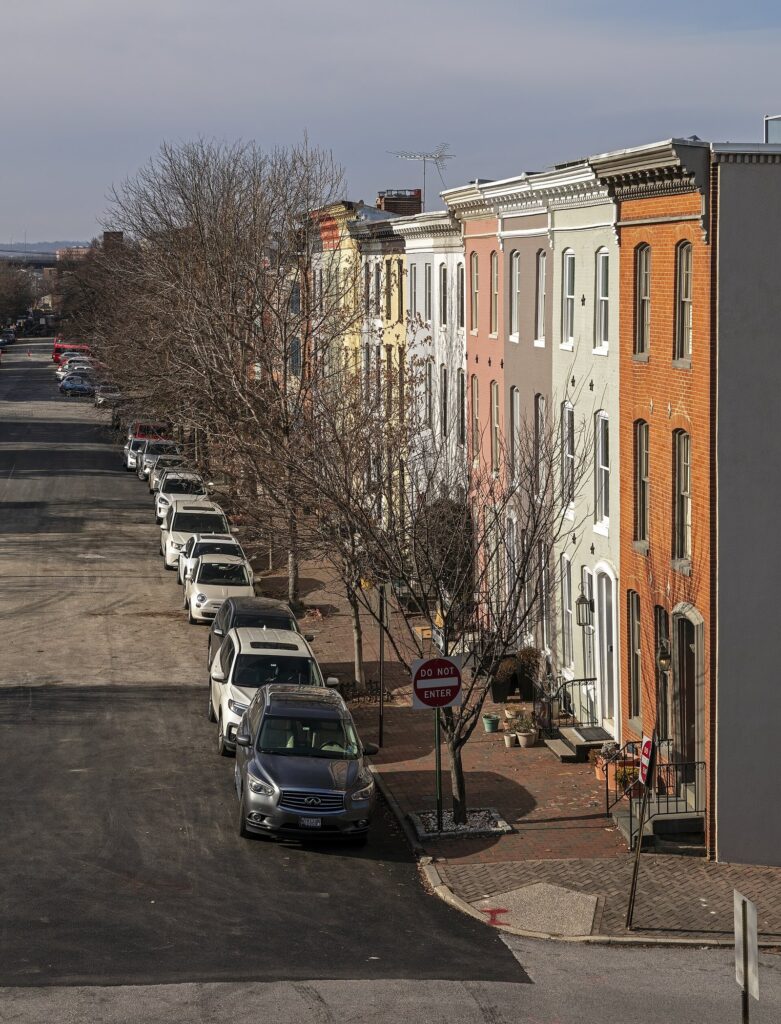
- Federal Hill rowhouses: photo by Acroterion, Wikimedia Commons (CC BY-SA 4.0)