In the summer of 2024, Maryland’s state parks filled up and shut their gates 166 times. Sandy Point was often full by mid-morning on hot Saturdays, and people who had driven an hour with a car full of beach chairs got turned around at the booth. So the state changed how Maryland state parks work in summer. Nine of the busiest now take day-use reservations on summer weekends and holidays, and in 2025 not one of those parks had to close because of crowds. The parks themselves are the same as ever: in one state you can drive from a 53-foot mountain waterfall to a Chesapeake Bay beach to a cypress swamp, usually for $3 to $7 a person.
Short answer: Maryland has about 50 state parks, plus state forests and natural areas, and most charge $3 to $7 per person on summer weekends and a few dollars per car, or nothing, the rest of the year. On a summer weekend or holiday, book a slot at parkdayuse.maryland.gov before heading to Sandy Point, Greenbrier, Point Lookout, North Point, Newtowne Neck, Gunpowder’s Hammerman Area, Rocky Gap, Swallow Falls or Kilgore Falls. Buy the $75 annual Passport ($100 for non-residents) only if your household will make four or more trips a year.
Every fee, rule and closure here was checked September 23, 2026 against the operators’ and agencies’ own websites, mainly the Maryland Department of Natural Resources (DNR).
On this page: How many parks · Reservations · Avoiding closures · Fees and passes · Every major park compared · Western Maryland · Frederick and Washington counties · Baltimore and Washington area · Harford and Cecil · Sandy Point and Southern Maryland · Eastern Shore · State vs national parks · Best parks for… · Seasons · Camping and cabins · Dogs, alcohol and access · Planning logistics · What to skip · FAQ
| At a glance | Details (checked September 2026) |
|---|---|
| How many parks | About 50 state parks. The Maryland Manual lists 48, plus 7 natural environment areas and 24 natural resource management areas |
| Day-use fees | $3 to $7 per person on summer weekends at the busy parks (out-of-state visitors usually pay $2 more); per vehicle, or free, at many parks off-season |
| Reservations | Summer weekends and holidays (Memorial Day weekend to Labor Day) at 9 parks; book up to 7 days ahead at parkdayuse.maryland.gov; about $1.50 per booking |
| Annual Passport | $75 Maryland residents, $100 non-residents; covers everyone in one vehicle, up to 10 people, for 12 months |
| Free or cheap entry | Veterans (year-round), active-duty military, Golden Age Pass for 62+ ($10 one-time fee), Universal Disability Pass, Every Kid Outdoors fourth graders |
| Camping | 2,000-plus campsites and about 120 cabins; book at parkreservations.maryland.gov or 1-888-432-2267 |
| Hours | Most day-use areas run roughly sunrise to sunset, year-round; each park posts its own hours |
| Best months | May, June, September and October; July and August for beaches, with a reservation |
| Drive times | Sandy Point about 45 minutes from DC; Cunningham Falls about 1¼ hours from Baltimore; Swallow Falls about 3½ hours from either city |
How many state parks does Maryland have?
About 50, depending on who’s counting and what counts as a park. The Maryland Manual, the state’s official almanac, lists 48 state parks, seven natural environment areas and 24 natural resource management areas, plus the Merkle Wildlife Sanctuary in Prince George’s County. The state’s own visitor pages round the parks up to “over 50.” Add the state forests, from Savage River and Green Ridge in the west to Pocomoke on the lower Shore, and you’re past 70 pieces of public land you can drive into, picnic on or camp in.
For a visitor the distinction matters less than the facilities. A full-service state park has a staffed or automated gate, a day-use fee in season, restrooms, often a beach or lake, and sometimes a campground and cabins. Natural environment areas such as Soldiers Delight near Owings Mills, and resource management areas such as Fair Hill in Cecil County, are wilder and simpler. State forests offer primitive camping and backroads with very few people.
The system is older than most people assume. Patapsco Valley began as a forest reserve in 1907 and counts as Maryland’s first state park. Many of the stone lodges, overlooks and shelters you’ll see in the mountain parks were built by the Civilian Conservation Corps in the 1930s, and the CCC also restored the Washington Monument on South Mountain and the walls of Fort Frederick.
For trip planning, it helps to think in six regions, which is how the park sections below are organized: the Garrett and Allegany County mountains; Frederick and Washington counties; the Baltimore and Washington suburbs; Harford and Cecil counties at the head of the Bay; Sandy Point and Southern Maryland; and the Eastern Shore.
Do you need a reservation in 2026?
Only at nine parks, and only on summer weekends and holidays. At every other park, and at those nine on weekdays and after Labor Day, you drive up and pay at the gate.
DNR started day-use reservations in 2025 after years of summer capacity closures. Five parks made up the first group, and four more were added for 2026:
| Reservation park | County, nearest town | Why it fills | On the list since |
|---|---|---|---|
| Sandy Point | Anne Arundel, near Annapolis | The closest big Bay beach to Baltimore and DC | 2025 |
| Greenbrier | Washington, near Boonsboro | Lake beach a few minutes off I-70 | 2025 |
| Point Lookout | St. Mary’s, Scotland | Beach, pier and campground at the tip of Southern Maryland | 2025 |
| North Point | Baltimore County, Edgemere | Small lots on the Bay shore | 2025 |
| Newtowne Neck | St. Mary’s, near Leonardtown | A small lot on a Potomac peninsula | 2025 |
| Gunpowder Falls, Hammerman Area | Baltimore County, Chase | The beach closest to eastern Baltimore County | 2026 |
| Rocky Gap | Allegany, Flintstone | Lake Habeeb’s beaches next to the resort | 2026 |
| Swallow Falls | Garrett, near Oakland | Maryland’s highest free-falling waterfall and limited parking | 2026 |
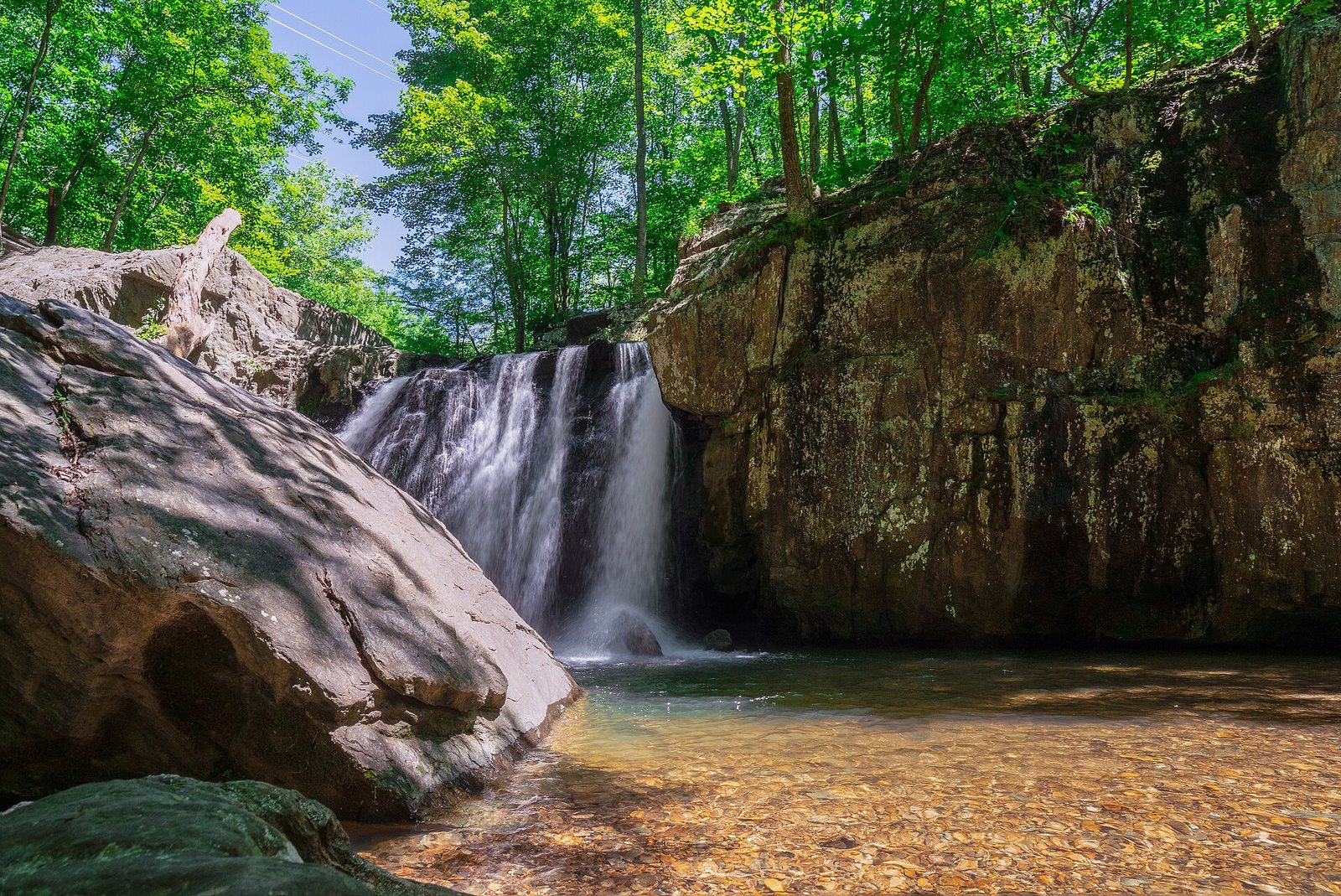
| Kilgore Falls (Rocks State Park) | Harford, Pylesville | A 28-car lot | 2026 |
How the system works:
- When: weekends and holidays from Memorial Day weekend through Labor Day. In 2026 that meant May 23 to September 7.
- Where: parkdayuse.maryland.gov. Camping, cabins and picnic shelters use a separate booking site.
- How far ahead: up to seven days before your visit. On a hot holiday weekend, book when the window opens rather than the night before.
- Cost: a service charge of about $1.50 per reservation, on top of the park’s normal entry fee.
- Who doesn’t need one: people who walk or bike in. DNR’s June 4, 2026 announcement says they need no reservation and pay nothing.
- Passholders: the annual Passport covers the entry fee, not the reservation. You still have to book a slot.
- Swallow Falls sells timed arrival windows, so choose one you can actually make from wherever you’re sleeping.
The system did what it was built to do. In 2024 the parks closed for capacity 166 times statewide; in 2025, the first reservation summer, none of the reservation parks closed for crowds. The price is spontaneity. A July beach day at Sandy Point now works like a restaurant booking, and a Saturday decided at breakfast works better at a park that isn’t on the list.
Expect reservations again in summer 2027, but DNR adjusts the list from year to year, so check which parks are on it in May before you plan around one.
How to avoid being turned away
Reservations fixed the nine worst bottlenecks, but the old rule still applies everywhere else: when a lot is full, the gate closes until cars leave. A lake beach an hour from the city on the first 90-degree Saturday of June is exactly where that happens. A few habits keep you on the right side of the gate:
- Book the reservation parks as soon as you know your date. Seven days out is the window; there’s no advantage to waiting.
- Arrive before 10 a.m. or after 3 p.m. at parks without reservations on summer weekends. Late afternoon at a lake beach, when the day-trippers pack up, is underrated.
- Go on a weekday. Most parks are half-empty on a Tuesday in July, and some charge less.
- Check the park’s status before you leave. DNR’s Maryland Park Service pages link to a Park Status Dashboard that shows closures, capacity and access problems such as the Swallow Falls road work.
- Have a plan B nearby. Greenbrier full? Cunningham Falls’ lake beaches are across the valley and don’t take reservations. Kilgore Falls booked? The main Rocks State Park area is minutes away.
- Walk or bike in if you’re staying close. At the reservation parks that means no booking and no fee.
What do Maryland state parks cost? Fees, passes and free entry
Each park sets its own rate, which is why the numbers bounce around. The pattern is simple enough: per person on summer weekends and holidays, per vehicle on weekdays and in the off-season, and about $2 more for out-of-state visitors. Plenty of smaller parks charge nothing at all. Here is what the busiest parks charged in 2026:
| Park | Summer weekends and holidays (2026) | Other times (2026) | Good to know |
|---|---|---|---|
| Sandy Point | $5 per person | $4 per person on weekdays May to September; $3 per vehicle October to April | No out-of-state surcharge; reservation on summer weekends |
| Point Lookout | $5 per person ($7 out of state) | $3 per vehicle ($5) on summer weekdays | Reservation on summer weekends |
| Cunningham Falls, Houck Area | $5 per person ($7 out of state) | $3 ($5) on summer weekdays | Card-payment gate; no reservations |
| Rocky Gap | $4 per person ($6 out of state) | Check the park page | Reservation on summer weekends |
| Patapsco Valley | $3 per person ($5 out of state), April to October | $2 per vehicle ($4) on weekdays | Maryland’s oldest state park |
| Deep Creek Lake | $3 per person ($5 out of state), Memorial Day to Labor Day | Per vehicle the rest of the year | Boat launch $10 ($12); Discovery Center free |
| Swallow Falls | $3 per person ($5 out of state) in summer | Check the park page | Timed entry on summer weekends; entrance road closure |
| Kilgore Falls (Rocks) | $3 per person ($5 out of state) plus the booking fee | Check the park page | 28-car lot; reservation on summer weekends |
| Calvert Cliffs | $5 per vehicle ($7 out of state) | Same | Cash only |
| Assateague State Park | $5 per person, Memorial Day weekend to Labor Day | $5 per vehicle | Maryland’s oceanfront state park |
Bring both cash and a card. DNR has been replacing staffed booths with automated card-payment gates, at Cunningham Falls and Seneca Creek among others, and card payments add a processing fee. A few parks, Calvert Cliffs the best known, still take cash only.
The Maryland State Park and Trail Passport
The annual Passport costs $75 for Maryland residents and $100 for everyone else (checked September 2026). It covers day-use entry for everyone in one vehicle, up to 10 people, at every state park for a full year from the date you buy it. It also includes unlimited boat launching at state park ramps and 10% off state-run concessions and boat rentals. Maryland-resident police officers, firefighters, EMTs and similar emergency workers get $40 off. Details and ordering are on DNR’s Passport page.
Does it pay off? Run the numbers on your own household. A family of four pays $20 per summer weekend visit to Sandy Point, so the $75 resident pass pays for itself on the fourth trip. An out-of-state family of four pays $28 on a summer weekend at Point Lookout or Cunningham Falls, so the $100 pass also breaks even on the fourth trip. A couple who goes twice a summer should just pay at the gate.
Three catches. The pass isn’t valid until the physical card arrives, and DNR won’t expedite orders or replace lost passes, so don’t buy it the week of your trip. It covers the fee but not the reservation at the nine reservation parks. And at Sandy Point, Point Lookout and St. Mary’s River, the automatic gates open with a magnetic swipe card; call the park office once your pass arrives to get one.
Free and discounted entry
- Veterans: day-use entrance fees are waived year-round for all veterans, Maryland residents or not. The waiver covers the veteran only, unless the park is charging per vehicle that day. Bring proof of your veteran status.
- Active-duty military: free entry with a military ID.
- Adults 62 and older: the Golden Age Pass costs a one-time $10 processing fee and lasts for life. It gives the holder free day use, free boat launching and half-price camping for one site from Sunday through Thursday, holidays excluded (campsites and camper cabins, not full-service cabins). When a park charges per vehicle, everyone in the car gets in with the cardholder.
- Visitors with disabilities: the Universal Disability Pass is free and lifetime, and covers the holder plus one companion where an entry fee is charged.
- Fourth graders: Maryland honors the federal Every Kid Outdoors pass, so a US fourth grader and family get in free.
- First responders: the $40 Passport discount above.
What doesn’t work: the federal America the Beautiful passes, including the senior pass and the new $250 non-resident pass, are not state park passes. They get you into Antietam or Assateague Island National Seashore, not into Sandy Point.
Every major park compared
The table runs roughly west to east and covers the parks most visitors actually go to. “Reservation” means summer weekends and holidays only; “beach” means a designated swimming area unless noted.
| Park | County, nearest town | Known for | Beach or swimming | Camping | Summer weekend reservation |
|---|---|---|---|---|---|
| Swallow Falls | Garrett, Oakland | Muddy Creek Falls, old-growth hemlocks | No | Campground | Yes, timed |
| Herrington Manor | Garrett, Oakland | Lake, log cabins, winter ski trails | Lake beach | Cabins | No |
| Deep Creek Lake | Garrett, McHenry | Beach, boat launch, Discovery Center | Lake beach | Campground | No |
| New Germany | Garrett, Grantsville | Small lake, cabins, cross-country skiing | Lake | Campground and cabins | No |
| Big Run | Garrett, Savage River State Forest | Reservoir quiet | No | Primitive sites | No |
| Rocky Gap | Allegany, Flintstone | Lake Habeeb, resort and golf next door | Lake beaches | Campground and cabins | Yes |
| Green Ridge State Forest | Allegany, Flintstone | Backroads and solitude | No | Primitive sites | No |
| Fort Frederick | Washington, Big Pool | 1756 stone fort, C&O Canal access | No | Campground | No |
| Washington Monument | Washington, Boonsboro | 1827 monument, Appalachian Trail, hawk watching | No | No | No |
| Greenbrier | Washington, Boonsboro | Lake beach on South Mountain | Lake beach | Campground | Yes |
| Cunningham Falls | Frederick, Thurmont | 78-foot cascade, Hunting Creek Lake | Lake beaches | Campgrounds | No |
| Patapsco Valley | Howard and Baltimore, Ellicott City | Swinging Bridge, Cascade Falls, Thomas Viaduct | No | Campground (Hollofield) | No |
| Gunpowder Falls, Hammerman | Baltimore County, Chase | Bay-side beach, paddling | Beach | No | Yes |
| Gunpowder Falls, Hereford | Baltimore County, Monkton | Trout water, river trails | No | No | No |
| North Point | Baltimore County, Edgemere | Black Marsh, old trolley park | Shoreline | No | Yes |
| Sandy Point | Anne Arundel, Annapolis | Bay beach beside the Bay Bridge | Bay beach, lifeguards in summer | No | Yes |
| Rocks and Kilgore Falls | Harford, Jarrettsville and Pylesville | King and Queen Seat, Kilgore Falls | No | No | Kilgore Falls only |
| Susquehanna | Harford, Havre de Grace | 1794 grist mill, river trails, eagles nearby | No | Campground | No |
| Elk Neck | Cecil, North East | Turkey Point Lighthouse, river beaches | Beaches | Campground and cabins | No |
| Calvert Cliffs | Calvert, Lusby | Fossil beach below the cliffs | Fossil beach | No | No |
| Point Lookout | St. Mary’s, Scotland | Civil War prison site, lighthouse, pier | Beach | Campground | Yes |
| Newtowne Neck | St. Mary’s, Leonardtown | Potomac shoreline, 1731 church | Shoreline | No | Yes |
| Smallwood | Charles, Marbury | Marina, Mattawoman Creek, a general’s house | No | Campground | No |
| Purse | Charles, Nanjemoy | Fossil shark teeth on the Potomac | Shoreline | No | No |
| Janes Island | Somerset, Crisfield | Marsh water trails, boat-in beaches | Boat-in beaches | Campground and cabins | No |
| Pocomoke River | Worcester, Snow Hill | Cypress swamp paddling | Seasonal pool at Shad Landing | Campground | No |
| Tuckahoe | Caroline and Queen Anne’s, Queen Anne | Lake paddling, Adkins Arboretum | No | Campground | No |
| Martinak | Caroline, Denton | Choptank River camping | No | Campground | No |
| Assateague | Worcester, Berlin | Ocean beach, wild horses | Ocean beach, lifeguards in summer | Campground | No |
| Harriet Tubman Underground Railroad | Dorchester, Church Creek | Visitor center on the Tubman byway | No | No | No |
Western Maryland: waterfalls, mountain lakes and log cabins
The far west is Maryland’s high country. Garrett County’s lakes sit around 2,500 feet up, summer days run noticeably cooler than in Baltimore, and snow is dependable enough in most winters for cross-country skiing. It’s also a long way from anywhere: about 3½ hours from Washington or Baltimore and 2 to 2½ from Pittsburgh. Plan at least a weekend.
Swallow Falls State Park
If you only see one western park, make it this one. The Youghiogheny River and Muddy Creek meet here in a gorge shaded by old-growth hemlock and white pine, some of the oldest trees left in Maryland. A short loop trail takes you past Swallow Falls on the Youghiogheny, little Tolliver Falls, and Muddy Creek Falls, which drops about 53 feet and is the highest free-falling waterfall in the state. Henry Ford, Thomas Edison and Harvey Firestone camped beside it in 1918, so you’re not the first to make the drive.
Two 2026 complications. The park sells timed-entry reservations on summer weekends and holidays, at $3 per person ($5 out of state). And its main entrance road has been closed since March 9, 2026, for a bridge replacement that was supposed to take several weeks. Check DNR’s Park Status Dashboard for a reopening date or call the park office at 301-334-9180 before you drive 3½ hours.
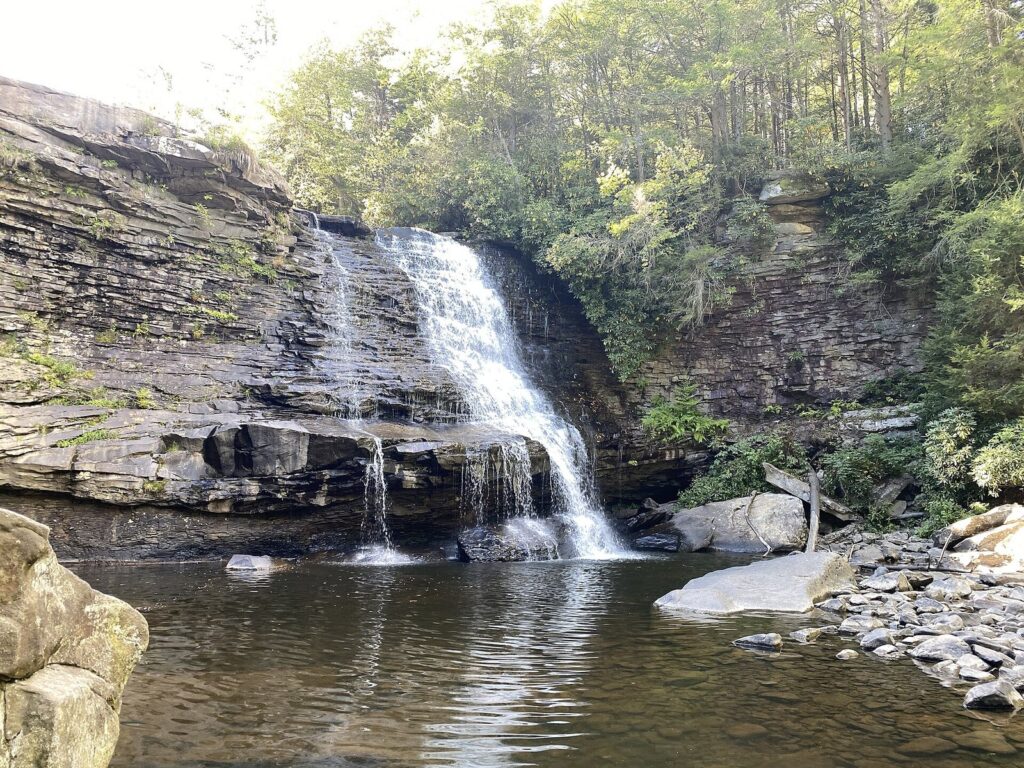
The falls are loudest in April and May, fed by snowmelt and spring rain, and thinnest in a dry August. In winter the rock steps along the gorge ice over, so traction cleats earn their place in the car.
Herrington Manor State Park
About five miles from Swallow Falls, Herrington Manor is built around a 53-acre lake with a sandy beach and canoe and kayak rentals in season. Its furnished log cabins book early for summer and October weekends, and a trail of roughly 5½ miles links the park to Swallow Falls for hikers and mountain bikers. In a snowy winter, the trails fill with cross-country skiers and snowshoers. It’s the park to pick if you want a cabin, a swim and a waterfall in one weekend without moving the car much.
Deep Creek Lake State Park
Maryland’s largest freshwater lake is ringed mostly by private homes, and this park is the main public way in: a swimming beach, a boat launch ($10, or $12 out of state), a campground in the woods on Meadow Mountain, hiking trails and the free Discovery Center, with exhibits on the lake and its wildlife. Summer entry was $3 per person ($5 out of state) from Memorial Day to Labor Day 2026, and per vehicle the rest of the year. For the rest of the lake, from boat rentals to Wisp to where to stay, see our guide to Deep Creek Lake.
New Germany State Park and Big Run
New Germany is the quiet one: a small lake with a swimming area, rental cabins in the woods, a campground and trail loops that become some of the state’s best cross-country ski runs when the snow cooperates. It sits inside Savage River State Forest, Maryland’s largest, a short drive south of I-68 near Grantsville. Big Run State Park, at the head of the Savage River Reservoir, is even more basic, with primitive campsites and little else. That’s the appeal: on a summer weekend when Deep Creek is buzzing with boats, you can hear the river here.
Rocky Gap State Park
Rocky Gap is the easiest western park to reach, right on I-68 a few miles east of Cumberland. Its center is Lake Habeeb, 243 acres of mountain water with swimming beaches, boat rentals and a campground and cabins along the shore. The Rocky Gap Casino Resort, with a hotel, casino and golf course, sits on park land across the lake, so you can camp on one side and eat a sit-down dinner on the other. The lakeside loop and the rocky gorge that gives the park its name make a good half-day on foot.
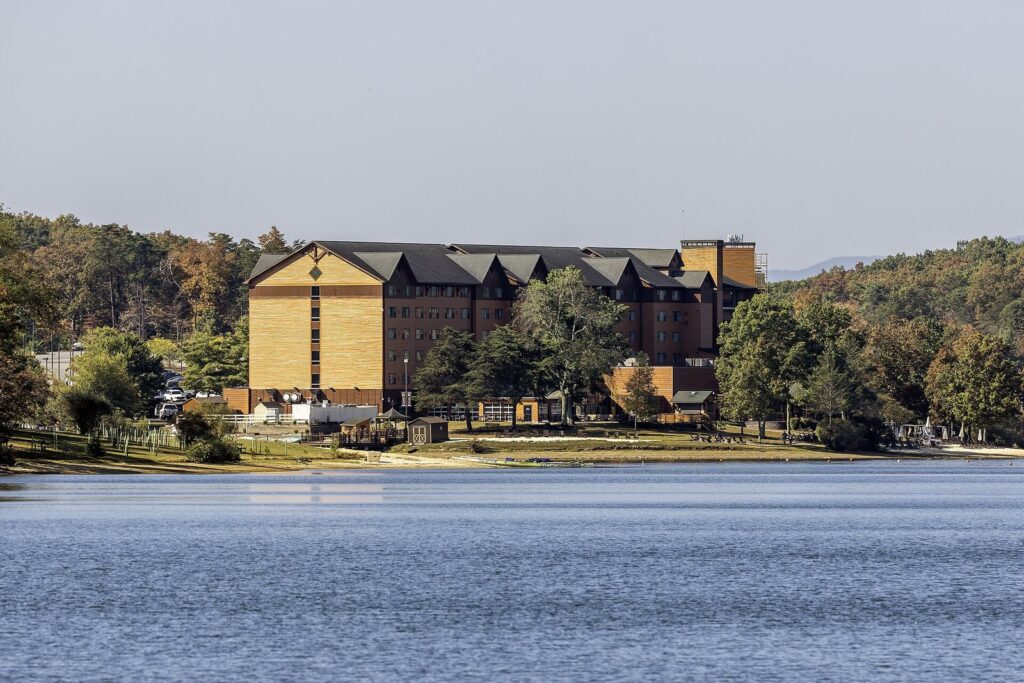
Rocky Gap joined the reservation list in 2026, with summer weekend entry at $4 per person ($6 out of state). One caution for late summer: the 2026 drought left Lake Habeeb unseasonably low. If another dry spell hits, check the beach status before you build a swim day around it.
Green Ridge and the rest of the far west
Green Ridge State Forest, east of Flintstone, is Maryland’s big backcountry: dirt roads, overlooks, primitive campsites and very few people, with the C&O Canal along its southern edge. Near Grantsville, Casselman River Bridge State Park is a 15-minute stop to see a stone arch bridge built for the National Road in 1813 and 1814. Neither is a destination on its own, but both reward a detour if you’re already out on I-68.
Plan it: Base yourself at Deep Creek Lake or in Oakland, and Swallow Falls, Herrington Manor, Deep Creek Lake State Park and New Germany all fit into two unhurried days. Rocky Gap works as a stop on the way in or out on I-68, roughly an hour east of the lake. Cell service fades in the valleys, so download maps before you leave the interstate.
Frederick and Washington counties: Catoctin, South Mountain and the Potomac
This is where most Washington and Baltimore families get their mountain fix, because it’s close: about an hour and a quarter to an hour and a half from either city. Catoctin Mountain and South Mountain are the eastern ridges of the Appalachians, with lake beaches, waterfalls, the Appalachian Trail and more Civil War and colonial history than any other park cluster in the state.
Cunningham Falls State Park
Cunningham Falls, just west of Thurmont, is the classic lake-beach-plus-waterfall day. The falls are a 78-foot cascade on Big Hunting Creek, usually called the tallest cascading waterfall in Maryland, reached by short trails from the William Houck Area around Hunting Creek Lake. That area also has the lake’s swimming beaches, boat rentals and a campground. The Manor Area, a few miles south along US 15, has a second campground and the stone stack of the Catoctin Iron Furnace, which made iron here from the 1770s.
Entry at the Houck Area was $5 per person on summer weekends ($7 out of state) and $3 on weekdays ($5) in 2026. There are no reservations, but the new card-payment gate means you should have a card ready, and the beaches do fill on hot weekends. Catoctin Mountain Park, the National Park Service land across Route 77 with the Chimney Rock and Wolf Rock hikes, is covered in our Frederick, Maryland guide, along with where to eat in town afterward.
Gambrill State Park
Gambrill, at the south end of Catoctin Mountain just northwest of Frederick, is the quickest mountain view from the city. The High Knob Area has stone overlooks and a stone lodge built by the CCC, and the trail network is one of the region’s go-to mountain bike systems. It’s a picnic-and-sunset park rather than a full-day destination, and that’s fine: it’s a short drive from downtown Frederick.
Greenbrier State Park
Greenbrier sits on South Mountain along US 40, a few minutes from Boonsboro and I-70. Its man-made lake has a sandy beach, boat rentals and a campground in the woods, and the Appalachian Trail crosses the mountain nearby. It’s popular enough that it went on the reservation list in 2025, so book on summer weekends. On a weekday, you may well have more sand than you need.
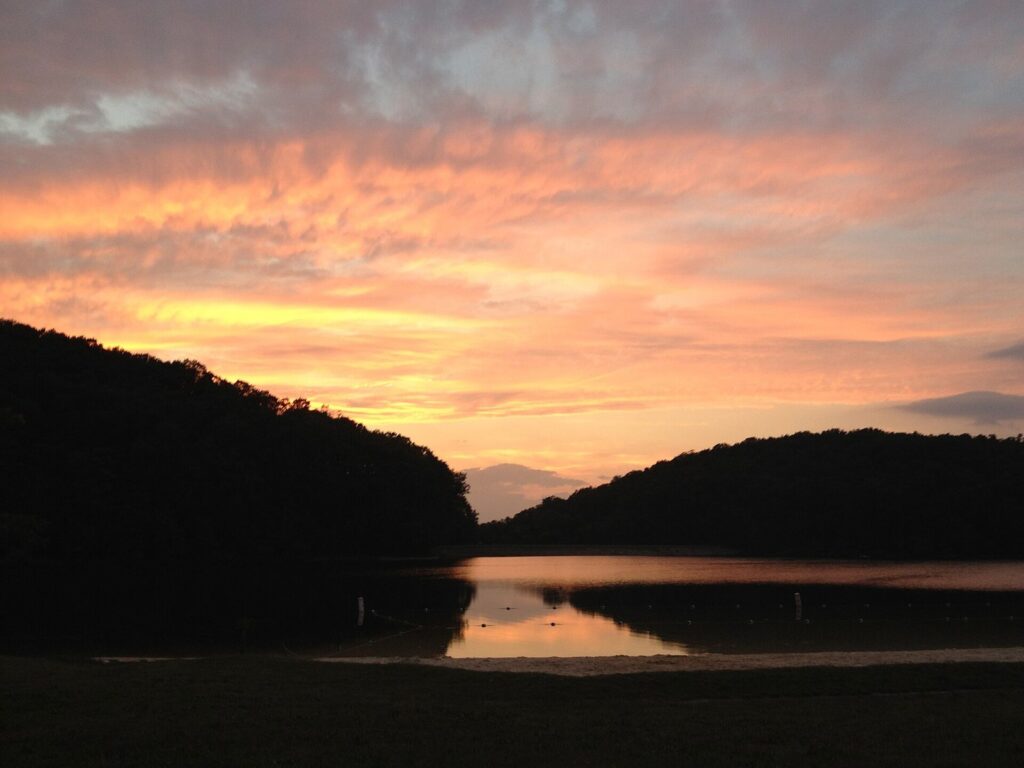
Washington Monument State Park
The first completed monument to George Washington isn’t in DC or Baltimore. It’s a squat stone tower on South Mountain above Boonsboro, raised by local residents in 1827 and restored by the CCC in the 1930s. A short uphill walk on the Appalachian Trail from the parking area gets you to the top, with a view west across the Hagerstown Valley. In September and October, volunteer hawk counters set up here to tally migrating raptors, and they’re usually happy to point out what’s flying.
Fort Frederick State Park
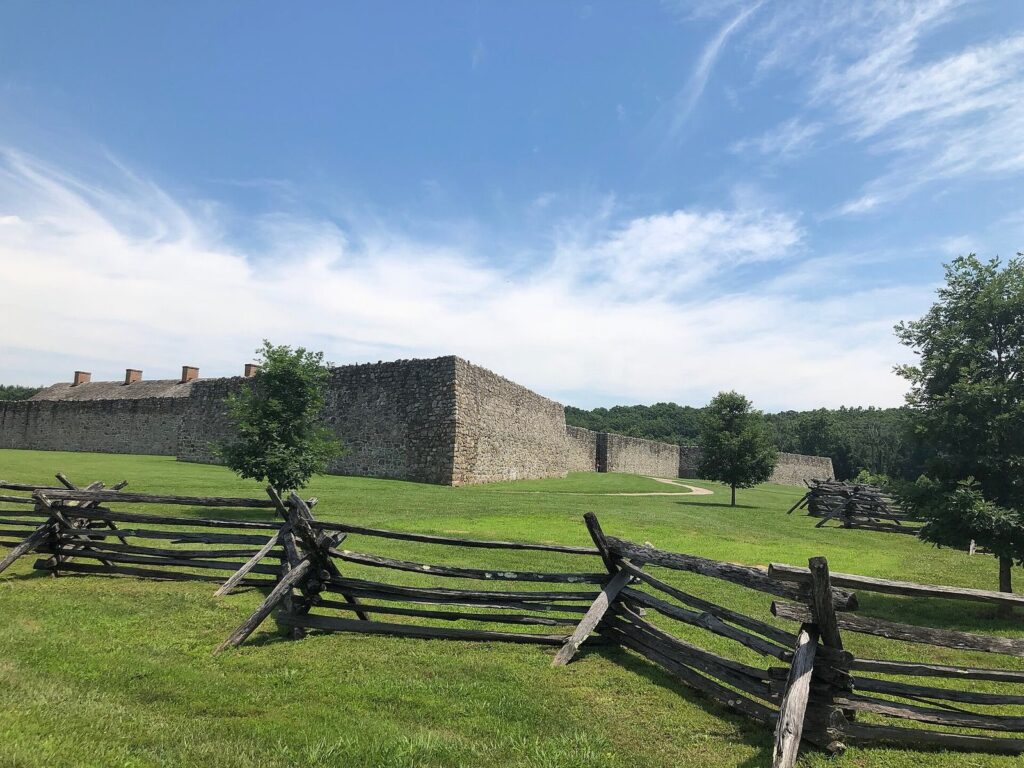
Built in 1756 during the French and Indian War, Fort Frederick near Big Pool is one of the few stone forts left from that era, with walls restored in the 1930s and reconstructed barracks inside. Living-history weekends bring it to life. On a quiet weekday, walk down to the C&O Canal towpath, which runs past the park, or bring a bike for the flat miles along Big Pool. There’s a campground, and it’s rarely full.
Two neighbors covered elsewhere
South Mountain State Battlefield, the September 1862 fight at Turner’s, Fox’s and Crampton’s gaps, belongs with our Antietam coverage, since most people visit the two together. Catoctin Mountain Park is a National Park Service unit and is covered with Frederick.
Plan it: Frederick is the natural base for Cunningham Falls and Gambrill, and Hagerstown or Boonsboro works for Greenbrier, Washington Monument and Fort Frederick. From DC or Baltimore, Thurmont is about 1¼ to 1½ hours and Hagerstown about 1½; from Philadelphia, allow about 3 hours.
Around Baltimore and Washington: Patapsco, Gunpowder, North Point and Seneca Creek
These are the parks you can reach after work. None is wilderness, but each has something the city doesn’t: a river gorge, a trout stream, a Bay shoreline or a lake with rental boats.
Patapsco Valley State Park
Maryland’s first state park follows about 32 miles of the Patapsco River through Baltimore and Howard counties, more than 16,000 acres split into separate areas with their own entrances. The Avalon and Orange Grove areas, between Elkridge and Catonsville, are the classic visit: the Swinging Bridge over the river, the short walk to Cascade Falls, and the Thomas Viaduct, a curved stone railroad bridge finished in 1835 that still carries trains. Hollofield, farther upriver, has the park’s campground and a valley overlook; McKeldin, at the west end, has rapids where the river’s two branches meet and quieter trails.
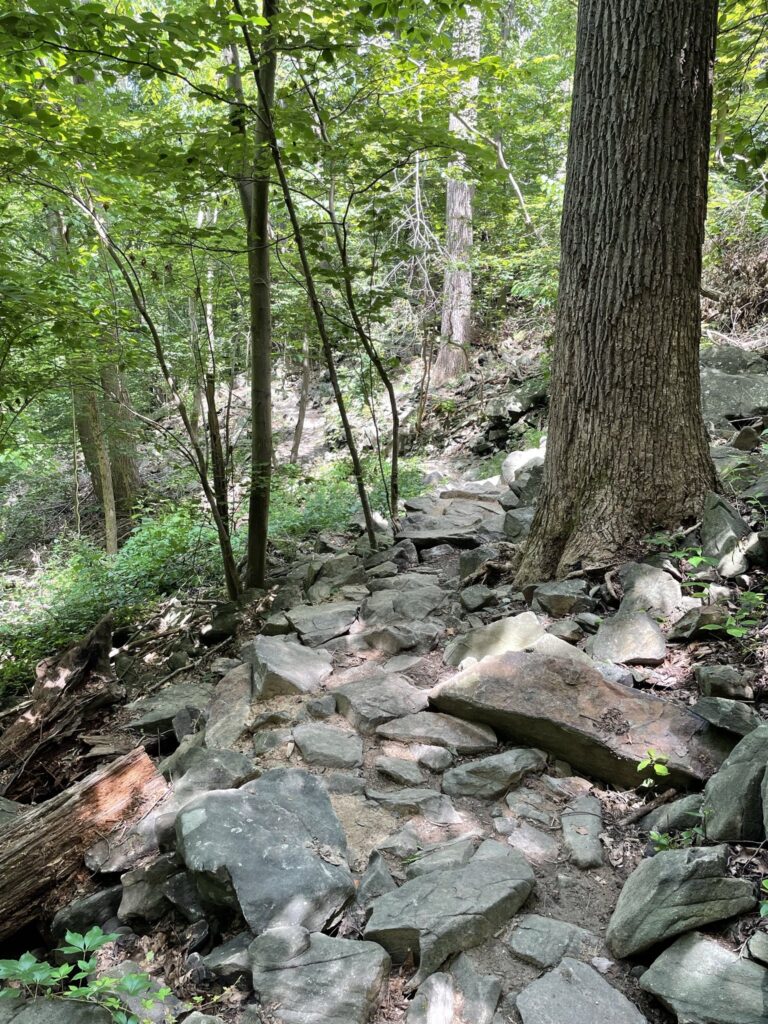
In 2026, entry at the main areas was $3 per person ($5 out of state) on weekends and holidays from April through October, and $2 per vehicle ($4) on weekdays. The river looks different from older photos around Ilchester: Bloede Dam, a drowning hazard for decades, was removed in 2018 to reopen the river to migrating fish. Downtown Ellicott City is a few minutes away for lunch.
Gunpowder Falls State Park
Gunpowder Falls is less one park than a string of them, about 18,000 acres following the Big and Little Gunpowder Falls rivers from northern Baltimore County down to the Bay. Three pieces matter most to visitors:
- Hammerman Area near Chase: a sandy beach on the Gunpowder River close to the Bay, with summer swimming, shaded picnic groves and paddle rentals nearby at Dundee Creek. It joined the reservation list in 2026.
- Hereford Area near Monkton: the cold tailwater below Prettyboy Dam holds trout, and the river trails are some of the prettiest walking north of Baltimore.
- Jerusalem Mill Village near Kingsville: a restored 18th-century mill village with a small museum, and a good starting point for the Little Gunpowder trails.
The Torrey C. Brown Rail Trail, the old Northern Central Railway line to the Pennsylvania border, is also part of Gunpowder Falls, though it belongs with Maryland’s bike trails more than here.
North Point State Park
North Point, at Edgemere on the Bay shore east of Baltimore, mixes the Black Marsh wildland with the remains of Bay Shore Park, a trolley amusement park that ran from 1906 to 1947. The old trolley station and a fountain still stand, and the shoreline has fishing spots and long views of the Bay. It’s small, its lots are small, and that’s why it has been on the reservation list since 2025.
Seneca Creek State Park
Seneca Creek in Gaithersburg is Montgomery County’s backyard park: 90-acre Clopper Lake with seasonal boat rentals, a disc golf course that draws players from across the region, and the Schaeffer Farm trails, a favorite of DC-area mountain bikers. It’s one of the parks with the new automated card-payment gates, so have a card ready.
Plan it: Patapsco’s Avalon Area is about 20 minutes from downtown Baltimore and roughly 45 minutes to an hour from DC. Seneca Creek is the easy DC-suburbs choice, and North Point and Hammerman are the east-side Baltimore picks, both with summer weekend reservations.
Harford and Cecil counties: Kilgore Falls, the Susquehanna and Turkey Point
The northeast corner, where the Susquehanna River pours into the head of the Bay, is the region most visitors skip. It shouldn’t be. It’s the closest Maryland parkland to Philadelphia and Wilmington, and it packs a waterfall, a lighthouse, an 18th-century mill and winter eagle-watching into a small area.
Rocks State Park and Kilgore Falls
Rocks State Park near Jarrettsville takes its name from the King and Queen Seat, a rock outcrop about 190 feet above Deer Creek with a long view over the treetops. Below it, Deer Creek runs clear and cold past picnic areas and fishing spots. Kilgore Falls sits in a separate piece of the park, the Falling Branch Area near Pylesville, where a short woods walk ends at a free-falling waterfall that drops into a pool framed by rock walls.
The catch is parking. The Falling Branch lot at 1026 Falling Branch Road holds 28 cars, which is why Kilgore went from free to reservations on summer weekends and holidays in 2026, at $3 per person ($5 out of state) plus the booking fee. Outside those days, arrive early or late; when the lot is full, it’s full, and roadside parking isn’t the answer.
Susquehanna State Park
Just upriver from the town of Havre de Grace, Susquehanna State Park covers the river bluffs and bottomland around Rock Run. The Rock Run Grist Mill dates to 1794, the Steppingstone Farm Museum shows rural life from a century ago, trails follow the old Susquehanna and Tidewater Canal, and there’s a wooded campground. From late fall into winter, bald eagles gather to fish below Conowingo Dam a few miles upstream, and the photographers lined up with long lenses tell you where to look.
Elk Neck State Park
At the southern end of the Elk Neck peninsula, between the Elk and North East rivers, Elk Neck is the most varied park in the northeast corner. It has sandy beaches on the North East River, marsh and forest trails, a big campground with cabins, and a walk out to Turkey Point Lighthouse, built in 1833 on a bluff about 100 feet above the head of the Chesapeake Bay. In September and October, Turkey Point is also a hawk-watching spot, and the view down the Bay at sunset is worth timing your walk around.
Horse people should also know Fair Hill, the natural resources management area near Elkton, with an 1860 covered bridge, miles of bridle trails and the Maryland 5 Star three-day event each October.
Plan it: Havre de Grace is the base for this corner, about 45 minutes to an hour from Baltimore, about 1½ hours from DC and about 1¼ to 1½ hours from Philadelphia. Susquehanna is close by, and Rocks, Kilgore Falls and Elk Neck are each within a short drive.
Sandy Point and Southern Maryland: Bay beaches, fossils and Point Lookout
South of Annapolis, Maryland narrows into long peninsulas between the Bay, the Patuxent and the Potomac. The parks here are about water: a big Bay beach, a fossil beach, and a campground at the point where the Potomac meets the Bay.
Sandy Point State Park
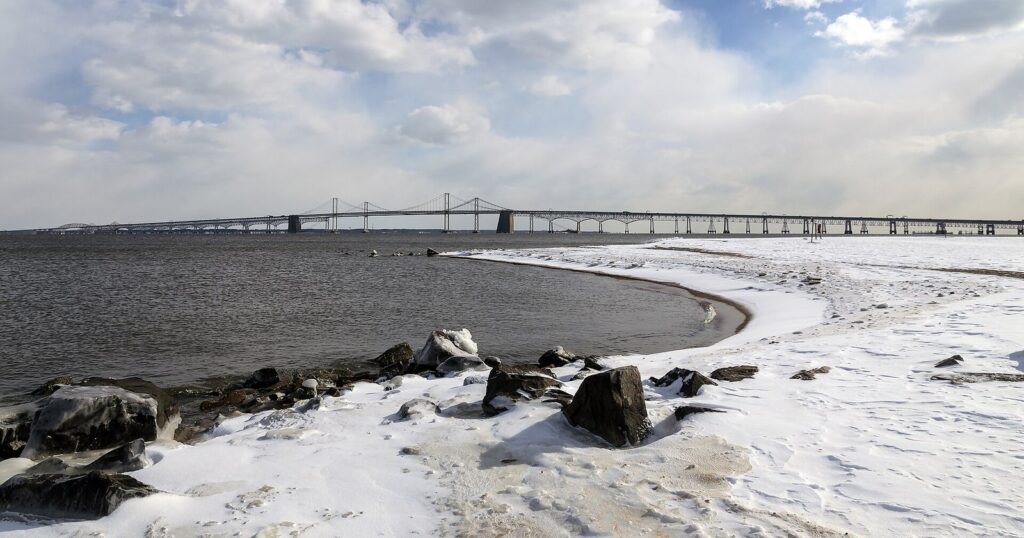
Sandy Point opened on June 25, 1952, a few weeks before the Bay Bridge that now towers over its beach. It covers 786 acres at the bridge’s western end, just outside Annapolis, Maryland, with a long sandy beach, lifeguards from 10 a.m. to 6 p.m. between Memorial Day and Labor Day, a boat launch, fishing and crabbing spots, and ships sliding under the bridge toward Baltimore.
From May through September in 2026, entry was $5 per person on weekends and holidays and $4 on weekdays; from October through April it’s $3 per vehicle, and there’s no out-of-state surcharge at any time. Summer weekends and holidays need a reservation, and passholders need the gate swipe card from the park office. Two big annual events use the beach: the Polar Bear Plunge in January and the Great Chesapeake Bay Swim in June.
Calvert Cliffs State Park
The cliffs along Calvert County’s Bay shore are layers of sediment laid down 10 to 20 million years ago, and they shed fossils every time a storm hits: shark teeth, ray plates, whale bone and shells. At the state park near Lusby, you reach the fossil beach on a trail of about 1.8 miles each way through the woods. The cliffs themselves are off-limits because they collapse without warning, so you search the sand and the surf line instead. Collecting on the beach is the whole point; digging into the cliff face is not allowed.
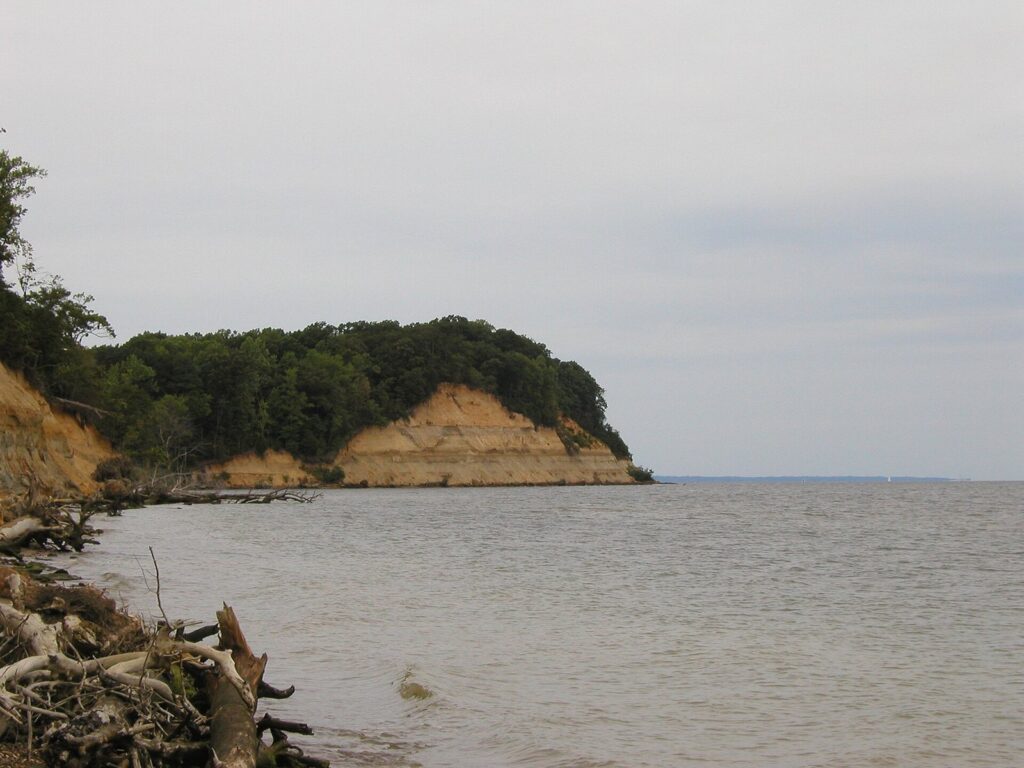
Entry is $5 per vehicle ($7 out of state), cash only. Go at low tide, ideally after a storm, bring a kitchen sieve and a bag for your finds, and keep expectations sane: most teeth are thumbnail-sized, and a big megalodon tooth is a rare prize. The walk is easy but long for small kids hauling buckets, so pack water and snacks.
Point Lookout State Park
Point Lookout is the end of the line: the tip of St. Mary’s County where the Potomac River meets the Chesapeake Bay. During the Civil War, the Union ran its largest prison camp for Confederate soldiers here; tens of thousands of men passed through, and thousands died. Today the park has a small Civil War museum, reconstructed earthworks at Fort Lincoln, a fishing pier, a swimming beach, a boat launch, a big campground, and the 1830 Point Lookout Lighthouse standing over the marsh.
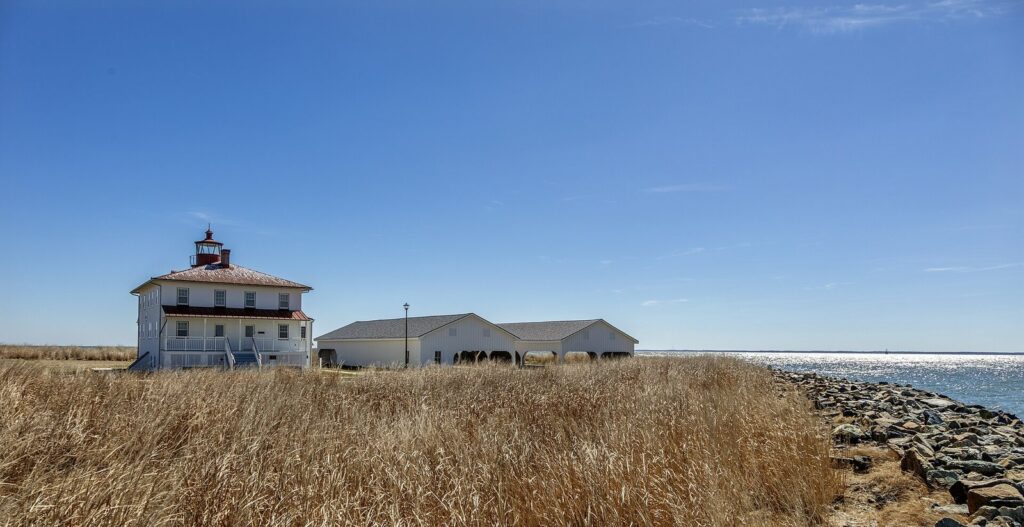
Summer weekends and holidays need a reservation, with entry at $5 per person ($7 out of state); summer weekdays were $3 per vehicle ($5) in 2026. In season, Smith Island Cruises sails from the park to Smith Island, at $65 for adults in 2026, which saves the long drive around to Crisfield.
Newtowne Neck, Smallwood, Purse and St. Clement’s Island
- Newtowne Neck near Leonardtown: a quiet Potomac peninsula with shoreline, trails and St. Francis Xavier Church, built in 1731 and one of the oldest Catholic churches in the original colonies. Its small lot is why it takes reservations on summer weekends.
- Smallwood near Marbury: a marina on Mattawoman Creek, a campground, and Smallwood’s Retreat, the restored home of Revolutionary War general and Maryland governor William Smallwood.
- Purse near Nanjemoy: undeveloped Potomac shoreline where people sift the sand for small fossil shark teeth. There are no facilities, so pack out everything.
- St. Clement’s Island: reachable only by boat, this is where Maryland’s first colonists landed in 1634. A seasonal water taxi runs from the county museum on the mainland.
Plan it: Sandy Point is about 45 minutes from DC and 40 from Baltimore. For Calvert Cliffs and Point Lookout, stay in Solomons or near St. Mary’s City: Calvert Cliffs is about 1¼ hours from DC and 1½ from Baltimore, and St. Mary’s City about 1½ hours from DC, with Point Lookout at the very end of Route 5 beyond it.
Eastern Shore parks: marsh, cypress and quiet campgrounds
Across the Bay, the land flattens out and the parks turn to water: marsh, slow rivers, cypress swamp and the Atlantic. They’re farther from the cities and a lot less crowded, and they’re at their best in spring and fall, when the bugs back off.
Janes Island State Park
Janes Island, across a narrow canal from Crisfield, is mostly salt marsh, and the best of it is only reachable by paddle. About 30 miles of marked water trails wind through the marsh to empty sandy beaches on Tangier Sound. The park rents canoes and kayaks in season, the campground and cabins sit close to the water, and the sunsets over the sound are the reason people drive three hours to get here. From June to September, bring serious bug spray, because the marsh breeds greenheads and mosquitoes in numbers that end picnics.
Pocomoke River State Park
Around Snow Hill, the Pocomoke River runs dark and slow through bald cypress swamp, scenery most people associate with the Carolinas. The state park has two areas: Shad Landing, with a marina, canoe and kayak rentals, a campground and a seasonal swimming pool, and Milburn Landing on the far bank near Pocomoke City. A few hours in a canoe among the cypress knees is the reason to come; the surrounding Pocomoke State Forest adds quiet trails.
Tuckahoe, Martinak and Wye Oak
- Tuckahoe near Queen Anne: a lake and creek made for beginner paddling, a campground, and Adkins Arboretum, a native-plant garden with its own trails inside the park.
- Martinak near Denton: a small, shady campground on the Choptank River and Watts Creek, with a boat launch for fishing and paddling.
- Wye Oak in Wye Mills: the smallest stop on this list. The Wye Oak, the largest white oak in the country, stood here for more than 400 years before a storm brought it down in 2002; a clone of the tree now grows on the site.
Harriet Tubman Underground Railroad State Park
Near Church Creek in Dorchester County, this state park’s visitor center, run with the National Park Service’s Harriet Tubman Underground Railroad National Historical Park, is the starting point for the Tubman byway through the fields and marshes where she was born and to which she returned to lead others to freedom. Blackwater National Wildlife Refuge, with its $3-per-vehicle Wildlife Drive, is next door.
Assateague State Park
Maryland’s only oceanfront state park, on Assateague Island south of Ocean City, has a guarded beach in summer, a big campground and the island’s wild horses. It gets its own full treatment in our Assateague guide, alongside the national seashore next door.
Plan it: Janes Island is about 3 to 3½ hours from DC or Baltimore by way of the Bay Bridge, which is cashless ($2.50 with a Maryland E-ZPass, $4 by Pay-By-Plate, collected eastbound only). From Philadelphia, it’s about 3¼ to 3¾ hours on the Delaware route (I-95, DE-1 and US-13), which skips the bridge entirely. Tuckahoe and Martinak are closer, about 1½ hours from DC or Baltimore across the bridge.
State parks vs national parks in Maryland
Search for the best national parks in Maryland and you’ll find there’s no Yellowstone-style national park here. What Maryland has is a set of National Park Service sites run under federal rules: Assateague Island National Seashore, Antietam and Monocacy national battlefields, the Chesapeake and Ohio Canal National Historical Park, Catoctin Mountain Park, Fort McHenry, the Harriet Tubman Underground Railroad National Historical Park, Hampton National Historic Site, and a string of Potomac parks near DC such as Fort Washington and Piscataway.
The practical difference is money. National Park Service sites that charge fees take the America the Beautiful pass ($80 a year for US residents, $250 for non-residents since 2026). Maryland state parks take the state Passport. Neither works at the other’s gates. Fort McHenry, for example, charges $15 per person 16 and older for its historic zone, and no state pass touches that. Catoctin Mountain Park is covered in our Frederick guide, Assateague’s national seashore in our Assateague guide, and the C&O Canal towpath with our trail coverage.
The best state parks in Maryland for…
| Best for | Go here | Why | Plan B |
|---|---|---|---|
| A Bay beach day | Sandy Point | Lifeguards, sand and the Bay Bridge overhead | Point Lookout, Elk Neck |
| A lake beach with kids | Cunningham Falls | Swimming beach plus a short waterfall walk | Greenbrier, Rocky Gap |
| Waterfalls | Swallow Falls | Muddy Creek Falls, about 53 feet | Cunningham Falls, Kilgore Falls |
| Paddling | Janes Island | Marked water trails to empty beaches | Pocomoke River, Tuckahoe |
| History | Point Lookout | Civil War prison camp and an 1830 lighthouse | Fort Frederick, Washington Monument |
| Fossils | Calvert Cliffs | Shark teeth in the surf line | Purse |
| Cabins | Herrington Manor | Log cabins by a swimming lake | New Germany, Janes Island |
| Fall color | Swallow Falls and Herrington Manor | Garrett County turns first | Gambrill, Washington Monument |
| Winter | New Germany | Cross-country skiing when the snow falls | Herrington Manor |
| Close to DC | Seneca Creek | Clopper Lake in Gaithersburg | Patapsco, Gambrill |
| Close to Baltimore | Patapsco Valley | About 20 minutes from downtown | Gunpowder Falls, North Point |
| Close to Philadelphia | Elk Neck | Beaches and a lighthouse at the head of the Bay | Susquehanna, Rocks |
If you can only do one park per region, our picks are Swallow Falls in the west, Cunningham Falls in the Catoctins, Patapsco near Baltimore, Elk Neck in the northeast, Calvert Cliffs or Point Lookout in the south, and Janes Island on the Shore. Sandy Point is the one to do on a weekday.
When to go: the best parks by season
Spring (April and May)
Waterfall season. Swallow Falls, Cunningham Falls and Kilgore Falls run fullest with snowmelt and spring rain, wildflowers come up along the river valleys, and there are no reservations until Memorial Day weekend. Lake water is still cold, so this is for hiking, not swimming. Garrett County can still see snow in April.
Summer (June to August)
Beach season, and the reservation system’s busy months. Book the reservation parks, go on weekdays when you can, and head west when the city bakes: the Garrett County lakes run noticeably cooler. Afternoon thunderstorms can close beaches for an hour or two, and the Eastern Shore marsh parks are at their buggiest.
Fall (September to November)
The best season overall. Reservations end after Labor Day, many parks switch to per-vehicle fees, and dogs are back in the day-use areas at many parks. Hawk watchers gather at Washington Monument and Turkey Point in September and October. Color usually peaks first in Garrett County in early to mid October and works east through the Catoctins and the Piedmont into early November; DNR posts weekly foliage reports through the season.
Winter (December to March)
The quiet months. Cross-country skiing and snowshoeing at New Germany and Herrington Manor when snow cooperates, bald eagles below Conowingo Dam near Susquehanna, empty Bay beaches for walking, First Day Hikes on New Year’s Day, and the Polar Bear Plunge at Sandy Point in January. Many campgrounds close for the season, but some parks keep cabins open year-round.
Camping and cabins in Maryland state parks
The Maryland Park Service runs more than 2,000 campsites, about 120 cabins and about 100 picnic shelters. All of them are booked through parkreservations.maryland.gov or by phone at 1-888-432-2267, not through the day-use site. Most reservations open up to a year ahead, and most parks require a two-night minimum on summer weekends. For summer and October weekends at the popular parks, book months out.
| Type | What you get | What to bring |
|---|---|---|
| Campsite | A pad, picnic table and fire ring; bathhouses at most campgrounds; electric hookups at some sites | Everything else |
| Camper cabin | A roof, beds or bunks and usually electricity; no bathroom or kitchen, with a bathhouse nearby | Bedding, cooking gear, a cooler |
| Full-service cabin | Furnished, with electricity, a kitchen and a bathroom with shower; some have fireplaces | Food, and check whether linens are included |
Where to aim: the log cabins at Herrington Manor and the cabins at New Germany for a mountain lake weekend; Janes Island, with both camper and full-service cabins, for the water; Elk Neck and Rocky Gap for cabins with beaches. For tent camping, Janes Island, Elk Neck, Greenbrier, Cunningham Falls and Deep Creek Lake are the popular picks, and Big Run and Green Ridge are the primitive options.
Two money-savers: the Golden Age Pass halves the camping fee from Sunday through Thursday (not full-service cabins, not holidays), and a midweek stay in June or September is often easy to book when weekends are gone. Statewide camping, including private campgrounds and the national seashore’s sites on Assateague, gets its own guide.
Dogs, alcohol, accessibility and hours
Can you bring a dog?
Often, but it depends on the park and the season. Pets must be leashed, licensed and vaccinated against rabies everywhere. At many parks, leashed pets are allowed in day-use areas only from Labor Day to the Friday of Memorial Day weekend, which keeps them off the busy summer beaches. Some campgrounds set aside pet-friendly loops, and a few camp-loop beaches allow dogs from late April through November 1. Pets are not allowed in park buildings or on playgrounds, except service animals. Check the specific park before you load the dog.
Is alcohol allowed?
Mostly no. Open containers are banned on park parking lots, roads, trails and other designated areas. You can drink in designated picnic shelters or areas with a $35 alcohol permit, and inside full-service cabins and motor homes, but not in camper cabins.
Accessibility
The free Universal Disability Pass covers entry for the holder and one companion, and DNR’s Access for All page covers accessible features and programs. Facilities vary a lot from park to park, so call the park office before you go to ask about accessible parking, trails, campsites, cabins and beach access.
Hours and holidays
Most day-use areas open in the morning and close at sunset, year-round, including holidays; campers can stay after hours. Visitor centers, nature centers and concessions keep their own schedules and some close for the winter. Before an early start or a holiday visit, check the park’s page for its posted hours.
Planning logistics: drive times, where to stay and what to pack
You need a car for almost every state park; public transit doesn’t reach the gates. Here are free-flow drive times to the main parks. Add traffic, especially on I-95, the Beltways and the Bay Bridge on summer weekends.
| Park (or nearest town) | From Washington, DC | From Baltimore | From Philadelphia |
|---|---|---|---|
| Sandy Point | About 45 minutes | About 40 minutes | About 2 to 2½ hours |
| Patapsco Valley (Ellicott City) | About 45 to 55 minutes | About 20 minutes | About 2 to 2½ hours |
| Cunningham Falls (Thurmont) | About 1¼ to 1½ hours | About 1¼ hours | About 2¾ to 3 hours |
| Greenbrier and Washington Monument (Hagerstown) | About 1½ hours | About 1½ hours | About 3 to 3½ hours |
| Susquehanna (Havre de Grace) | About 1½ hours | About 45 minutes to 1 hour | About 1¼ to 1½ hours |
| Calvert Cliffs | About 1¼ hours | About 1½ to 1¾ hours | About 3¼ to 3¾ hours |
| Rocky Gap | About 2¼ to 2½ hours | About 2¼ hours | About 4 to 4½ hours |
| Swallow Falls | About 3½ to 4 hours | About 3½ hours | About 5 to 6 hours |
| Janes Island (Crisfield) | About 3 to 3½ hours (Bay Bridge) | About 3 to 3½ hours (Bay Bridge) | About 3¼ to 3¾ hours (via Delaware) |
The Bay Bridge. Eastern Shore parks mean crossing it from DC or Baltimore. Tolls are cashless and collected eastbound only: $2.50 with a Maryland E-ZPass and $4 by Pay-By-Plate. The Maryland Transportation Authority’s best times to head east are Friday before 9 a.m. or after 8 p.m., Saturday before 7 a.m. or after 7 p.m., and Sunday before 10 a.m. or after 7 p.m. Coming back west, Sunday before 11 a.m. or after 10 p.m. is the safe window. Deck work on the eastbound span means overnight two-way traffic through spring 2027.
Where to stay. Inside the parks, the cabins are the best value in the system if you book early. Outside them, pick a base town for each region: Deep Creek Lake or Oakland for the Garrett parks; Cumberland or the resort at Rocky Gap for Allegany; Frederick or Hagerstown for the Catoctin and South Mountain parks; Havre de Grace for the northeast; Annapolis for Sandy Point; Solomons or Lexington Park for Calvert Cliffs and Point Lookout; and Crisfield or Salisbury for Janes Island. Hotel prices follow the usual pattern: summer and October weekends cost the most, and weekday stays are cheaper everywhere.
What to pack. Cash and a card for the gates, your reservation confirmation on your phone (with a screenshot, since signal fades in the mountains), water shoes for the lake beaches and fossil beach, bug spray for anything on the Shore in summer, and a physical Passport card if you have one. Leave the cooler of beer at home unless you have a permit and a shelter.
What to skip
Skip Sandy Point on a July Saturday without a reservation. You’ll sit in traffic for nothing. Book, or go on a weekday or after Labor Day, when the beach is quieter and parking costs $3 a car from October.
Skip the Passport if you’ll visit only once or twice. It takes about four family trips to break even, and it still doesn’t get you out of the reservation.
Don’t drive 3½ hours to Swallow Falls without checking the road. Until DNR confirms the entrance reopened, look at the Park Status Dashboard or call the office first.
Skip Kilgore Falls as a destination drive from DC. It’s a small waterfall with a 28-car lot. Worth it if you’re nearby or pairing it with Rocks and Susquehanna; not worth three hours round trip on its own.
Skip megalodon dreams at Calvert Cliffs. Go for the walk and the thumbnail-sized shark teeth, and count anything bigger as luck.
Skip the federal parks pass at state gates. America the Beautiful passes don’t work at Maryland state parks, the senior pass included.
Frequently asked questions
How many state parks are in Maryland?
About 50. The Maryland Manual lists 48 state parks plus seven natural environment areas and 24 natural resource management areas, and the state’s visitor pages say “over 50.” Count the state forests too and there are more than 70 public areas for recreation, from Swallow Falls in Garrett County to Janes Island near Crisfield.
Why visit Maryland state parks?
Range and price. Within about four hours you can stand under Maryland’s highest free-falling waterfall, swim at a Chesapeake Bay beach beside the Bay Bridge, paddle a cypress swamp and hunt fossil shark teeth. Entry usually costs $3 to $7 per person on summer weekends, less at other times, and dozens of parks are within 90 minutes of Washington or Baltimore.
Where can you find megalodon teeth in Maryland state parks?
Calvert Cliffs State Park near Lusby is the best-known spot: a beach at the end of a trail of about 1.8 miles where fossils wash out of the cliffs. Purse State Park on the Potomac near Nanjemoy is a quieter option. Megalodon teeth are rare at both; most finds are small shark teeth. Search at low tide after storms, and never dig into the cliffs.
Are Maryland state parks open on Easter?
Yes. Most day-use areas are open every day of the year, holidays included, from roughly morning to sunset. Easter falls before the summer reservation season, so you won’t need a day-use booking, and many parks charge per vehicle in spring. Visitor centers and concessions keep their own hours and may be closed, so check the park’s page before an Easter picnic.
Are Maryland state parks free for veterans?
Yes, for day use. Maryland waives day-use entrance fees year-round for all veterans, whether or not they live in Maryland. The waiver covers the veteran only, unless the park is charging per vehicle that day, when the whole car gets in. Active-duty service members get in free with a military ID. Camping and cabin fees are not covered.
Do you need a reservation to visit a Maryland state park?
Only at nine parks on summer weekends and holidays: Sandy Point, Greenbrier, Point Lookout, North Point, Newtowne Neck, Gunpowder’s Hammerman Area, Rocky Gap, Swallow Falls and Kilgore Falls. Book up to seven days ahead at parkdayuse.maryland.gov for about $1.50 plus entry. Walk-in and bike-in visitors don’t need one, and passholders still do.
Are dogs allowed in Maryland state parks?
At many parks, yes, on a leash and with current rabies vaccination, but the rules change by park and season. Many parks keep pets out of day-use areas and beaches from Memorial Day weekend to Labor Day, and pets are never allowed in buildings or on playgrounds. Some campgrounds have pet-friendly loops. Check the park’s page before you bring a dog.
Related Maryland guides
- Deep Creek Lake: boating, Wisp and where to stay
- Frederick, MD, and Catoctin Mountain Park
- Annapolis, MD, near Sandy Point
- Havre de Grace, gateway to Susquehanna State Park
Sources and verification
Everything on this page was checked on September 23, 2026 against the organizations listed below, and the guide is compiled from their published information rather than from first-hand visits.
- Maryland Park Service (Maryland Department of Natural Resources): park pages, fees and park status
- Maryland State Parks day-use reservations
- Maryland State Parks camping, cabin and shelter reservations
- DNR: State Park Passes (Passport, Golden Age Pass, Every Kid Outdoors)
- DNR: veterans’ day-use fee waiver
- Garrett County: Swallow Falls bridge replacement notice
- National Park Service: America the Beautiful passes
Also consulted: the Maryland Manual (Maryland State Archives) for the park count, the Maryland Geological Survey for waterfall heights, the Maryland Transportation Authority for Bay Bridge tolls and travel times, the National Park Service for Fort McHenry fees, the U.S. Fish and Wildlife Service for Blackwater, and Smith Island Cruises for its Point Lookout departures.
Maryland Tourism Guide is an independent publication. It is not affiliated with Visit Maryland or any agency or business named here, and no one paid to be included.
Photo credits
- Kilgore Falls, Rocks State Park (featured image): photo by Andrew Parlette, Wikimedia Commons (CC BY 2.0)
- Sandy Point State Park and the Bay Bridge: photo by Acroterion, Wikimedia Commons (CC BY-SA 4.0)
- Muddy Creek Falls, Swallow Falls State Park: photo by TheTurducken, Wikimedia Commons (CC BY 2.0)
- Lake Habeeb, Rocky Gap State Park: photo by Acroterion, Wikimedia Commons (CC BY-SA 4.0)
- Greenbrier State Park lake: photo by Clarissajoy, Wikimedia Commons (CC0)
- Fort Frederick State Park: photo by Jfleon11, Wikimedia Commons (CC BY-SA 4.0)
- Trail in Patapsco Valley State Park: photo by Elliott R. Plack, Wikimedia Commons (CC BY-SA 4.0)
- Calvert Cliffs: photo by Alex Zorach, Wikimedia Commons (CC BY-SA 3.0)
- Point Lookout Lighthouse, Point Lookout State Park: photo by Acroterion, Wikimedia Commons (CC BY-SA 4.0)