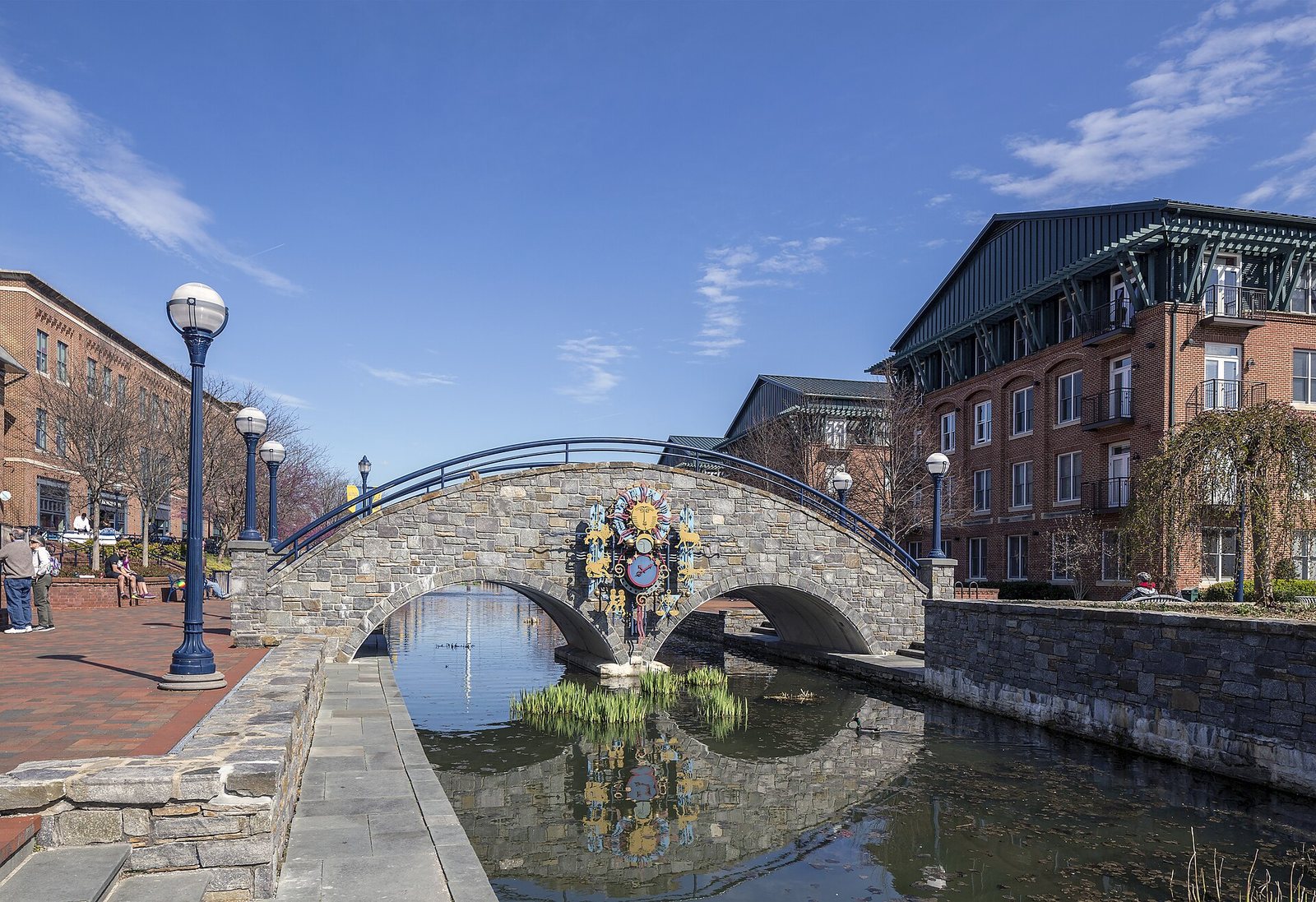
Look at Frederick from Baker Park and the skyline is mostly church steeples, a row of them rising above the rooftops, the “clustered spires of Frederick” that John Greenleaf Whittier put into his 1863 poem about Barbara Frietchie. Walk a few blocks east and the spires give way to a restored creek lined with brick paths, public art and restaurant patios, then to a former factory district full of breweries. That mix of old and reinvented is the point of a Frederick MD trip: a historic county seat an hour from Washington that has become one of the best small-city weekends in the Mid-Atlantic, with the Catoctin Mountains 20 minutes up the road.
The short answer: Frederick is worth a day and better for a weekend. Its 50-block historic downtown has more than 200 shops, galleries, restaurants, breweries and distilleries, and Carroll Creek Park runs through the middle of it. Add the National Museum of Civil War Medicine ($9.50), the Monocacy battlefield (free), and a day in Catoctin Mountain Park (free) or at Cunningham Falls, and you have a full trip. It’s about an hour from Washington and Baltimore by car, and Frederick County’s hotel tax is a modest 5%. The county drew 2.1 million visitors in 2024.
Every price, date and rule on this page was checked on September 23, 2026 against the operators’ and agencies’ own websites. Two things have changed since many guides were written: Flying Dog, once Frederick’s best-known brewery tour, closed its Frederick brewery in 2023, and the Byron footbridge that linked Maryland to Harpers Ferry, a favorite side trip, has been closed since July 27, 2026. Both are covered below.
On this page: At a glance · Is it worth it? · History · Districts · Downtown walking route · Museums and history · Civil War loop · Food · Breweries and more · Arts and nightlife · Where to stay · Catoctin Mountains · Thurmont and Emmitsburg · Orchards and farms · More hiking and biking · Seasons and events · Rainy days · For couples · Accessibility · Getting there · Getting around · With kids · Free things · Frederick or its rivals · Day trips · A weekend plan · A day trip · Tips · Costs · What to skip · FAQ
Frederick at a glance
| Question | Answer (checked September 2026) |
|---|---|
| Where is it? | Frederick County, western central Maryland, where I-70 meets I-270 and US 15, below the Catoctin Mountains. |
| How far? | About 1 hour to 1 hour 15 minutes from Washington and about 1 hour from Baltimore, before traffic. |
| Downtown | A 50-block historic district with Carroll Creek Park running through it; walkable in a day. |
| Top museum | National Museum of Civil War Medicine: $9.50; Monday to Saturday 10 a.m. to 5 p.m., Sunday 11 a.m. to 5 p.m. |
| Parks | Monocacy National Battlefield and Catoctin Mountain Park are both free. |
| Breweries | A cluster along Carroll Creek plus taprooms around town; Flying Dog’s Frederick brewery closed in 2023. |
| Hotel taxes | 5% Frederick County room tax plus Maryland’s 6% sales tax. |
| Trains | MARC’s Brunswick Line serves Frederick on weekdays only; no weekend trains. |
| Big dates | Catoctin Colorfest in Thurmont, Oct 10 to 11, 2026; ghost tours on Saturday evenings Nov 14 to 28, 2026. |
| Best time | October for color and festivals; April to June and September for walking weather. |
Is Frederick MD worth visiting?
Yes, and it’s one of Maryland’s most underrated trips. Frederick is the state’s second-largest city, with about 78,000 people, but it feels like a big, confident small town. Its downtown kept its 18th- and 19th-century buildings, then filled them with independent restaurants, bars, antique shops and galleries, and a flood-control project turned Carroll Creek into a landscaped park with footbridges and patios. Around it, Frederick County layers on Civil War battlefields, orchards and wineries, and the forested Catoctin Mountains, with hiking trails, waterfalls and the presidential retreat at Camp David hidden in the trees.
It’s less worth it if you want big-ticket attractions. Frederick has no aquarium, no theme park and no famous museum to anchor a trip; its pleasures are walking, eating, drinking and getting outdoors. And downtown on a Saturday night can be busy, with parking to match. For most visitors from Washington and Baltimore, though, that’s exactly the appeal: a relaxed weekend with good food, an hour from home.
Verdict: worth a full day and ideally a weekend, especially in spring and fall. It’s the best small-city base in western Maryland for food, history and the mountains.
Go if you like walkable downtowns, good restaurants and breweries, Civil War history, antiques, and hiking within half an hour.
Stay overnight if you want Catoctin Mountain Park or Antietam as well as downtown, or you’re coming for Colorfest in October.
Skip it if you need headline attractions or a beach. Frederick is about atmosphere, food and the outdoors, not sights you tick off.
A short history of Frederick
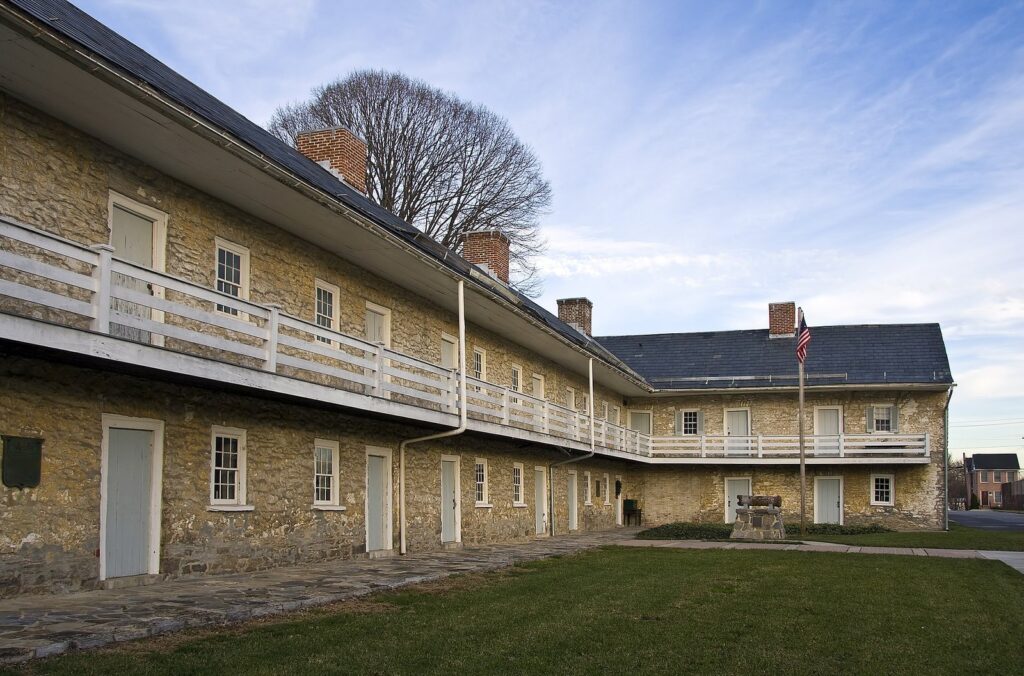
Frederick was laid out in 1745 on land owned by Daniel Dulany, and settled largely by German immigrants moving south from Pennsylvania, which is why so many of its oldest buildings are fieldstone and why its early churches were Lutheran and Reformed. Schifferstadt, a stone farmhouse from 1756, is one of the best surviving examples of that German colonial architecture. During the Revolution, the stone Hessian Barracks held prisoners of war.
The Civil War came through Frederick again and again. Armies marched past on their way to Antietam in 1862 and Gettysburg in 1863, and the town’s churches, schools and warehouses became hospitals for thousands of wounded soldiers, a history the National Museum of Civil War Medicine tells today. In July 1864, Confederate General Jubal Early demanded a ransom of $200,000 from the town, and the same day his army fought Union troops at the Monocacy River just south of town, a delay credited with saving Washington from capture. Whittier’s poem, meanwhile, made a legend of Barbara Frietchie, an elderly resident said to have defied Confederate troops by waving a Union flag.
In the 20th century, downtown declined and flooded. After a devastating 1976 flood, the city built an underground flood-control system and, over the following decades, turned Carroll Creek into the park that now anchors downtown’s revival.
Frederick’s districts: where things are
Frederick is easy to understand once you know its parts.
- The historic downtown: the 50-block core around Market and Patrick streets, with the spires, the museum, most restaurants and the shops. This is where you’ll spend most of your time.
- Carroll Creek and the East End: the creek park running east from Market Street, and beyond it the old industrial blocks around East Street, now breweries, restaurants, apartments and Everedy Square.
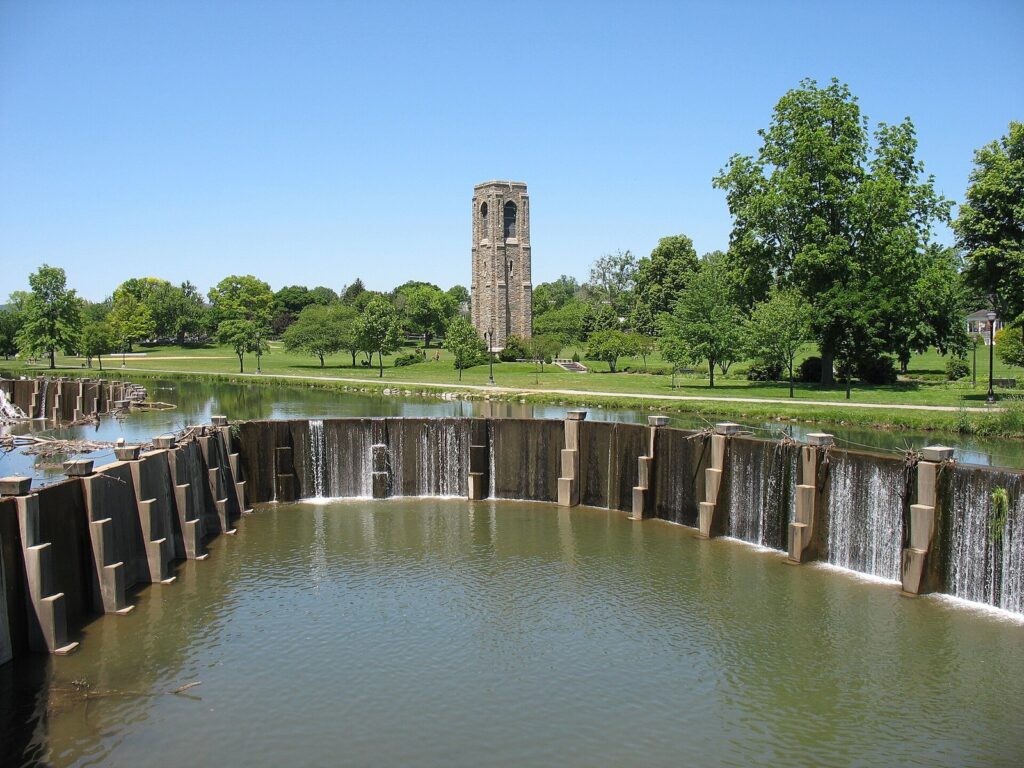
- Baker Park and the west side: the city’s big park, the carillon, Mount Olivet Cemetery to the south, and quiet streets of 19th-century houses.
- The Golden Mile and the highway edges: US 40 west of downtown and the areas along I-270 and US 15, with shopping centers, chain restaurants and most of the city’s hotels.
- The countryside: Middletown Valley to the west toward South Mountain, the Catoctin foothills to the north around Thurmont, New Market’s antiques to the east, and Urbana and the Sugarloaf area to the south, dotted with farms, orchards and wineries.
Visitors who stay downtown can walk to almost everything in the first two areas; the rest need a car.
A walking route through downtown Frederick and Carroll Creek
Downtown Frederick is compact, flat enough and best seen on foot. This loop takes two to three hours with stops and covers the highlights.
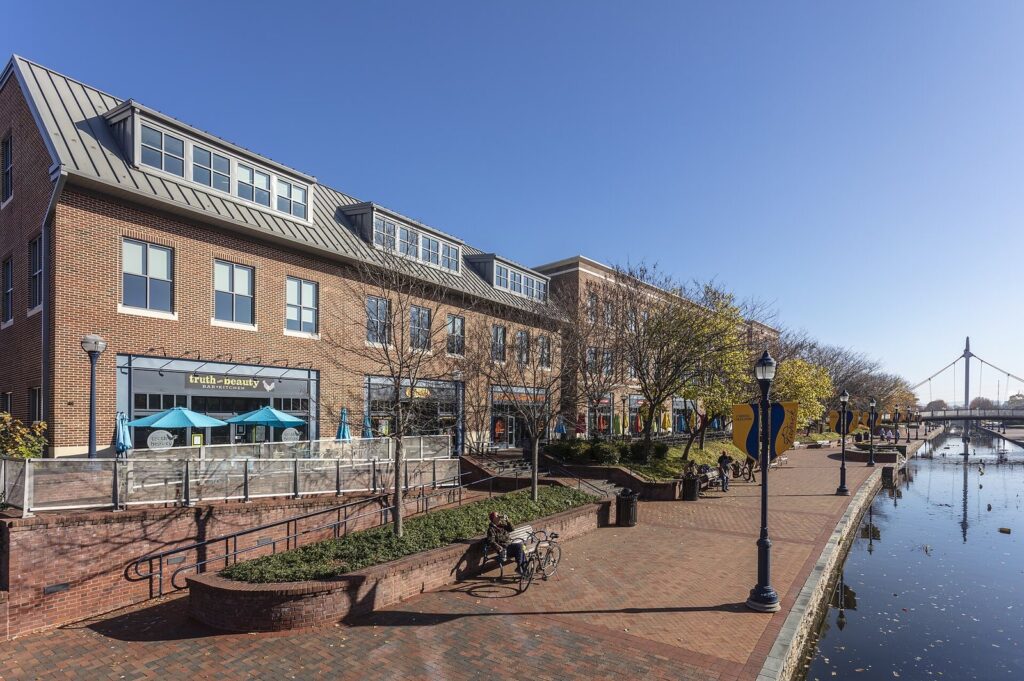
- Carroll Creek Park. Start on the creek, a landscaped linear park with brick paths, fountains, footbridges, water gardens and restaurant patios. Walk east along the water.
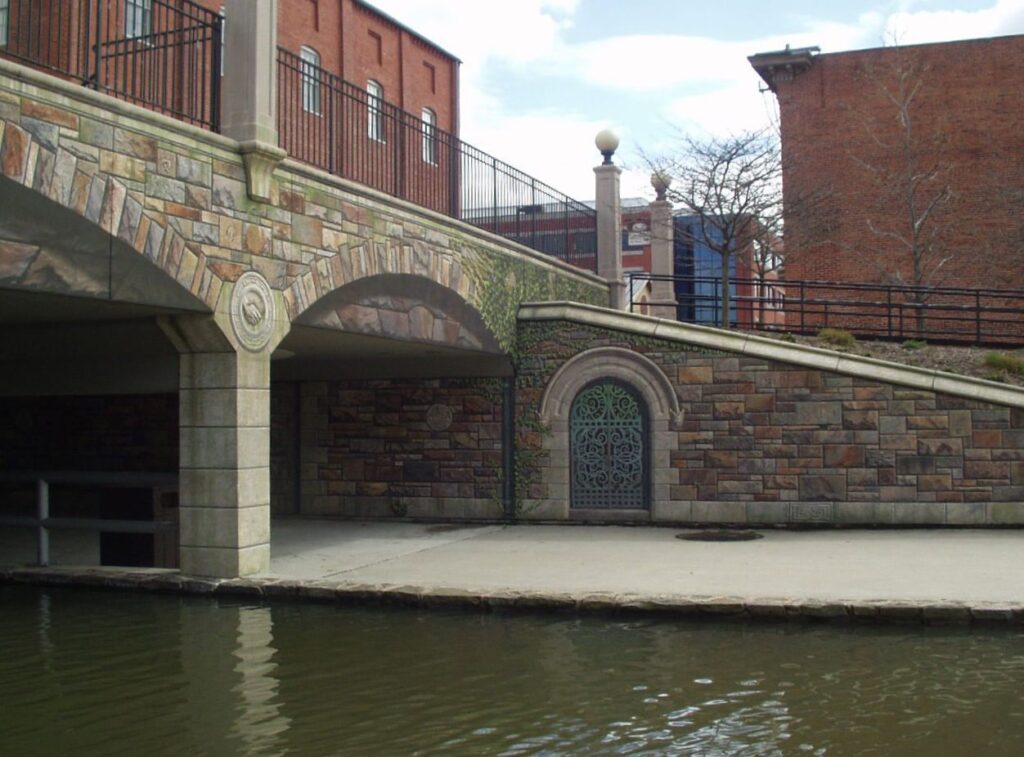
- The Community Bridge. Look closely at the concrete bridge where South Carroll Street crosses the creek: it’s painted to look like an old stone bridge covered in carved symbols, a trompe-l’oeil mural that fools most people until they touch it.
- The east end. Past the bridge, the old factory and warehouse district holds breweries, a distillery or two and restaurants, now one of Frederick’s liveliest corners.
- Everedy Square and Shab Row. Turn north to East Street, where small 19th-century rowhouses hold shops and restaurants.
- Market Street. Walk west to North Market Street, the main shopping and dining street, lined with independent shops, galleries, antique stores and cafes.
- Patrick Street and the museum. At the Square Corner, where Market meets Patrick, turn east for the National Museum of Civil War Medicine at 48 East Patrick Street.
- Church Street and the spires. Walk Church Street for the clustered spires up close, then head west to Baker Park, with its lake, carillon tower and the classic view back to the steeples.
Antiques and shopping
Frederick is a serious antiques town. Downtown’s shops and antique malls hold everything from furniture to vintage clothing, and New Market, a small town about 7 miles east, calls itself the antiques capital of Maryland. Market Street and Carroll Creek add galleries, bookstores, kitchen shops and boutiques. Many shops close by 6 p.m. and open later on Sundays, so do your shopping before dinner.
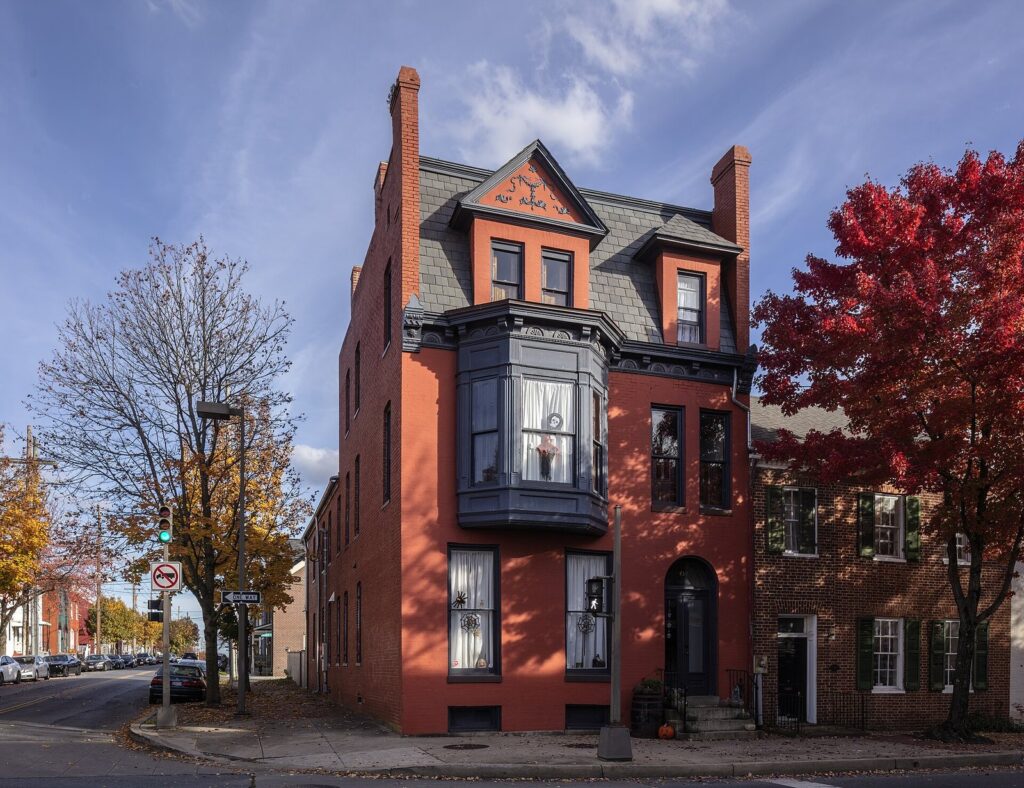
Plan it: walk the creek in the morning, when it’s quiet, shop Market Street at midday, and come back to the creek at dusk, when the patios fill and the lights come on.
Museums and history
National Museum of Civil War Medicine
Frederick’s best museum, at 48 East Patrick Street, tells the story of medical care in the Civil War: field hospitals, surgeons, nurses, embalmers, ambulances and the innovations that came out of the war, in a building that served as an undertaker’s during the conflict. It’s more absorbing and less gruesome than it sounds. Admission is $9.50, and it’s open Monday to Saturday from 10 a.m. to 5 p.m. and Sunday from 11 a.m. to 5 p.m., with last entry at 4:15 p.m.; it closes on New Year’s Day, Easter, Thanksgiving, Christmas Eve and Christmas Day. Allow 90 minutes. See the museum’s site for exhibits and events.
Monocacy National Battlefield
Just south of town, Monocacy preserves the fields where Union troops delayed Jubal Early’s army on July 9, 1864, the “battle that saved Washington.” It’s free, with a visitor center open Thursday to Monday from 9 a.m. to 5 p.m., a driving tour and walking trails along the river. It’s an easy hour or two from downtown, and quieter than the bigger battlefields.
Schifferstadt Architectural Museum
This 1756 stone house, built by German settlers, is one of the oldest buildings in Frederick and a rare survivor of colonial German architecture, with a vaulted cellar and original ironwork. It’s open for walk-in visits on Saturdays and Sundays from 2 to 5 p.m., mainly from April to December.
Mount Olivet Cemetery
South of downtown, Mount Olivet holds the graves of Francis Scott Key, author of “The Star-Spangled Banner,” and Barbara Frietchie, plus a large section of Confederate dead from the nearby battles. It’s free to walk and peaceful.
More history stops
Heritage Frederick, the county historical society, runs a museum on East Church Street that covers the county’s story from its German settlers onward; check its current hours. The Barbara Fritchie House on West Patrick Street is a reconstruction of the home of the woman in Whittier’s poem; its opening days vary, so look before you go. And a short drive south of downtown, Rose Hill Manor Park, the former home of Maryland’s first elected governor, Thomas Johnson, is a county park with farm museums that appeal to children.
A Civil War driving loop from Frederick
Frederick sits at the center of the 1862 Maryland Campaign and the 1864 raid on Washington, and a single day’s drive links the key sites.
- Frederick: start at the National Museum of Civil War Medicine, where the story of the wounded who filled the town’s churches and warehouses sets up everything else. Near Frederick, in September 1862, Union soldiers found a copy of Robert E. Lee’s battle orders wrapped around cigars, the famous “Lost Order” that tipped off the Union army to Lee’s plans.
- South Mountain: drive west over the ridge to the gaps where the two armies fought on September 14, 1862, three days before Antietam.
- Antietam: continue to Sharpsburg for the battlefield of September 17, 1862, the bloodiest single day in American history. Budget two to three hours for the visitor center and the driving tour.
- Harpers Ferry: if time allows, drive on to the West Virginia town that changed hands repeatedly during the war, remembering that the footbridge from the Maryland side is closed.
- Monocacy: finish back south of Frederick at the site of the July 9, 1864 battle that delayed Jubal Early’s march on Washington.
Most visitors split this over two days, with Antietam and South Mountain on one and Frederick and Monocacy on the other. For Gettysburg, allow a separate day.
Where to eat in Frederick
Frederick’s restaurant scene is its biggest draw after the scenery. The historic district packs in more good independent restaurants than towns twice its size, and the county’s farms and orchards supply many of them.
- Brewer’s Alley, at 124 North Market Street, has been Frederick’s brewpub since 1996, pouring its own beer with American pub food in a historic building.
- Isabella’s Taverna and Tapas Bar, on North Market Street, serves Spanish small plates with sidewalk seating.
- The Tasting Room, at 101 North Market Street, pairs regional dishes with a wine and martini bar.
- Carroll Creek patios, Everedy Square and the East End breweries add everything from tacos and ramen to barbecue and pizza.
Coffee, bakeries and breakfast
Downtown’s cafes, bakeries and brunch spots are part of the weekend ritual, and many open early enough for a coffee before a walk along the creek. Weekend brunch is busy, so arrive before 10 a.m. or expect a wait. For picnic supplies before a hike in the Catoctins, stock up downtown or at a farm market on the way north.
Food and drink tours
Guided walking tours pair downtown history with tastings at restaurants, bakeries and breweries, and they’re a good way to sample several places in one afternoon. Visit Frederick lists current tasting, history and ghost tours; most run on weekends and book up in the fall.
What to eat in Frederick, Maryland
Frederick doesn’t have one signature dish the way Baltimore has crab cakes. Its strength is range and freshness: farm-to-table menus built on Frederick County produce, orchard fruit and dairy; brewery food trucks and gastropubs; ethnic restaurants from all over; and Maryland staples like crab cakes on most menus. In season, stop at a farm stand or orchard on the way in or out; apples, peaches, berries and pumpkins are all county crops.
Plan it: book dinner on Friday and Saturday nights, when the best tables go early, and do a brewery or two in the afternoon, when taprooms are quieter.
Breweries, distilleries and wineries
Frederick and its county have dozens of breweries, wineries and distilleries within about 20 miles, and Frederick hosts the annual Maryland Craft Beer Festival, with more than 50 Maryland breweries.
- The Carroll Creek brewing district: a cluster of breweries in the former factory district on the east side of downtown, all walkable from one another.
- Rockwell Brewery: its Riverside taproom, opened in May 2023, is billed as the largest in Frederick, with live music on weekends.
- Monocacy Brewing Company and Attaboy Beer, two of the city’s popular taprooms.
- Brewer’s Alley, the original brewpub on Market Street.
A note on Flying Dog: the brand that made Frederick famous among beer drinkers stopped brewing in Frederick in August 2023, when production moved to FX Matt Brewing in New York. Its new owners have talked about opening a Frederick taproom, but none was open as of September 2026, so skip any guide that still sends you to the Flying Dog tour.
Frederick County’s wineries are scattered through the countryside, many with tasting rooms, lawns and views of the mountains, and they’re best visited with a designated driver. Distilleries in and around downtown pour local spirits.
Arts, music and nightlife
Frederick punches above its weight culturally. The Weinberg Center for the Arts, in a restored 1920s movie palace on West Patrick Street, hosts concerts, films, comedy and touring shows. The Delaplaine Arts Center, in a converted mill building on Carroll Creek, has free galleries of regional art and classes. Public art turns up everywhere: murals, sculptures along the creek and the Community Bridge’s painted stonework.
After dark, downtown Frederick is lively but relaxed. The Carroll Creek breweries and downtown bars fill on Friday and Saturday nights, a few places host live music most weekends, and the creek’s patios stay busy until late in warm weather. It’s more of a long-dinner-and-a-nightcap town than a club town, and most of the action winds down by midnight.
Where to stay in Frederick MD
- Downtown: a small number of hotels and historic inns put you within walking distance of restaurants, bars and Carroll Creek. They’re the best choice if you want to park once and walk all weekend.
- Near I-270 and US 15: chain hotels on the edge of the city, with free parking and lower rates, about 10 minutes’ drive from downtown.
- Bed-and-breakfasts: in historic houses downtown and farmhouses around the county, good for couples.
- In the mountains: cabins and campsites around Catoctin Mountain Park, Cunningham Falls State Park and Thurmont, for a woodsy weekend 20 minutes north.
Where to stay in Frederick MD with family
Families usually do best at the suite hotels near I-270 and US 15, with kitchens or kitchenettes, pools, free parking and easy access to both downtown and the mountains. For a more outdoorsy trip, a cabin near Thurmont puts Catoctin’s trails and Cunningham Falls’ summer beach a few minutes away.
Budget for 11% in taxes: Frederick County’s 5% room tax plus Maryland’s 6% sales tax. Rates rise on weekends in October, when Colorfest and the fall color draw crowds, and during big university and county events. Weeknights are the best value.
Booking tips
For fall weekends, especially Colorfest weekend and the peak-color Saturdays in mid-October, book a room a month or more ahead, and expect higher weekend rates. For the rest of the year, a few weeks’ notice is usually enough, and weeknights are often much cheaper than Friday and Saturday. If you’re driving from Washington, a hotel near I-270 makes the Friday-evening arrival easier; if you’re coming for the restaurants and breweries, pay a little more to stay downtown and walk.
Catoctin Mountain Park and Cunningham Falls
About 20 minutes north of downtown, near Thurmont, the Catoctin Mountains rise from the farmland, the easternmost ridge of the Blue Ridge in Maryland. Two parks share them: Catoctin Mountain Park, run by the National Park Service, and Cunningham Falls State Park, run by the state.
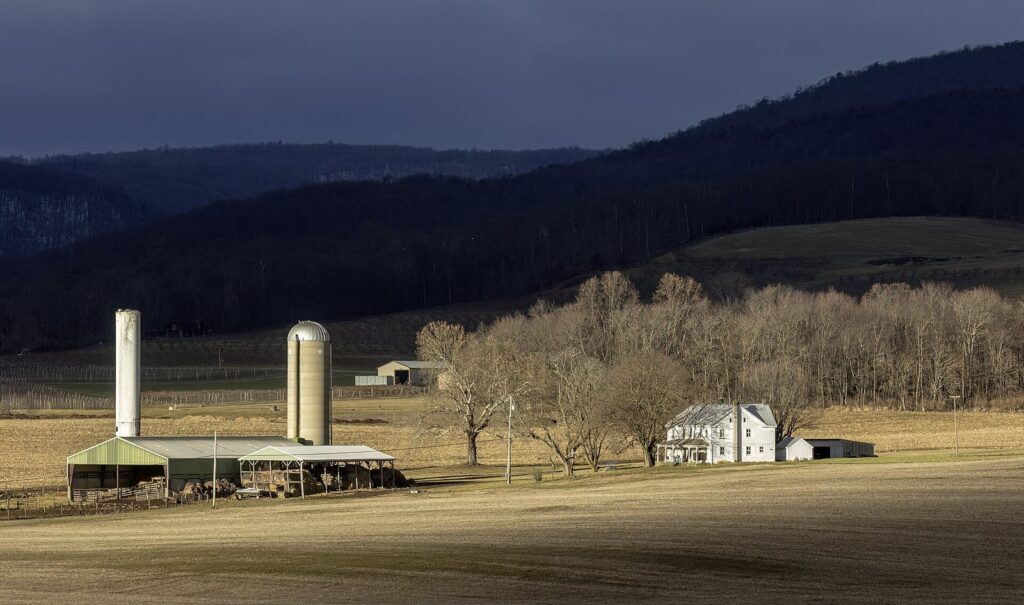
Catoctin Mountain Park
Catoctin Mountain Park is free, with a visitor center open daily from 9 a.m. to 4:30 p.m., and it logged 460,857 visits in 2025. It’s a hiker’s park: trails climb to rocky viewpoints like Chimney Rock and Wolf Rock, wind through hardwood forest, and connect to Cunningham Falls. The park started as a New Deal recreation area, and its historic cabin camps still host overnight stays.
It’s also home to Camp David, the presidential retreat, which sits inside the park, unmarked and closed to the public. You won’t see it, you won’t find it on park maps, and you shouldn’t try to get close.
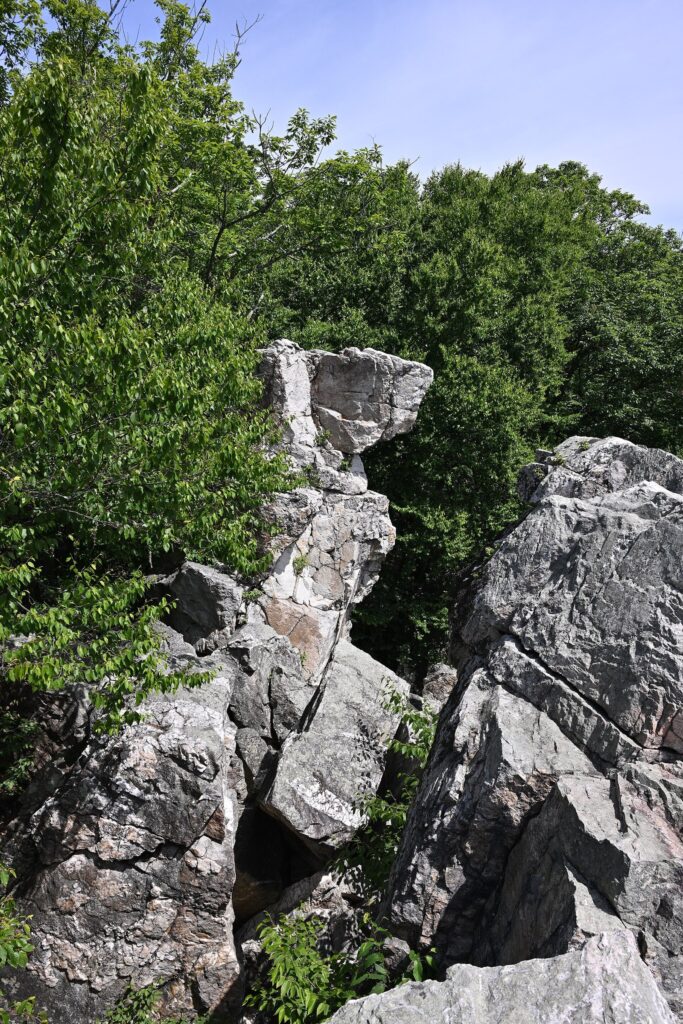
Cunningham Falls State Park
Next door, Cunningham Falls State Park is named for its waterfall, a long cascade over rock that’s among the tallest in Maryland, reached by a short trail. The park also has a lake with a sandy beach, boat rentals and a campground. It charges a day-use fee and its lake area can fill on summer weekends, so come early or on a weekday.
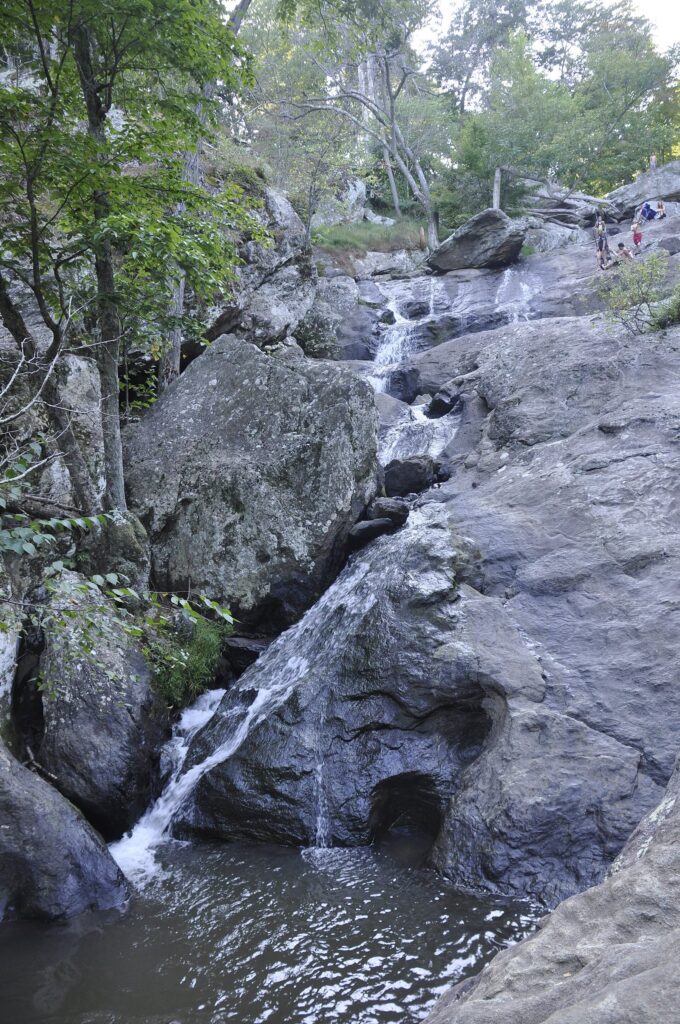
Plan it: hike Catoctin Mountain Park in the morning (Wolf Rock and Chimney Rock make a good loop), then drop down to Cunningham Falls for the waterfall and, in summer, a swim. Stop at the park visitor center first for maps and trail conditions. For fall color, mid-October is usually best.
Thurmont and Emmitsburg
Thurmont and Colorfest
Thurmont, the small town at the foot of the mountains, is the gateway to both parks, with diners, orchards and farm markets nearby. Every October it hosts Catoctin Colorfest, a huge arts and crafts show that fills the town; in 2026 it runs on October 10 and 11. It’s a fun day if you like crafts and fair food, but traffic and parking are intense, so arrive early, or visit the parks on a different weekend if you’re there for hiking.
Emmitsburg
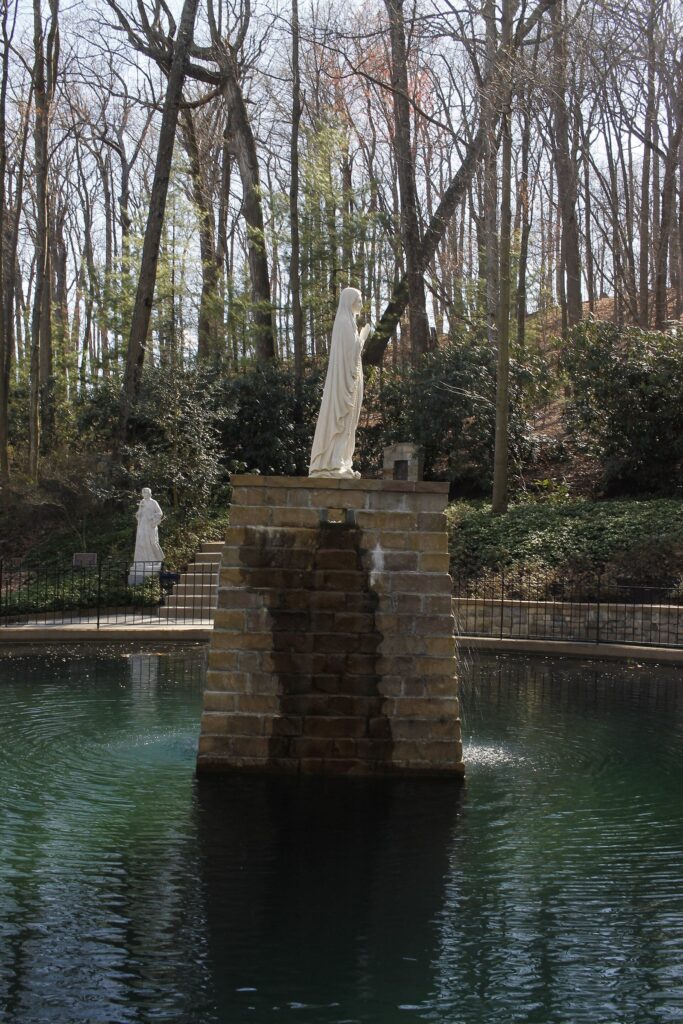
Emmitsburg, near the Pennsylvania line, has two Catholic shrines that draw pilgrims and curious visitors alike. The National Shrine Grotto of Lourdes, on the mountainside above Mount St. Mary’s University, is a quiet wooded grotto with statues, gardens and a replica of the Lourdes grotto. The National Shrine of St. Elizabeth Ann Seton honors the first American-born saint, who founded her Sisters of Charity here. Both are peaceful stops on the way to or from Gettysburg, just across the state line; check their websites for visiting hours.
Orchards, farms and the countryside
Frederick County is one of Maryland’s biggest farming counties, and the countryside is part of the trip. In summer and fall, orchards and farms around Thurmont, Emmitsburg, Middletown and the eastern county open for pick-your-own berries, peaches, apples and pumpkins, and roadside markets sell produce, cider, preserves and baked goods. Many have fall weekend festivals with hayrides and corn mazes. Seasons and hours vary by farm and by harvest, so check each farm’s own schedule before you drive.
The county’s wineries sit in the same countryside, many with tasting rooms, picnic lawns and mountain views, and several distilleries and cideries have joined them. Combine a farm stop and a tasting with a drive over the Catoctin or South Mountain ridges, and you have one of the best autumn Saturdays in Maryland. Pick a designated driver, or book a tour.
More hiking and biking near Frederick
Beyond Catoctin, the ridges west of Frederick hold more trails:
- Gambrill State Park, on Catoctin Mountain just west of the city, has overlooks and a network of wooded trails, the closest real hiking to downtown.
- The Appalachian Trail runs along South Mountain west of Frederick for about 40 miles through Maryland, with easy day hikes to viewpoints and to Washington Monument State Park, home of the first monument to George Washington, near Boonsboro.
- South Mountain State Battlefield, where Union and Confederate troops fought for the mountain passes in September 1862, days before Antietam.
- Sugarloaf Mountain, south of the city, with short climbs to rocky summits and views over the Potomac valley.
For cycling, the C&O Canal towpath follows the Potomac a short drive southwest of Frederick, flat and car-free for 184.5 miles between Washington and Cumberland; the stretches around Point of Rocks and Brunswick make easy out-and-back rides. Road cyclists love the county’s rolling farm lanes and the long climbs over the Catoctin ridge.
Seasons and events in Frederick
| Season | What’s on | Worth knowing |
|---|---|---|
| Spring (March to May) | Blossoms, gardens, ghost tours start in May | Pleasant walking weather; fewer crowds |
| Summer (June to August) | Patio season on Carroll Creek, Cunningham Falls beach | Hot and humid; mountains are cooler |
| Fall (September to November) | The Great Frederick Fair (mid-to-late September; Sept 18 to 26 in 2026), Colorfest (Oct 10 to 11, 2026), fall color, ghost tours | The busiest and most beautiful season; book October weekends early |
| Winter (December to February) | Holiday lights and shopping downtown | Quiet and cheaper; some mountain facilities close |
The best time to visit Frederick
For most people, mid-September to early November is the sweet spot: comfortable walking weather, harvest at the farms and orchards, color on the Catoctin ridge, and Colorfest and the ghost tours on the calendar. April to June is the next best, with flowering trees along the creek, green mountains and patio season beginning. July and August are hot but lively in the evenings, and January and February are quiet, cold and cheap, good for museums and restaurants rather than hiking.
Spring
Spring brings blossoms to Baker Park and Carroll Creek, the reopening of patios, and waterfalls running full in the Catoctins after winter rain. It’s also when the ghost tours return for their Saturday-night season in May and June. Weekends are pleasant but not yet crowded, and hotels are easier to book than in the fall.
Fall
Fall is Frederick’s best season. The Great Frederick Fair, a traditional county fair, runs for a week and a half in mid-to-late September (check the fair’s site for 2027 dates), Colorfest takes over Thurmont in October, orchards open for picking, and the color in the Catoctins usually peaks in mid-October. Downtown’s patios stay busy through the first cool weeks.
Ghost tours
A town this old and this Civil War-soaked has plenty of stories, and the Ghost Tours of Historic Frederick lead lantern-lit walks through downtown. In 2026 they run on Saturday evenings from May 2 to June 27 (8 to 9:30 p.m.) and November 14 to 28 (7 to 8:30 p.m.), with Friday and Saturday tours at other times in season. Book ahead in October.
Christmas
From late November, downtown dresses up for the holidays, with lights along Carroll Creek and Market Street, holiday shopping and seasonal events. It’s a cozy, less crowded time to visit, with lower hotel rates outside the weekends.
Winter
Winter is Frederick’s quiet season. Downtown’s holiday lights and shopping carry it through December, and January and February bring the lowest hotel rates, easy restaurant reservations and museums to yourself. In the Catoctins, a dusting of snow makes the forest beautiful, but trails and park roads can be icy, and some facilities keep reduced winter hours, so check with the park before you drive up.
Is Frederick MD worth visiting in July?
Yes, with realistic expectations. July is hot and humid, but downtown comes alive in the evenings, when Carroll Creek’s patios fill and the breweries throw their doors open. Do outdoor walking early, save the afternoon heat for the museum or a taproom, and head up to the Catoctin Mountains, where the shade and elevation make hiking bearable, or to Cunningham Falls’ lake for a swim.
Frederick on a rainy day
Frederick handles bad weather well, because so much of it is indoors and close together:
- The National Museum of Civil War Medicine, 90 minutes under a roof.
- Heritage Frederick, the county historical society’s museum, for local history.
- The antique shops and malls downtown and in New Market, easily a whole afternoon.
- The Delaplaine Arts Center‘s free galleries on Carroll Creek.
- A show or film at the Weinberg Center for the Arts.
- A brewery or distillery crawl in the East End, a short, covered dash between taprooms.
- A long lunch on Market Street.
Save Catoctin, Cunningham Falls and Monocacy’s trails for a dry day; the rocks on the mountain trails get slippery in the wet.
Frederick for couples
Frederick makes an easy romantic weekend within an hour of Washington and Baltimore. Stay downtown or at a bed-and-breakfast in a historic house, walk Carroll Creek at dusk when the lights come on, and book a tasting-menu dinner or a tapas bar on Market Street. The next morning, drive up to the Catoctins for a hike to a rocky overlook, stop at an orchard or a winery on the way back, and finish with a brewery flight on the creek. In the fall, add a lantern-lit ghost tour; in December, the downtown holiday lights.
Accessibility
Downtown Frederick is one of the easier historic towns in Maryland to get around. The Carroll Creek promenade is largely level with paved paths, many Market Street shops have street-level entrances, and the city garages have elevators. Brick sidewalks are uneven in places, and some older buildings have steps at the door. In the mountains, the Catoctin Mountain Park visitor center is accessible, but most trails to the viewpoints are rocky and steep; ask rangers about the easiest options. The Monocacy battlefield’s driving tour lets you see the main sites from the car.
Getting to Frederick
| From | Distance | Drive, no traffic |
|---|---|---|
| Baltimore | 50 miles | About 55 minutes to 1 hour 5 minutes |
| Washington, DC | 49 to 56 miles | About 1 hour to 1 hour 15 minutes |
| Harrisburg, PA | 73 miles | About 1 hour 25 minutes to 1 hour 40 minutes |
| Wilmington, DE | 121 to 122 miles | About 2 hours 5 minutes to 2 hours 30 minutes |
| Richmond, VA | 150 to 152 miles | About 2 hours 35 minutes to 3 hours |
| Philadelphia | 149 to 153 miles | About 2 hours 40 minutes to 3 hours 10 minutes |
| Pittsburgh | 202 to 203 miles | About 3 hours 25 minutes to 4 hours |
| New York City | 240 to 241 miles | About 4 hours to 5 hours |
From Washington, I-270 runs straight to Frederick, and from Baltimore, I-70 does the same. Both carry heavy commuter traffic on weekday mornings and evenings, and I-270 can add half an hour or more at rush hour, so aim to drive mid-morning or after 7 p.m. Thurmont and the Catoctin parks are about 20 minutes north of Frederick on US 15.
By train
MARC’s Brunswick Line serves Frederick from Washington’s Union Station, but on weekdays only; there are no weekend trains on the Brunswick or Camden lines, so a weekend visit means driving. There’s no Amtrak service to Frederick.
By air
The nearest major airports are BWI Marshall, Washington Dulles and Reagan National, each roughly an hour or more by car. Frederick’s municipal airport handles general aviation only.
Getting around Frederick
Downtown is walkable, and once you’ve parked you won’t need the car until you leave. The city runs public parking garages close to Carroll Creek and Market Street, which are the easiest option on weekends; street parking fills quickly on Friday and Saturday evenings. For the Catoctin parks, Thurmont, Emmitsburg, Monocacy and the wineries, you’ll need a car. Ride-shares work downtown and for brewery hopping.
On foot, by bike and after dark
Walking is the way to see downtown: from Baker Park in the west to the East End breweries is roughly a half-hour stroll along the creek, and nearly every restaurant is within a few blocks of Market Street. Cyclists will find the creek path pleasant but short; for real rides, drive or pedal out to the C&O towpath or the farm roads. After a brewery crawl, don’t drive: downtown is well served by ride-shares and taxis on weekend nights, and many visitors book a downtown room precisely so they can walk back.
Frederick with kids
- Baker Park: playgrounds, a lake with ducks, the carillon tower and space to run, a few blocks from Market Street.
- Carroll Creek: a flat stroller-friendly walk with fountains, bridges and ice cream.
- Catoctin Mountain Park: short trails, boulders to scramble on and a free visitor center.
- Cunningham Falls State Park: the waterfall walk and, in summer, the lake beach.
- Farms and orchards: pick-your-own fruit in summer and fall, and pumpkins in October.
- National Museum of Civil War Medicine: best for older children and teens with an interest in history.
With a dog
Frederick is a dog-friendly town by Maryland standards. Leashed dogs are a common sight on the Carroll Creek promenade and in Baker Park, and many brewery and restaurant patios welcome them in good weather. Before heading into the parks, check each one’s pet rules and keep dogs leashed on the trails, especially on the rocky overlooks.
Free and cheap things to do in Frederick
Frederick is an easy city to enjoy on a budget:
- Carroll Creek Park and the Community Bridge.
- Baker Park, the carillon and the view of the spires.
- Monocacy National Battlefield, free, with trails along the river.
- Catoctin Mountain Park, free, with its hiking trails and visitor center.
- Mount Olivet Cemetery, with the graves of Francis Scott Key and Barbara Frietchie.
- The Delaplaine Arts Center‘s galleries.
- Window-shopping on Market Street and in the antique shops.
- Sugarloaf Mountain, free to visit.
Add the $9.50 Civil War medicine museum and a brewery flight, and a full day in Frederick can cost less than lunch in Washington. Park in a city garage rather than risking tickets on the street.
Frederick, Annapolis or Ellicott City?
Frederick often competes with two other historic Maryland towns for a day out from Washington or Baltimore.
| Frederick | Annapolis | Ellicott City | |
|---|---|---|---|
| Feel | Small city, restaurants and breweries, mountains nearby | Colonial capital and sailing town on the water | Old mill town on a steep main street |
| Headline sights | Carroll Creek, Civil War medicine museum, Catoctin | Naval Academy, State House, harbor | Main Street shops and history |
| Best for | Food, beer, hiking, a relaxed weekend | History, boats, crabs | A short half-day of shopping and cafes |
| Time needed | A day to a weekend | A day to a weekend | Half a day |
| From Baltimore, no traffic | About 55 minutes to 1 hour 5 minutes | About 40 to 45 minutes | About 20 minutes |
If you want mountains and a food town, pick Frederick; if you want water and the Navy, Annapolis; for a quick outing close to Baltimore, Ellicott City.
Day trips from Frederick
Frederick is a natural base for western Maryland’s history and scenery:
- Antietam National Battlefield, near Sharpsburg, the site of the bloodiest single day of the Civil War on September 17, 1862: $20 per vehicle for three days, cashless, with the visitor center open daily from 9 a.m. to 5 p.m.
- Harpers Ferry, West Virginia, at the meeting of the Potomac and Shenandoah: $20 per vehicle for three days, cashless. The Byron footbridge from the Maryland side has been closed since July 27, 2026, with a shuttle from the C&O Canal’s Lock 34, so plan to drive to the national park’s main entrance.
- Sugarloaf Mountain, a privately owned mountain south of Frederick with trails and views, free to visit.
- New Market, about 7 miles east, for antiques.
- Gettysburg, Pennsylvania, just over the state line beyond Emmitsburg, for the Civil War’s most famous battlefield.
- The wineries scattered across Frederick County’s countryside.
A weekend in Frederick
Friday evening: arrive after the I-270 rush, check in downtown, and have dinner on Market Street or along Carroll Creek.
Saturday morning: walk Carroll Creek and the Community Bridge, then the National Museum of Civil War Medicine when it opens at 10.
Saturday afternoon: Monocacy National Battlefield (Thursday to Monday) or antique shopping downtown and in New Market, then a brewery or two in the Carroll Creek district.
Saturday night: dinner, then a ghost tour in season.
Sunday: drive north to Catoctin Mountain Park for a morning hike to Wolf Rock or Chimney Rock, see Cunningham Falls, lunch in Thurmont, and an orchard or the Emmitsburg shrines on the way home.
A day trip from Washington or Baltimore
- 9:30 a.m.: leave after the morning rush and head up I-270 or I-70.
- 10:45 a.m.: park in a downtown garage and walk Carroll Creek to the Community Bridge.
- 11:30 a.m.: the National Museum of Civil War Medicine.
- 1 p.m.: lunch on Market Street.
- 2:30 p.m.: Monocacy National Battlefield (Thursday to Monday) or a drive north to Catoctin Mountain Park for a short hike.
- 5 p.m.: a brewery in the Carroll Creek district.
- 7 p.m.: dinner downtown, then drive home after the evening rush has cleared.
Practical tips
- Book dinner on weekends. Frederick’s best restaurants fill on Friday and Saturday nights.
- Use the garages. Downtown street parking fills quickly on weekends; the city garages are close to everything.
- Watch the calendar. Monocacy’s visitor center is closed Tuesdays and Wednesdays, and Schifferstadt opens mainly on weekend afternoons.
- Dress for two climates. The Catoctin ridge can be several degrees cooler and windier than downtown.
- Plan for October crowds. Colorfest weekend and peak-color Saturdays bring heavy traffic around Thurmont and full downtown restaurants.
- Carry a little patience on I-270. The commuter corridor is the weak link in any Frederick trip; time your drive around it.
What a Frederick trip costs
| Item | Cost (checked September 2026) |
|---|---|
| National Museum of Civil War Medicine | $9.50 |
| Monocacy National Battlefield | Free |
| Catoctin Mountain Park | Free |
| Cunningham Falls State Park | Day-use fee (higher on summer weekends); check DNR |
| Antietam National Battlefield | $20 per vehicle, 3 days, cashless |
| Harpers Ferry National Historical Park | $20 per vehicle, 3 days, cashless |
| Hotel taxes | 5% county room tax plus 6% state sales tax |
| US residents’ America the Beautiful pass | $80 a year (non-residents $250) |
Frederick is a good-value trip by Mid-Atlantic standards: most of the sights are free, the museum is under $10, and hotels, especially on the edge of town, cost less than in Washington or Annapolis. Food and drink will be your biggest spend.
What to skip
Skip the Flying Dog brewery tour. The Frederick brewery closed in 2023; head to the Carroll Creek breweries instead.
Skip I-270 at rush hour. Drive in mid-morning on Friday or after 7 p.m.
Skip planning a weekend by MARC. The Brunswick Line runs weekdays only.
Skip Colorfest weekend if you’re there to hike. Thurmont’s traffic is intense; hike Catoctin another weekend.
Skip walking to Harpers Ferry across the Potomac. The footbridge has been closed since July 27, 2026.
Skip looking for Camp David. It’s closed, unmarked and not worth the trouble.
Frederick FAQ
Is Frederick MD worth visiting?
Yes. Frederick has one of Maryland’s best historic downtowns, with Carroll Creek Park, independent restaurants, breweries and antique shops, plus the National Museum of Civil War Medicine and the free Monocacy battlefield, all about an hour from Washington and Baltimore. Catoctin Mountain Park and Cunningham Falls are 20 minutes north. It’s best as a weekend, especially in fall.
Is Frederick Maryland worth visiting for a day?
Yes. A day covers Carroll Creek, Market Street, the Civil War medicine museum ($9.50) and dinner downtown, or downtown plus a morning hike in Catoctin Mountain Park. You’ll want a weekend to add Monocacy, the Thurmont area and a brewery crawl without rushing. Avoid I-270’s rush hours on the way in and out.
What to eat in Frederick Maryland?
Frederick’s specialty is variety rather than one dish: farm-to-table menus built on Frederick County produce and orchard fruit, brewpub food at Brewer’s Alley, Spanish tapas at Isabella’s, regional dishes at The Tasting Room, and plenty of Maryland crab cakes. Add a brewery flight along Carroll Creek and a farm-stand stop for apples, peaches or berries in season.
Where to stay in Frederick MD?
Stay downtown in a hotel or historic inn if you want to walk to restaurants and Carroll Creek, at a chain hotel near I-270 or US 15 for lower rates and free parking, or in a cabin near Thurmont for the Catoctin Mountains. Budget for 11% in taxes (5% county plus 6% state), and book October weekends early.
Where to stay in Frederick MD with family?
Suite hotels near I-270 and US 15 suit most families, with kitchens, pools, free parking and quick drives to both downtown and the mountains. For an outdoor weekend, a cabin near Thurmont puts Catoctin Mountain Park’s trails and Cunningham Falls’ summer beach a few minutes away. Downtown inns are better for couples than for young kids.
Is Frederick MD worth visiting as a tourist?
Yes, particularly if you enjoy food, history and the outdoors more than big attractions. Its downtown, Civil War sites and mountains make it one of the best small-city trips in the region, and it’s an easy base for Antietam, Harpers Ferry and Gettysburg. It’s a relaxed, local-feeling place rather than a tourist town.
Is Frederick MD worth visiting in July?
Yes, if you plan around the heat. July evenings on Carroll Creek’s patios and in the breweries are lively, and the Catoctin Mountains offer shade and cooler hiking, plus a lake beach at Cunningham Falls. Walk downtown early, spend the hottest hours in the Civil War medicine museum or a taproom, and book dinner on weekends.
How far is Frederick from Washington, DC?
About 49 to 56 miles, or roughly 1 hour to 1 hour 15 minutes without traffic, via I-270. Rush-hour traffic can add half an hour or more. MARC’s Brunswick Line also connects Washington’s Union Station with Frederick, but only on weekdays, so weekend visitors should drive.
Sources and verification
Every price, date and rule on this page was checked on September 23, 2026 against the organizations listed below. The guide is compiled from those sources; it doesn’t claim first-hand visits.
- Visit Frederick: downtown, breweries, tours and 2024 tourism statistics
- National Museum of Civil War Medicine
- National Park Service: Catoctin Mountain Park and Monocacy National Battlefield
- National Park Service: Antietam fees and Harpers Ferry’s Byron footbridge notice
- Maryland Transit Administration: MARC timetables
- City of Frederick
We also used Frederick County Landmarks Foundation (Schifferstadt), Ghost Tours of Historic Frederick, Catoctin Colorfest, Rockwell Brewery, Brewer’s Alley and other restaurants’ own sites, news reports on Flying Dog Brewery, Maryland DNR (Cunningham Falls), Maryland’s Department of Legislative Services county tax tables and routed drive-time estimates, which are free-flow figures before traffic.
Maryland Tourism Guide is an independent publication. It is not affiliated with Visit Maryland or any agency or business named here, and no one paid to be included.
Photo credits
- Carroll Creek Park (featured image): photo by Acroterion, Wikimedia Commons (CC BY-SA 4.0)
- Hessian Barracks: photo by Acroterion, Wikimedia Commons (CC BY-SA 4.0)
- Carroll Creek promenade: photo by Acroterion, Wikimedia Commons (CC BY-SA 4.0)
- Community Bridge: photo by Stacy, Wikimedia Commons (CC BY-SA 2.0)
- Market Street, Frederick: photo by Acroterion, Wikimedia Commons (CC BY-SA 4.0)
- Catoctin Mountain and farm: photo by Acroterion, Wikimedia Commons (CC BY-SA 4.0)
- Wolf Rock: photo by G. Edward Johnson, Wikimedia Commons (CC BY 4.0)
- Cunningham Falls: photo by Jarek Tuszyński, Wikimedia Commons (CC BY 4.0)
- National Shrine Grotto of Lourdes: photo by Bohemian Baltimore, Wikimedia Commons (CC BY-SA 4.0)
- Baker Park: photo by Jennifer Boyer, Wikimedia Commons (CC BY 2.0)