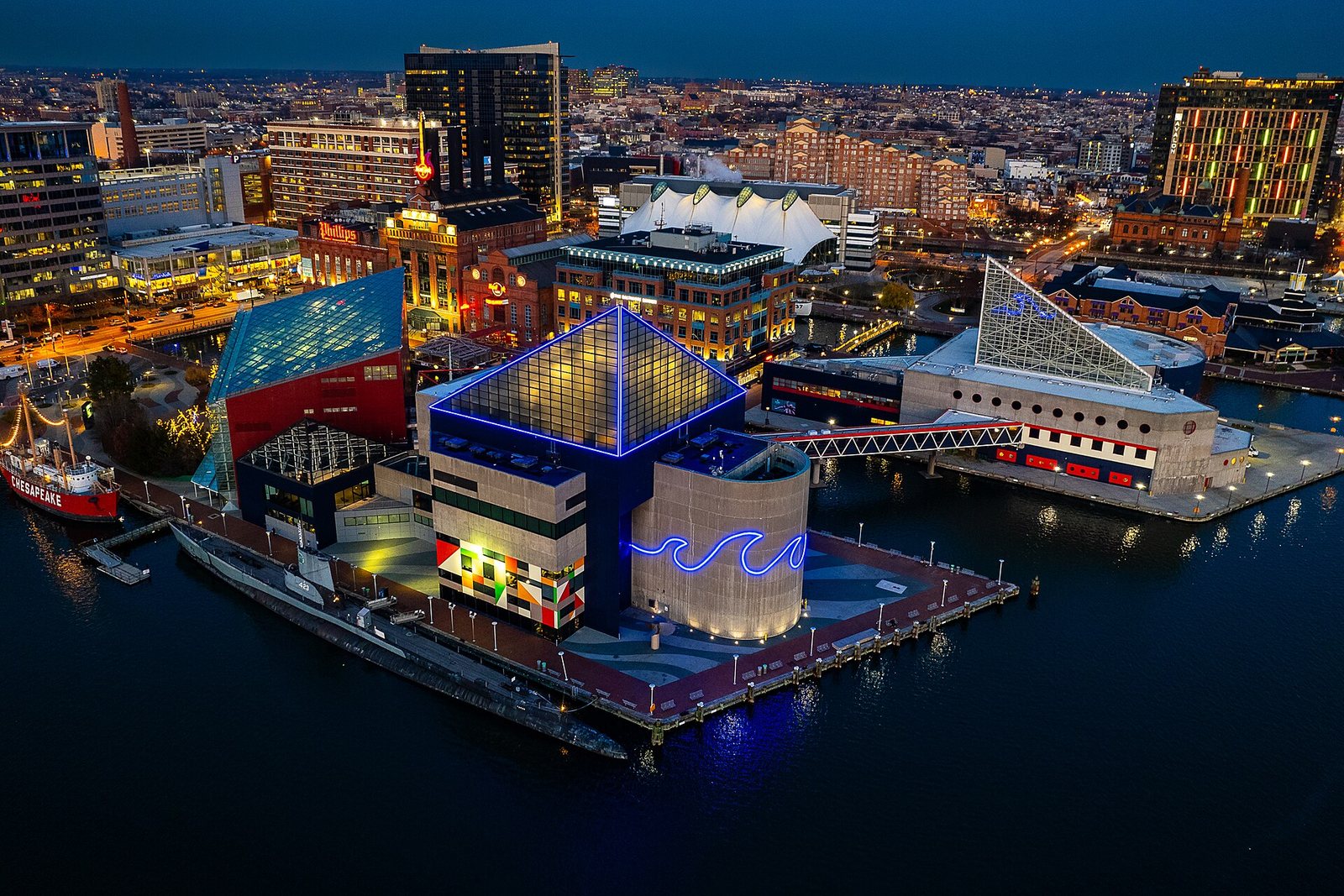
Sixty years ago, the Inner Harbor was a basin of rotting piers and empty warehouses at the edge of downtown. Then Baltimore built a promenade, an aquarium, a science center and a pair of glass-roofed market pavilions, and the formula spread to waterfronts around the world. An Inner Harbor Baltimore visit today still follows that brick promenade around the water: sharks and a rainforest at the National Aquarium, a Civil War-era sloop at the dock, dinosaurs at the Maryland Science Center, and the view from the 27th floor of the World Trade Center. It’s also a waterfront in transition, and it pays to know what’s changed.
The short answer: the Inner Harbor is worth a full day, especially with kids. The big tickets in 2026 are the National Aquarium ($49.95 for adults), the Maryland Science Center ($34.95), Historic Ships in Baltimore ($21.95) and Fort McHenry ($15), a short water-taxi hop away. Getting around is cheap: the Charm City Circulator is free, and the new on-demand water taxi starts at $1 a ride. Harborplace’s pavilions are still open while their redevelopment waits, and the promenade is busy and patrolled into the evening. For the rest of the city, from Fells Point to Hampden, see our guide to things to do in Baltimore.
Every price, date and rule on this page was checked on September 23, 2026 against the operators’ and agencies’ own websites. Several things changed in 2026 and still trip up older guides: City Cruises, home of the Spirit of Baltimore dinner cruises, left Baltimore on April 25; the water taxi became an on-demand service booked by app; the free Harbor Connector changed its routes on March 2; and the Coast Guard cutter once called Taney now goes by “USCG Cutter 37.”
On this page: At a glance · Is it worth it? · History · Harborplace in 2026 · A walk around the harbor · Attractions and prices · Federal Hill · Sunset spots · Photo spots · Fort McHenry · On the water · Where to eat · Shopping · Next door · Where to stay · Getting there and parking · Is it safe? · Accessibility · Events and fireworks · When to go · Day plans · With kids · Costs · On a budget · What to skip · FAQ
The Inner Harbor at a glance
| Question | Answer (checked September 2026) |
|---|---|
| Where is it? | Downtown Baltimore’s waterfront, at the head of the Patapsco River’s northwest branch, between Federal Hill, Harbor East and the stadiums. |
| Top attractions | National Aquarium ($49.95 adults), Maryland Science Center ($34.95), Historic Ships ($21.95), Top of the World ($8), American Visionary Art Museum ($20). |
| Fort McHenry | $15 for ages 16 and up, cashless; grounds and visitor center free; reach it by water taxi or the free Banner Circulator. |
| Water taxi | On demand through the TransiGo app, from $1 a ride, daily 11 a.m. to 7 p.m.; seasonal weekend Water Trolley $20 adults. |
| Free transport | Charm City Circulator buses; Harbor Connector commuter boats on weekdays. |
| Harborplace | Both pavilions still open with about 30 local tenants; redevelopment delayed by a lawsuit filed Sept 21, 2026. |
| Getting there | About 45 minutes to 1 hour from Washington by car; MARC or Amtrak to Penn Station, or light rail to downtown. |
| Hotel taxes | 9.5% Baltimore City room tax plus Maryland’s 6% sales tax. |
| Big dates | Christmas Village, Nov 21 to Dec 27, 2026; New Year’s Eve fireworks at midnight; July 4 fireworks over the harbor. |
Is the Inner Harbor Baltimore worth visiting?
Yes, for a day, and it’s the obvious base for a first trip to Baltimore. The concentration is the appeal: within a 20-minute walk you have one of the country’s best aquariums, a big hands-on science museum, a fleet of historic warships, an outsider-art museum, a lighthouse and the best free view in the city from Federal Hill. With children, it’s hard to beat anywhere in the Mid-Atlantic, and the water taxi turns getting around into part of the fun.
It’s less rewarding if you’re looking for the Baltimore of neighborhoods, dive bars and crab houses. The Inner Harbor is the city’s front porch: polished, commercial and full of visitors. Harborplace, the market pavilions that once defined it, is half-empty and awaiting redevelopment, and some chain restaurants and souvenir shops feel generic. The fix is simple. Do the harbor’s attractions in the daytime, then take the water taxi or walk the promenade to Fells Point, Harbor East or Federal Hill for dinner.
Verdict: worth a full day for the Aquarium, the Science Center and the ships, and worth staying nearby for a longer Baltimore trip. Pair it with the neighborhoods for the real city.
Go if you have kids, love museums or history, or want Fort McHenry and a boat ride in the same afternoon.
Stay nearby if you’re coming for a game, a convention or a first visit and want to walk everywhere.
Skip the harbor for dinner on a longer trip: the best food is a short walk or water-taxi ride away in Fells Point, Harbor East and Little Italy.
A short history of the Inner Harbor
For two centuries, the Inner Harbor was Baltimore’s working port: ships unloading coffee, sugar and immigrants, warehouses and rail yards crowding the water, and shipyards up the shore in Fells Point. By the mid-20th century, shipping had moved to bigger terminals downriver, and the basin was left with decaying piers and empty buildings on the edge of a struggling downtown.
The turnaround began in the 1960s, when the city started clearing the waterfront and laying out a public promenade. The Maryland Science Center opened in 1976, which is why it celebrates its 50th anniversary in 2026; the World Trade Center followed in 1977; Harborplace opened in 1980; and the National Aquarium in 1981. Crowds came, and cities from Boston to Sydney studied the result. In 2009 the Urban Land Institute called the Inner Harbor “the model for post-industrial waterfront redevelopment around the world.” Four decades on, the city is working out the next chapter, starting with what replaces Harborplace.
Harborplace in 2026: what’s there and what’s next
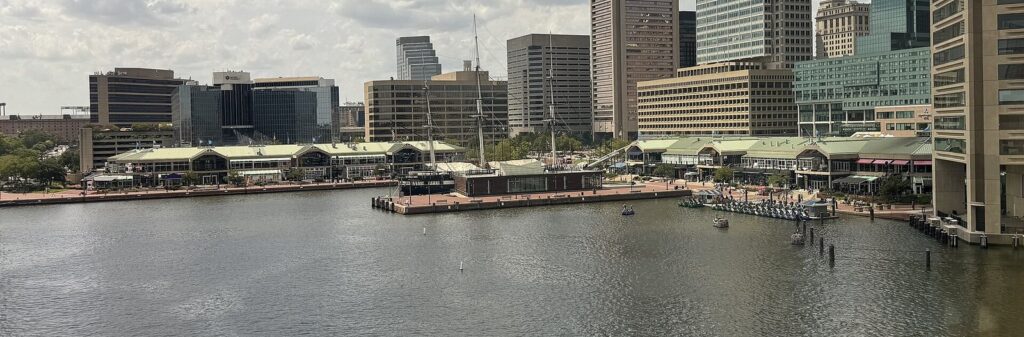
Harborplace’s two pavilions, on Pratt Street and Light Street, opened in 1980 and made the Inner Harbor a destination. By the 2020s they had emptied out, and the city approved a redevelopment plan by a local developer. As of September 2026, both pavilions are still standing with about 30 local tenants, construction was “anticipated to begin before the end of 2026,” and residents filed a lawsuit against the plan on September 21, 2026, according to the project’s own FAQ and local reporting. The pavilions are expected to stay open at least into January 2027.
For visitors, that means two things. First, don’t plan a day around Harborplace itself: it has some food and shops, but it’s not the draw it once was, and anything you read calling it “demolished” is wrong, at least for now. Second, expect construction fencing and changes around the Pratt and Light Street corner once work begins. The promenade and the attractions around the harbor stay open either way.
A walk around the harbor
The brick promenade wraps the whole Inner Harbor and continues for miles east through Harbor East, Fells Point and Canton and south toward Locust Point. A good loop, clockwise from the stadiums, takes about an hour without stops and a full day with them:
- Camden Yards and the Convention Center: start west of the harbor, where the light rail and the ballpark are.
- Harborplace and the Light Street corner: the pavilions, the amphitheater and the heart of the waterfront.
- West Shore and the Maryland Science Center: the science museum, with West Shore Park and Rash Field nearby, where Christmas Village sets up in winter.
- Federal Hill: climb the park for the classic skyline view, then drop down to the American Visionary Art Museum at its foot.
- Back along the water: the paddle-boat docks and the USS Constellation at Pier 1.
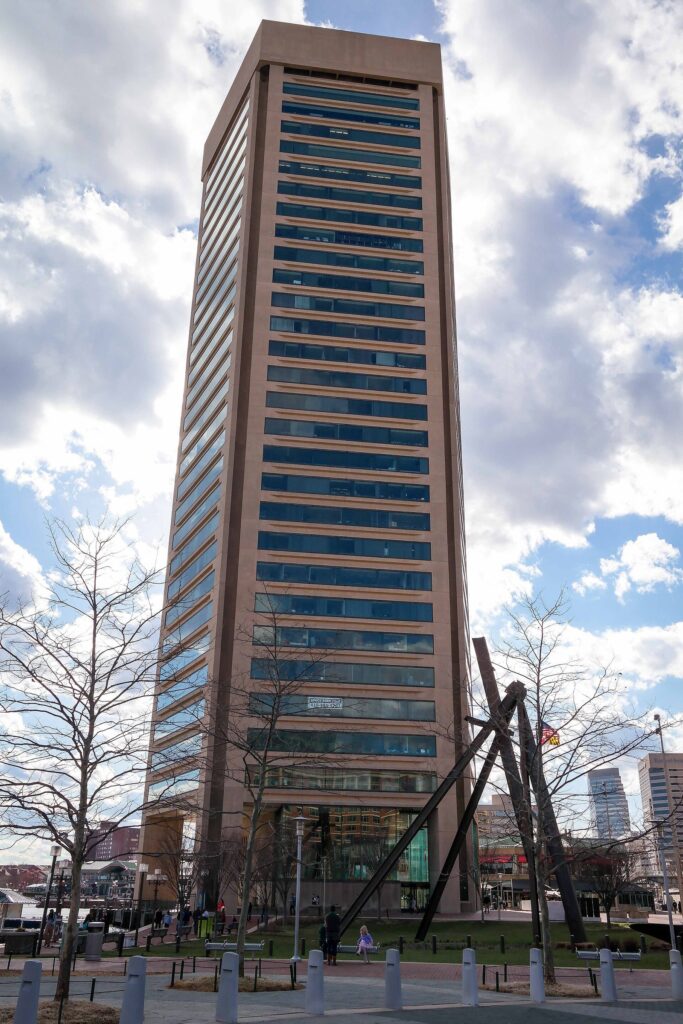
- The World Trade Center: the pentagonal tower on the water, with the Top of the World observation level on the 27th floor.
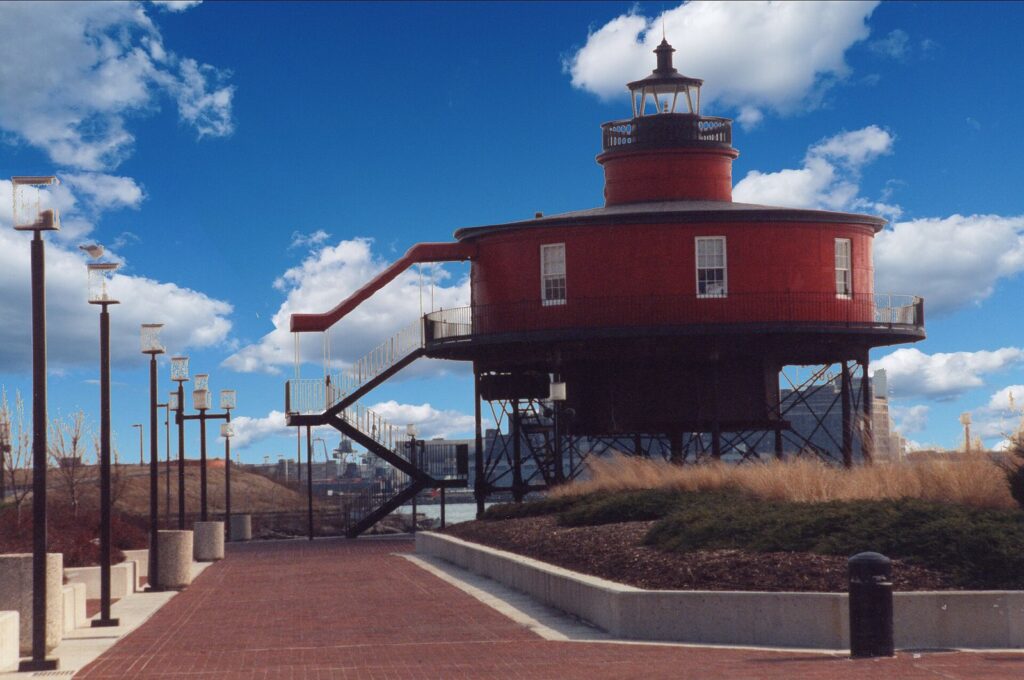
- Piers 3 to 5: the National Aquarium, the submarine and lightship, the Coast Guard cutter and the Seven Foot Knoll Lighthouse.
- Harbor East and beyond: keep walking east for restaurants, and on to Fells Point in about 20 minutes.
Mr. Trash Wheel
Walk the promenade east past the Aquarium toward Harbor East and look for the odd contraption at the mouth of the Jones Falls: a water wheel with a canopy and a pair of giant googly eyes. That’s Mr. Trash Wheel, a solar- and water-powered machine that scoops floating trash out of the stream before it reaches the harbor, and a genuine local celebrity with a family of sibling wheels around the city. It’s free to see from the promenade and a surprisingly good way to explain to kids why the harbor’s water is getting cleaner.
Walking times from the Aquarium
| To | On foot, roughly | Or |
|---|---|---|
| Maryland Science Center | 10 to 15 minutes along the promenade | Circulator |
| Harbor East and Little Italy | About 10 minutes | Walk |
| Federal Hill Park | About 20 minutes | Walk |
| Camden Yards | 15 to 20 minutes | Circulator, light rail |
| Fells Point | About 20 to 25 minutes | Water taxi, Circulator |
| Penn Station | About 35 minutes | Circulator, light rail |
| Fort McHenry | Too far for most | Water taxi, Banner Circulator |
Inner Harbor attractions and 2026 prices
| Attraction | Adult price (2026) | Other tickets | Allow |
|---|---|---|---|
| National Aquarium | $49.95 | $39.95 ages 5 to 20 and 70+; under 5 free; Friday 5 to 9 p.m. $24.95 | 2.5 to 3 hours |
| Maryland Science Center | $34.95 | $26.95 ages 3 to 12; $33.95 seniors; closed Mondays | 3 hours |
| Historic Ships in Baltimore | $21.95 | $19.95 seniors, military, students; $9.95 ages 6 to 14 | 1.5 to 2 hours |
| Top of the World Observation Level | $8 | $6 seniors; $5 ages 3 to 12; open Wednesday to Sunday | 45 minutes |
| American Visionary Art Museum | $20 | Check for reduced rates | 2 hours |
| Port Discovery Children’s Museum | $25.95 | Near the harbor, on Market Place | 2 to 3 hours |
| Reginald F. Lewis Museum | $15 | Harbor East | 1.5 hours |
| Star-Spangled Banner Flag House | $9 | Jonestown, near Little Italy | 1 hour |
| Fort McHenry | $15 (ages 16+) | Under 16 free; grounds and visitor center free | 2 hours |
| Paddle boats | $25 per 30 minutes | Electric pirate boats $40 per 30 minutes | 30 to 60 minutes |
National Aquarium
The Aquarium spans two piers and drew about 1.1 million guests in 2025. Its highlights include a multi-level Atlantic coral reef, an open-ocean shark exhibit, a rooftop rainforest under a glass pyramid, jellyfish, an Australian river gorge and the dolphins, which are still in Baltimore while the long-discussed move to an ocean sanctuary awaits a site. Adults (21 to 69) pay $49.95, youth (5 to 20) and seniors (70 and over) $39.95, and under-5s are free. The Friday night session, 5 to 9 p.m., costs half price, $24.95. Buy tickets ahead on the Aquarium’s site, arrive at opening or on a Friday evening, and allow two and a half to three hours.
Tips for the Aquarium
- Go early or late. The first hour after opening and the half-price Friday evening session are the calmest times; late morning and early afternoon on weekends, school holidays and rainy days are the busiest.
- Follow the route. The main building is laid out as a one-way climb up through the exhibits to the rainforest at the top, then down by ramps past the shark tanks; allow time rather than rushing the upper floors.
- Save the dolphins for last, in the connected pavilion across the bridge, and check the day’s schedule for talks and feeding times.
- Bring layers. The rainforest is hot and humid, and the galleries below are cool.
- Plan a break. Three hours of glass and crowds tire out small children; the promenade outside is the easiest place to reset.
Maryland Science Center
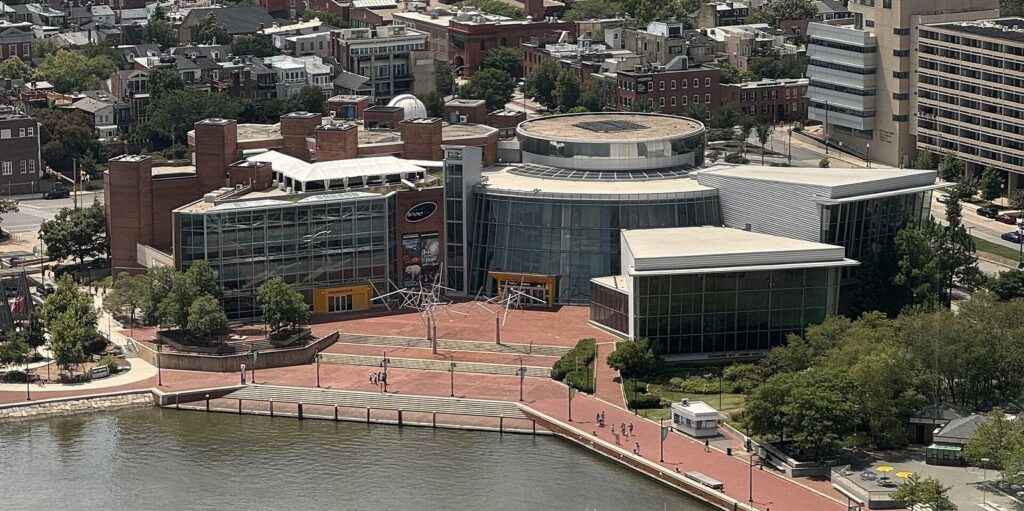
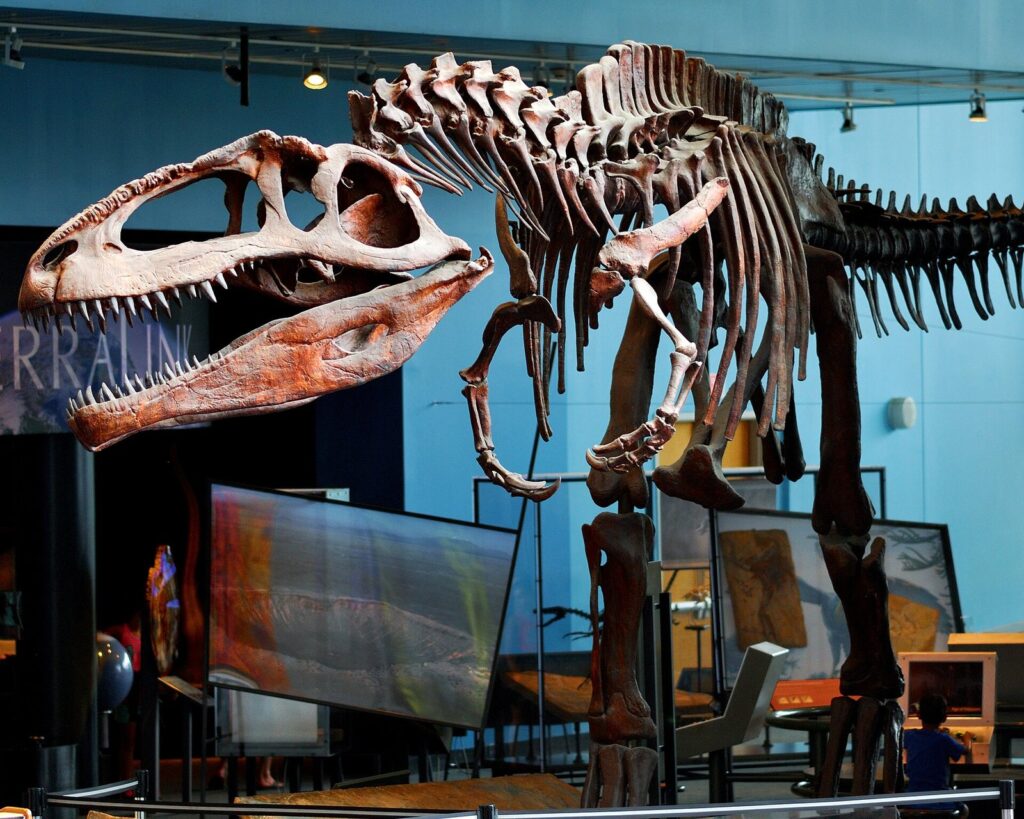
On the harbor’s west shore, the Science Center celebrates its 50th anniversary in 2026 with three floors of hands-on exhibits, a dinosaur hall, a planetarium and a large-format film screen. Adults pay $34.95, children 3 to 12 $26.95 and seniors $33.95, and it’s closed on Mondays. It’s the best rainy-day option at the harbor and a natural pair with the Aquarium on a two-day visit.
Historic Ships in Baltimore
Four historic vessels and a lighthouse make up this floating museum. The USS Constellation, an 1854 sloop-of-war and the last sail-powered warship built by the US Navy, is at Pier 1. Around the Aquarium you’ll find the World War II submarine Torsk, the lightship Chesapeake, and the Coast Guard cutter that served at Pearl Harbor, now called “USCG Cutter 37” rather than the Taney of older guides. The Seven Foot Knoll Lighthouse, an 1850s screwpile light moved to the waterfront, stands at Pier 5. Tickets are $21.95 for adults, $19.95 for seniors, military and students, and $9.95 for ages 6 to 14.
Top of the World Observation Level
The observation level on the 27th floor of the Baltimore World Trade Center, the pentagonal tower on the water, has the best paid view in the city: the harbor, the stadiums, Fort McHenry and out toward the harbor mouth. Its future looked uncertain in 2026 when the landlord moved to end its lease, but city leaders announced it’s staying open for years to come, run with the Living Classrooms Foundation. It opens Wednesday to Sunday; tickets cost $8 for adults, $6 for seniors and $5 for ages 3 to 12.
American Visionary Art Museum
At the foot of Federal Hill, AVAM shows the work of self-taught artists, from huge whirligigs to intricate sculptures, in a building covered in mosaics. It’s one of the most original museums in the country. Adults pay $20. Allow two hours, then climb the hill behind it for the view.
Port Discovery, the Flag House and the Reginald F. Lewis Museum
Just north and east of the harbor, three more museums round out a longer visit. Port Discovery Children’s Museum ($25.95) fills three floors with climbing, building and play for young kids. The Star-Spangled Banner Flag House ($9) is the home of Mary Pickersgill, who sewed the giant flag that flew over Fort McHenry. And the Reginald F. Lewis Museum ($15), in Harbor East, covers Maryland’s African American history and culture.
Federal Hill Park: the free view
Climb the steps of Federal Hill Park, on the harbor’s south side, and the whole Inner Harbor opens up below you: the Science Center, the Aquarium’s pyramids, the World Trade Center, the downtown towers and the boats in the basin. It’s the best free view in the city, and at sunset or after dark, when the skyline lights up, it’s one of the best in the state. The hill has history too: Union troops fortified it during the Civil War and trained their guns on the city, a reminder of how divided Baltimore was. The park has benches, paths and grass for a picnic, and the neighborhood’s bars and restaurants are a block away.
Where to watch the sunset
At sunset the downtown towers catch the last light, the water turns gold, and then the skyline lights up across the basin. The best spots to watch:
- Federal Hill Park: the classic panorama, free, with the whole basin below you.
- Top of the World: 27 floors up, Wednesday to Sunday, with the city spread out on every side.
- The promenade by the World Trade Center and Pier 5: at water level, with the ships and the Seven Foot Knoll Lighthouse in the foreground.
- On the water: an evening water taxi or a City Lights cruise, as the towers light up.
Photo spots
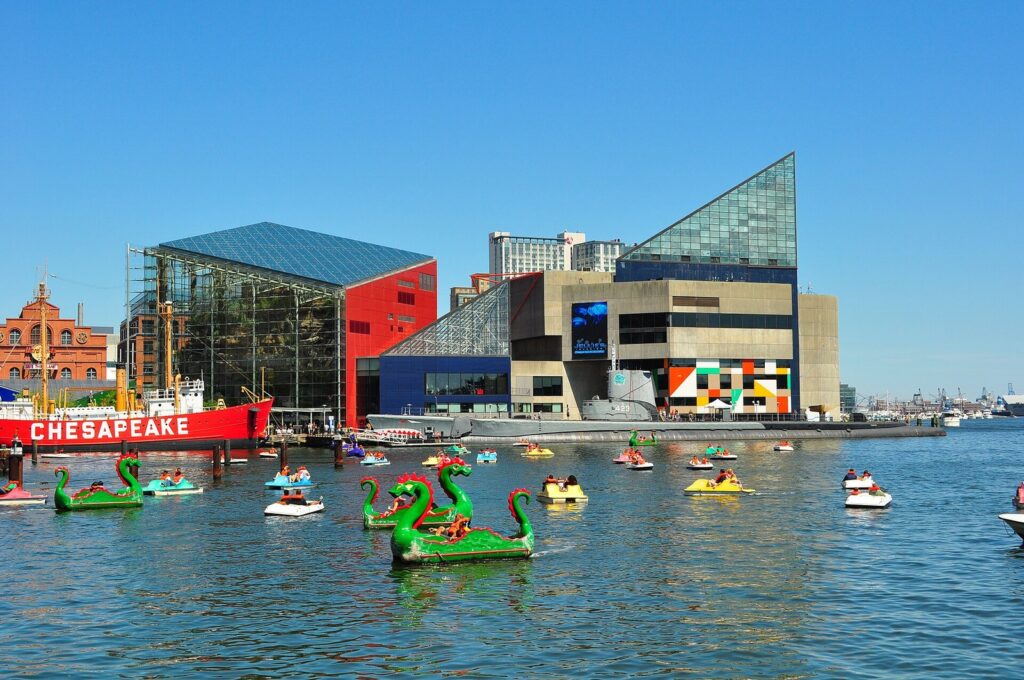
The Inner Harbor is one of the most photographed places in Maryland, and a few spots do most of the work. From the top of Federal Hill Park, you get the classic wide shot of the basin and skyline. At water level, the promenade by the Aquarium frames the glass pyramids with the red lightship Chesapeake in front, and the dragon paddle boats add color in summer. The Seven Foot Knoll Lighthouse and the USS Constellation’s masts make strong foregrounds against the towers, especially in the blue hour after sunset, when the buildings light up and reflect in the water. And from Top of the World, you can shoot the whole harbor from above through the windows, best on a clear day.
Fort McHenry by water taxi or the free Banner route
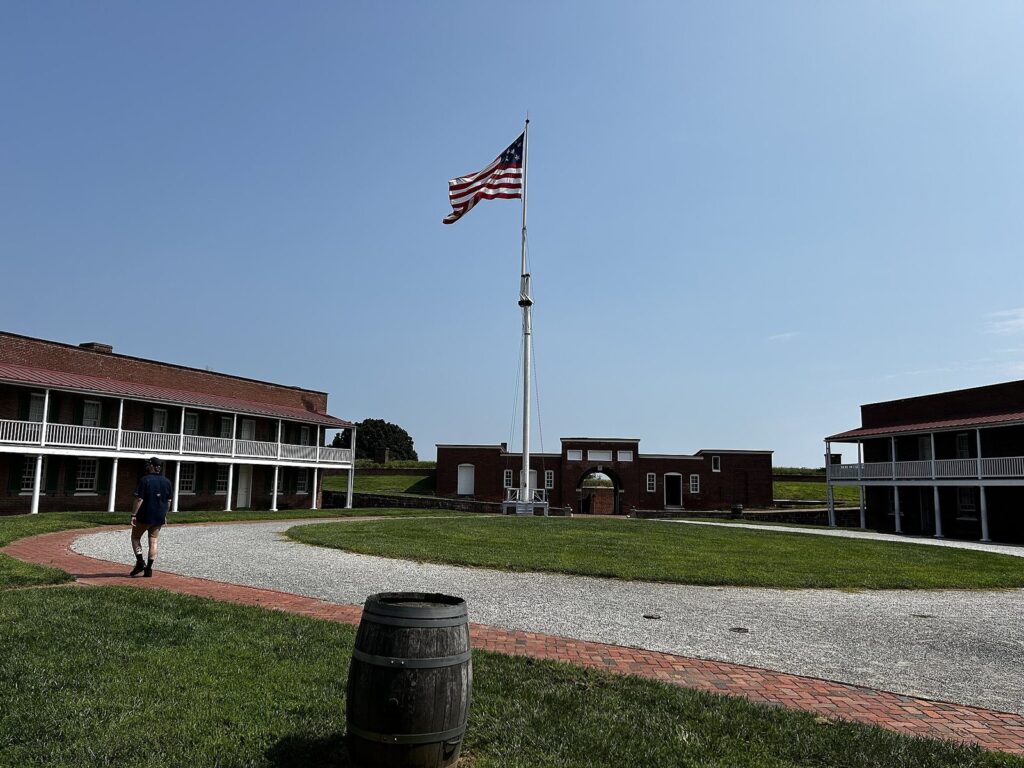
Fort McHenry, where the September 1814 bombardment inspired “The Star-Spangled Banner,” sits at the tip of Locust Point, about three miles by road from the Inner Harbor. The historic fort costs $15 for visitors 16 and over, good for seven days and cashless; the grounds, visitor center and film are free, and under-16s pay nothing. It’s open year-round except Thanksgiving, December 25 and January 1; check the Park Service’s hours for the season.
The story behind the anthem
On the night of September 13 to 14, 1814, a British fleet bombarded Fort McHenry for about 25 hours, trying to force its way into Baltimore’s harbor. Francis Scott Key, a Washington lawyer held aboard a ship downriver during the attack, saw the fort’s giant garrison flag still flying at dawn and wrote the verses that became “The Star-Spangled Banner,” adopted as the national anthem in 1931. The flag itself, sewn by Mary Pickersgill and her helpers in what’s now the Flag House near the harbor, is preserved at the Smithsonian in Washington. Seeing the fort, the Flag House and the harbor in one day ties the story together.
Two car-free ways to get there:
- By water: book the on-demand water taxi through the TransiGo app, or ride the seasonal weekend Water Trolley. It’s the most memorable way to arrive, and the harbor views are part of the visit.
- By bus: the free Charm City Circulator’s Banner route runs from the Inner Harbor through Federal Hill to the fort.
Allow two hours at the fort, including the film. The flag change and ranger talks run on a seasonal schedule, so check what’s on the day you go.
On the water: water taxi, Harbor Connector, cruises and paddle boats
The water taxi
The Baltimore Water Taxi used to run fixed routes with day passes. It now runs on demand: you book through the TransiGo app, rides start at $1, the service covers 10 docks around the harbor, and it operates daily from 11 a.m. to 7 p.m. On weekends in season, the hop-on Baltimore Water Trolley costs $20 for adults and $10 for children 3 to 12. Either way, it’s the best way to link the Inner Harbor with Fells Point, Canton and Fort McHenry.
The free Harbor Connector
The city’s free Harbor Connector boats serve commuters on weekdays. Since March 2, 2026, Route 2 runs a triangle between Canton Waterfront Park, Locust Point and a new stop at Maritime Park in Fells Point during morning and evening peaks, and Route 3 runs every 15 minutes on weekdays from 7 a.m. to 8 p.m. It’s free, but on weekends you’ll need the water taxi.
Harbor cruises
If you remember the Spirit of Baltimore dinner cruises, they’re gone: City Cruises ended all Baltimore operations on April 25, 2026 and moved the ship to Washington. Watermark still runs Cruises on the Bay from the harbor, with 45-minute narrated tours of the Inner Harbor, a Friday evening cruise and one-hour City Lights tours after dark. In Fells Point, Urban Pirates sails its pirate ship, the Relentless, from the Ann Street Pier from April to October, Wednesday to Sunday, with family cruises and adult trips.
Paddle boats
The dragon-headed paddle boats by the historic ships are a classic Inner Harbor photo: $25 for 30 minutes in a Chessie paddle boat that holds up to four, or $40 for 30 minutes in an electric pirate boat for up to six. They’re a Living Classrooms Foundation program, run from Piers 1 to 3 in season, and a good way to see the Aquarium from the water without a ticket.
Where to eat at the Inner Harbor
The harbor’s restaurants lean toward seafood, big-name chains and places with a view. Three reliable names in 2026: Phillips Seafood, a Maryland crab-cake institution; Miss Shirley’s Cafe on Pratt Street, famous for brunch and long weekend waits; and the Rusty Scupper, with water views from across the harbor. For something more local, walk 10 minutes east to Harbor East and Little Italy, or take the water taxi to Fells Point, where the city’s best restaurants and bars are thicker on the ground. Lexington Market, a short light rail ride north, is the place for a classic crab cake.
Plan it: eat breakfast or brunch near the harbor, lunch between attractions, and head to a neighborhood for dinner. On game days and convention weeks, book ahead or eat early.
Shopping at the Inner Harbor
Shopping at the Inner Harbor has thinned out with Harborplace’s decline, and it’s no longer a reason to come. What’s left are the remaining Harborplace shops and food stalls, gift shops at the museums (the Aquarium’s and Science Center’s are good for kids), and a few stores in the buildings along Pratt Street. Harbor East, a short walk away, has the area’s upscale boutiques and national brands, and Fells Point’s independent shops, antiques and record stores are a water-taxi ride away. For edible souvenirs, pick up a tin of crab seasoning or a box of Berger cookies to take home.
Next door: Harbor East, Little Italy and Fells Point
The Inner Harbor’s best feature may be what’s around it. Walk east along the promenade and in 10 minutes you’re in Harbor East, a district of new towers with the area’s best hotels, restaurants and shops. Just north, Little Italy’s rowhouses hold old-school red-sauce restaurants and bakeries. Keep going on the promenade, or take the water taxi, and in about 20 minutes you reach Fells Point, Baltimore’s cobblestoned maritime neighborhood of pubs, shops and waterfront squares. To the south, Federal Hill’s rowhouse streets have bars and a market hall. Our guide to Baltimore’s neighborhoods, museums and food covers them all.
Where to stay at the Inner Harbor
The Inner Harbor has the city’s biggest concentration of hotels, and staying here means you can walk to the Aquarium, the ballparks and the water taxi.
- On the water: big-brand hotels along Pratt and Light streets with harbor views, the most convenient and usually the priciest.
- Near Camden Yards and the Convention Center: good for game days and conventions, a few minutes’ walk from the water.
- Harbor East: newer luxury hotels among restaurants and shops, a short walk east.
- Fells Point: boutique hotels and inns in historic buildings, a water-taxi ride away.
Budget for 15.5% in taxes: Baltimore City’s 9.5% room tax plus Maryland’s 6% sales tax. Rates and parking fees climb on Ravens weekends, big conventions and Preakness weekend, which returns to Pimlico on Sunday, May 23, 2027. Weeknights in winter are the cheapest time to stay.
Getting to the Inner Harbor and parking
By train
Amtrak and MARC’s Penn Line stop at Penn Station, north of Mount Vernon, about a 30-minute walk or a short Circulator or light rail ride from the harbor. MARC costs $9 one way from Washington’s Union Station and $6 from BWI; on weekends, only the Penn Line runs. MARC’s weekday Camden Line ends at Camden Station, next to the ballpark and a few minutes’ walk from the water.
By light rail and bus
Light rail runs from BWI Airport through downtown, with stops by Camden Yards and the Convention Center within walking distance of the harbor. Fares are $2 one way or $4.60 for a day pass. The free Charm City Circulator links the harbor with Penn Station, Mount Vernon, Fells Point, Federal Hill and Fort McHenry, Monday to Thursday 7 a.m. to 8 p.m., Friday to midnight, Saturday 9 a.m. to midnight and Sunday 9 a.m. to 7 p.m.
By car
| From | Distance | Drive, no traffic |
|---|---|---|
| Washington, DC | 37 to 39 miles | About 45 minutes to 1 hour |
| Wilmington, DE | 73 miles | About 1 hour 20 minutes to 1 hour 30 minutes |
| Harrisburg, PA | 80 miles | About 1 hour 30 minutes to 1 hour 45 minutes |
| Philadelphia | 101 to 104 miles | About 1 hour 50 minutes to 2 hours 10 minutes |
| Richmond, VA | 146 to 154 miles | About 2 hours 35 minutes to 3 hours 5 minutes |
| New York City | 192 miles | About 3 hours 15 minutes to 4 hours |
The Key Bridge collapsed in March 2024 and its replacement is targeted for late 2030, so I-695 is closed across the harbor mouth and traffic uses the Fort McHenry and Harbor tunnels. Hazardous-material loads, including propane tanks over 10 pounds on RVs, can’t use either tunnel.
Parking
Garages ring the Inner Harbor, and prices vary widely by operator, time and event: game days, concerts and conventions push rates up sharply. Book a spot ahead through a parking app, choose a garage a few blocks back from Pratt Street for lower rates, or park once at your hotel and walk. On-street meters exist but fill quickly.
Game days and conventions
The Inner Harbor sits between Oriole Park at Camden Yards, M&T Bank Stadium and the Convention Center, so a home game or a big convention changes everything around it. Traffic backs up on Pratt Street, Russell Street and I-395, garage prices climb and restaurants fill before and after events. On those days, take light rail or the Circulator instead of driving, book dinner early, and plan the Aquarium for the morning, before the crowds arrive for an evening game. Check the Orioles, Ravens and Convention Center calendars when you pick your dates.
Is the Baltimore Inner Harbor safe?
For tourists using normal city sense, yes. The Inner Harbor is the busiest, most patrolled part of Baltimore, with crowds from morning into the evening, police and ambassadors on the promenade, and attractions that draw families all day. Citywide, violence has fallen sharply: Baltimore recorded 133 homicides in 2025, the fewest in about 50 years, and nonfatal shootings dropped by about a quarter.
At night
The promenade around the Aquarium, Harbor East and the Light Street side stay lively into the evening in warm weather, especially on weekends and event nights. After the crowds thin out, late at night, stick to the lit, busy stretches, move between neighborhoods by ride-share or water taxi rather than walking long empty blocks, and give a wide berth to rowdy late-night crowds. As anywhere, don’t leave bags or valuables visible in parked cars.
Is the area around the Inner Harbor safe?
The waterfront, Harbor East, Federal Hill and Fells Point are the city’s busiest visitor areas. A few blocks north and west of the harbor, downtown’s office district can feel deserted after business hours; it’s not the same as dangerous, but it’s a reason to plan your route or take the Circulator after dark.
Accessibility
The Inner Harbor is one of the most accessible parts of Baltimore. The promenade around the basin is wide, paved and mostly level, with ramps at the main plazas, and the big attractions, including the Aquarium and the Science Center, are built for strollers and wheelchairs. The historic ships are the exception: their ladders and narrow decks make below-deck areas hard or impossible to reach for anyone with limited mobility, so ask at the ticket booth what’s accessible before you buy. Fort McHenry’s grounds and visitor center are accessible, though parts of the historic fort have uneven brick and grass. Water taxi access varies by boat and dock, so mention any needs when you book.
Events and fireworks at the Inner Harbor
| Event | When | What to know |
|---|---|---|
| Baltimore Running Festival | Saturday, Oct 17, 2026 | Road closures around downtown |
| Christmas Village | Nov 21 to Dec 27, 2026 | German-style holiday market at West Shore Park |
| New Year’s Eve | December 31 | Music around the harbor and fireworks at midnight |
| Fourth of July | July 4 | Afternoon music along the promenade and evening fireworks over the water |
The New Year’s Eve celebration has traditionally filled the harbor from the evening until the midnight fireworks; at the 2025-26 edition, music started at 6 p.m. and fireworks barges were placed in the Inner Harbor channel and between Point Park and Domino Sugar. The July 4, 2026 celebration ran from 1 to 10 p.m. along the promenade, with the Navy Band Commodores and the Baltimore Symphony Orchestra, and fireworks from the waterfront at 9:30 p.m. Check Visit Baltimore’s event listings for the 2026-27 New Year’s Eve and July 4, 2027 details. For both, arrive early for a spot, and expect garages to fill and prices to climb.
Christmas Village
From November 21 to December 27, 2026, Christmas Village fills West Shore Park, next to the Science Center, with a German-style holiday market of wooden stalls, ornaments, crafts, mulled wine and German food. It’s one of the best reasons to visit the harbor in winter; pair it with the Aquarium or the Science Center on the same day, and come on a weekday if you can, when it’s less crowded.
When to visit the Inner Harbor
The Inner Harbor is a year-round destination, but the seasons change the experience.
- Spring (April to May): mild weather, paddle boats and harbor tours starting up, and baseball back at Camden Yards. Weekday school groups crowd the Aquarium and Science Center.
- Summer (June to August): the busiest months, with long evenings on the promenade, full boat schedules and July 4. It’s hot and humid, so save outdoor walking for mornings and evenings.
- Fall (September to November): the most comfortable walking weather, Ravens games and the Running Festival. The best time for a weekend.
- Winter (December to February): quiet and cheaper, with Christmas Village, the holiday lights and New Year’s Eve; the museums are uncrowded on weekdays.
Half-day, full-day and rainy-day plans
Half a day
The National Aquarium at opening (about three hours), then a walk along the promenade to the USS Constellation and a paddle boat or a climb up Federal Hill for the view.
A full day
The Aquarium in the morning, lunch near the harbor, the water taxi to Fort McHenry in the early afternoon, back by the Banner Circulator, then Top of the World at sunset (Wednesday to Sunday) and dinner in Harbor East or Fells Point.
A rainy day
The Maryland Science Center (closed Mondays) in the morning, lunch, then the Aquarium in the afternoon or on a half-price Friday evening. Add Port Discovery with young kids or the American Visionary Art Museum with teens and adults.
Two days
Day one on the harbor attractions; day two at Fort McHenry in the morning, then the neighborhoods: Fells Point by water taxi, Harbor East and Little Italy for dinner.
The Inner Harbor with kids
This is Baltimore’s family headquarters. The Aquarium (under-5s free) and the Science Center, with its dinosaurs and planetarium, can fill two days on their own. Port Discovery is designed for the under-10s. The historic ships let kids climb into a submarine and explore a sailing warship, and the paddle boats and water taxi are adventures in themselves. At Fort McHenry, under-16s get in free. Build in breaks on the grass at West Shore Park or Federal Hill, and remember the Science Center is closed on Mondays.
What an Inner Harbor day costs
| Item | Cost (checked September 2026) |
|---|---|
| National Aquarium | $49.95 adults; $24.95 Friday 5 to 9 p.m. |
| Maryland Science Center | $34.95 adults; $26.95 ages 3 to 12 |
| Historic Ships in Baltimore | $21.95 adults; $9.95 ages 6 to 14 |
| Top of the World | $8 adults; $5 ages 3 to 12 |
| Fort McHenry | $15 ages 16+; under 16 free |
| Water taxi (on demand) | From $1 a ride |
| Water Trolley (weekends in season) | $20 adults; $10 ages 3 to 12 |
| Paddle boats | $25 or $40 per 30 minutes |
| Charm City Circulator | Free |
| Light rail, bus, Metro | $2 one way; $4.60 day pass |
| Hotel taxes | 9.5% city room tax plus 6% state sales tax |
A family of four doing the Aquarium, the Science Center and the ships in one weekend should budget several hundred dollars in admissions alone, so pick your two favorites or use the Aquarium’s half-price Friday evenings. Fort McHenry, Federal Hill, the promenade and the Circulator are cheap or free.
The Inner Harbor on a budget
The Inner Harbor’s paid attractions add up fast, but plenty of it is free or cheap. The promenade, Federal Hill Park and the views cost nothing, and so does the Charm City Circulator. Fort McHenry’s grounds, visitor center and film are free, and the historic fort itself is free for under-16s. The Aquarium’s Friday night session is half price, at $24.95. The on-demand water taxi starts at $1, and on weekdays the Harbor Connector boats are free. For lunch, grab something at Lexington Market or a casual spot in Harbor East rather than a waterfront restaurant. And stay a little away from the water, near Camden Yards or Mount Vernon, where hotel rates and parking often cost less.
What to skip
Skip a Spirit of Baltimore dinner cruise. City Cruises left Baltimore on April 25, 2026; book Watermark or Urban Pirates instead.
Skip the old water-taxi day pass. The service is on demand now: download the TransiGo app, or ride the weekend Water Trolley.
Skip planning around Harborplace. It’s still open but half-empty, with redevelopment pending.
Skip the Aquarium at midday on a rainy Saturday. Go at opening, or on a Friday evening at half price.
Skip the Science Center on a Monday. It’s closed.
Skip dinner on Pratt Street on a long trip. Fells Point, Harbor East and Little Italy are a short walk or boat ride away.
Inner Harbor FAQ
Is Baltimore Inner Harbor safe for tourists?
Yes, with normal city awareness. The Inner Harbor is Baltimore’s busiest and most patrolled area, with crowds, police and ambassadors from morning into the evening. Citywide homicides fell to 133 in 2025, the fewest in about 50 years. Stick to busy, lit areas after dark, use ride-shares or the water taxi between neighborhoods, and keep valuables out of sight in parked cars.
Is Baltimore Inner Harbor safe at night?
The promenade around the Aquarium, the Light Street side and Harbor East stay busy into the evening, especially in warm weather and on weekends, and those areas are generally fine. Late at night, when crowds thin out, stay on lit, busy routes, avoid walking long empty blocks of the downtown office district, and take a ride-share back to your hotel if it’s more than a few blocks away.
What to do in Baltimore Inner Harbor?
Visit the National Aquarium ($49.95 for adults), the Maryland Science Center ($34.95) and Historic Ships in Baltimore ($21.95); see the view from Top of the World ($8) or Federal Hill (free); take the water taxi to Fort McHenry ($15 for ages 16 and up); ride a dragon paddle boat; and walk the promenade to Harbor East and Fells Point for dinner.
Is Baltimore Inner Harbor worth visiting?
Yes, especially for families and first-time visitors. It packs the National Aquarium, the Science Center, historic warships, an observation deck and an outsider-art museum into a 20-minute walk, with Fort McHenry a short boat ride away. It’s less interesting for food and nightlife, so pair it with Fells Point, Harbor East or Federal Hill.
How do you get to Fort McHenry from the Inner Harbor?
By water, book the on-demand water taxi through the TransiGo app (from $1) or ride the seasonal weekend Water Trolley ($20 for adults). By land, the free Charm City Circulator’s Banner route runs from the Inner Harbor through Federal Hill to the fort. Entry to the historic fort costs $15 for ages 16 and up; the grounds are free.
Where do you park at the Inner Harbor?
Use one of the many garages around the harbor, ideally booked ahead through a parking app; rates vary by operator and jump on game days, concerts and conventions. Garages a few blocks back from Pratt Street usually cost less. Or skip the car: light rail stops near Camden Yards and the Convention Center, and the free Circulator connects Penn Station.
Is the Harborplace in Baltimore closed?
No, not yet. As of September 2026, both Harborplace pavilions were still open with about 30 local tenants. Redevelopment was expected to begin before the end of 2026, but a lawsuit filed on September 21, 2026 means the pavilions are expected to stay open at least into January 2027. The promenade and surrounding attractions stay open either way.
How much time do you need at the Inner Harbor?
A full day covers the National Aquarium, a walk around the promenade and one more stop, such as the historic ships, Top of the World or Fort McHenry by water taxi. With children, allow two days to add the Maryland Science Center and Port Discovery without rushing. Half a day is enough for the Aquarium and a stroll to Federal Hill for the view.
Related Maryland guides
Sources and verification
Every price, date and rule on this page was checked on September 23, 2026 against the organizations listed below. The guide is compiled from those sources; it doesn’t claim first-hand visits.
- National Aquarium: plan your visit
- Maryland Science Center: tickets and hours
- Historic Ships in Baltimore
- Top of the World Observation Level: visitors and tickets
- National Park Service: Fort McHenry fees and hours
- City of Baltimore: Charm City Circulator and Harbor Connector notices
- Harborplace redevelopment FAQ
We also used the Baltimore Water Taxi and TransiGo announcements, Living Classrooms (paddle boats), Watermark, Urban Pirates, news reports on City Cruises’ exit and the Top of the World lease, the Waterfront Partnership and Visit Baltimore event listings, the American Visionary Art Museum, Port Discovery, the Reginald F. Lewis Museum, the Flag House, the Maryland Transit Administration, the Key Bridge rebuild site, the mayor’s 2025 public-safety release and routed drive-time estimates, which are free-flow figures before traffic.
Maryland Tourism Guide is an independent publication. It is not affiliated with Visit Maryland or any agency or business named here, and no one paid to be included.
Photo credits
- National Aquarium at night (featured image): photo by Matthew Binebrink, Wikimedia Commons (CC BY-SA 4.0)
- Harborplace, 2024: photo by Toohool, Wikimedia Commons (CC BY-SA 4.0)
- Paddle boats and the Aquarium: photo by AndrewHorne, Wikimedia Commons (public domain)
- Maryland Science Center: photo by Toohool, Wikimedia Commons (CC BY-SA 4.0)
- Seven Foot Knoll Lighthouse: photo by Bobdid77, Wikimedia Commons (CC BY-SA 4.0)
- Baltimore World Trade Center: photo by Smash the Iron Cage, Wikimedia Commons (CC BY-SA 4.0)
- Fort McHenry: photo by Northern-Virginia-Photographer, Wikimedia Commons (CC0)
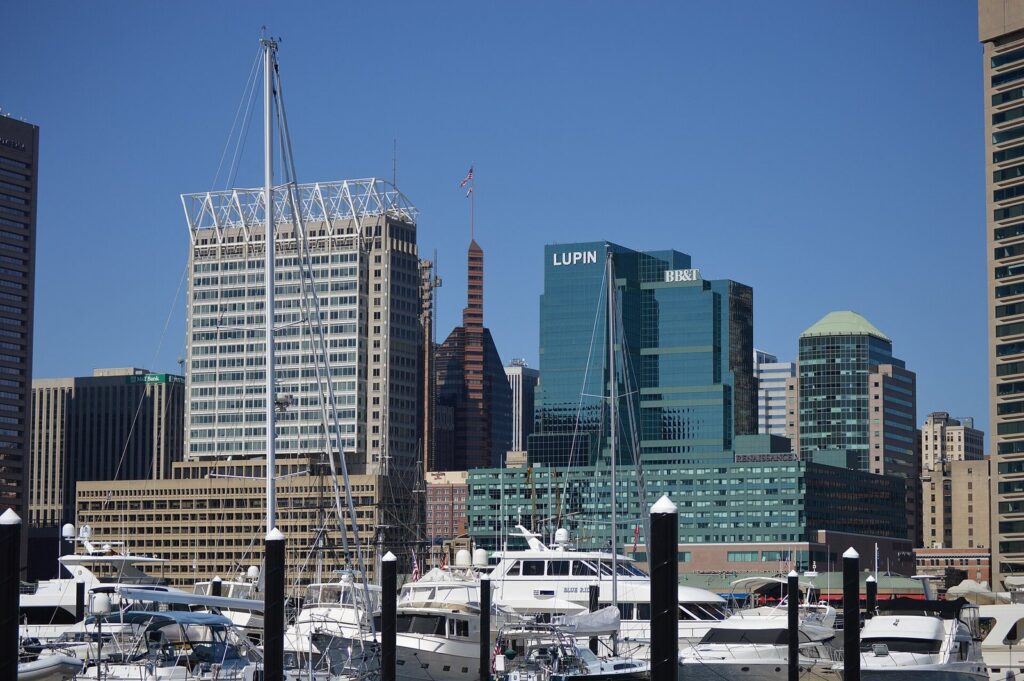
- Skyline over the marina: photo by Kimberlyshorter, Wikimedia Commons (CC BY-SA 4.0)
- Science Center dinosaur hall: photo by Christopher Amrich, Wikimedia Commons (CC BY-SA 2.0)