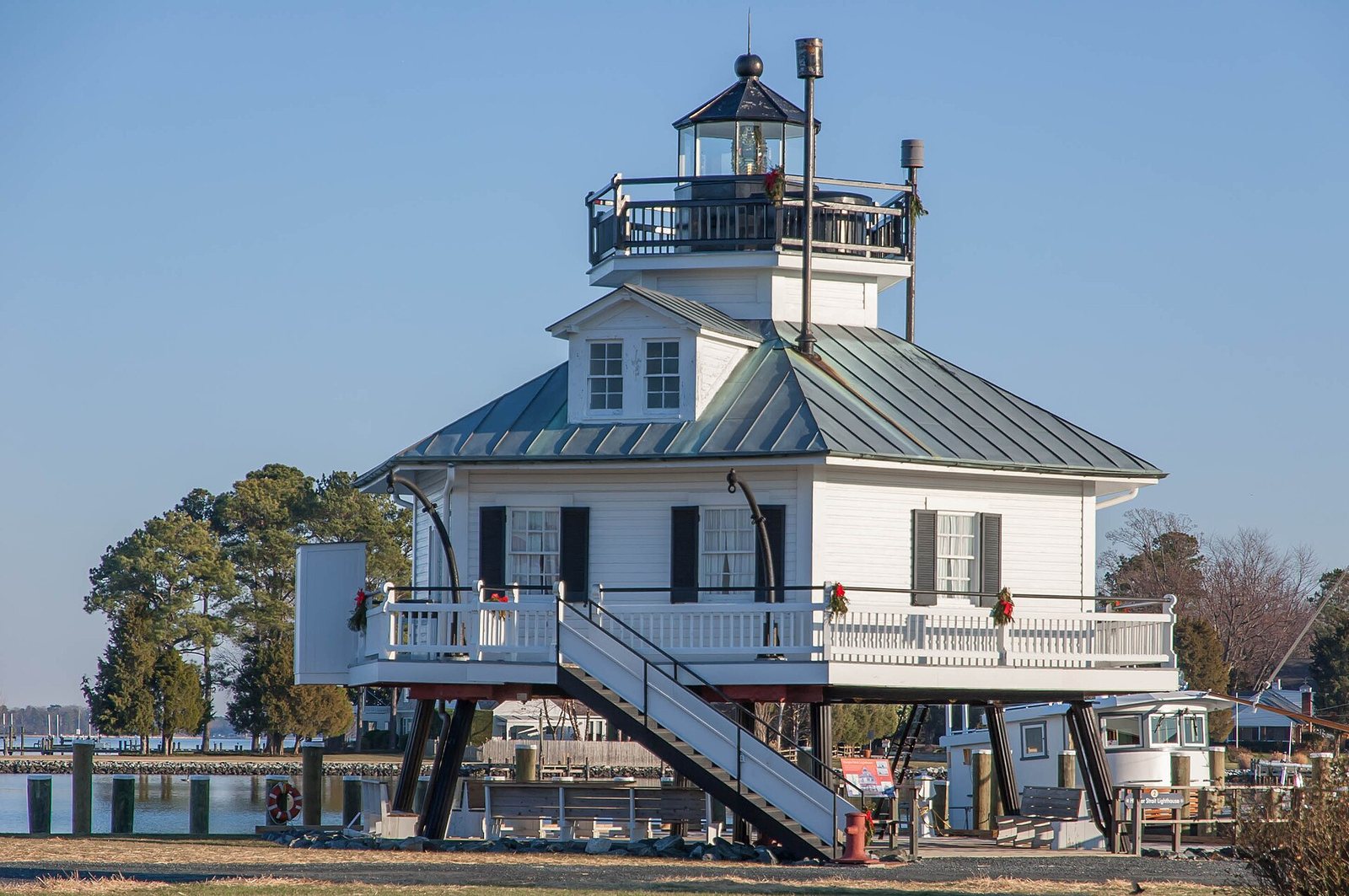
The white hexagonal lighthouse standing on iron legs at the end of Navy Point didn’t start life in St. Michaels. It guarded Hooper Strait, down the Bay, from 1879 until the Coast Guard retired it, and in 1966 the Chesapeake Bay Maritime Museum cut it in half and floated it here on a barge. That’s a fair summary of a St Michaels MD visit: a small harbor town that gathered up the Chesapeake’s working history, its skipjacks, log canoes, crab houses and watermen’s stories, and set it all out along a single main street and one of the prettiest harbors on the Eastern Shore.
The short answer: St. Michaels is worth a day from Washington, Baltimore or Annapolis and better as an overnight, especially if you add Easton, Oxford and Tilghman Island on a loop through Talbot County. It’s about an hour and a half from Washington and Baltimore over the Bay Bridge. The main draws are the Chesapeake Bay Maritime Museum ($20 for adults online in 2026), a boat ride on the Miles River, Talbot Street’s shops and inns, crabs on the water, and the little car ferry between Oxford and Bellevue. It’s a town for couples, history lovers and slow weekends, not for nightlife or beaches.
Every price, date and rule on this page was checked on September 23, 2026 against the operators’ and agencies’ own websites. Two things have changed since many guides were written: the Bay Bridge’s tolls are cashless (and its eastbound deck is under repair into 2027), and in Oxford the historic Robert Morris Inn has been condemned and closed, so don’t plan lunch or a room there.
On this page: At a glance · Is it worth it? · History · Talbot Street and the harbor · Maritime museum · On the water · Crab houses and restaurants · Winery, distillery and brewery · Shopping · Where to stay · Easton, Oxford and Tilghman · Nature · Events · When to go · Rainy days · Getting there · Getting around · A day trip · A romantic weekend · With kids · Beyond Talbot · Tips · Costs · What to skip · FAQ
St. Michaels at a glance
| Question | Answer (checked September 2026) |
|---|---|
| Where is it? | Talbot County on Maryland’s Eastern Shore, on the Miles River off the Chesapeake Bay. About 1,000 year-round residents. |
| How far? | About 1.5 to 2 hours from Washington or Baltimore over the Bay Bridge; about 2.5 hours from Philadelphia through Delaware. |
| Bay Bridge toll | Eastbound only, cashless: $2.50 with a Maryland E-ZPass, $4 by Pay-By-Plate or out-of-state E-ZPass, $6 by video. |
| Top sight | Chesapeake Bay Maritime Museum: $20 adults online ($22 at the door), $8 ages 6 to 17 online; 10 a.m. to 5 p.m., April to October; tickets good for two days. |
| Boat rides | 70-minute Miles River cruises (season through Nov 21, 2026); two-hour skipjack sails from the museum. |
| Oxford-Bellevue Ferry | Mid-April to mid-November; crossings under 10 minutes, about every 20 minutes; bikes and dogs welcome. |
| Hotel taxes | Talbot County’s 4% room tax, the lowest county rate in Maryland, plus the state’s 6% sales tax. |
| Big dates | Waterfowl Festival in Easton, Nov 13 to 15, 2026; Christmas in St. Michaels, Dec 10 to 13, 2026. |
| Best time | May to June and September to October; the second weekend of December for Christmas. |
Is St Michaels MD worth visiting?
Yes, if you like the idea of a small, walkable harbor town with a first-rate museum, good food and water all around. St. Michaels has been a shipbuilding town, an oystering and crabbing port and, for the last half century, a weekend escape for Washington and Baltimore. Its main street, Talbot Street, runs through a historic district of 18th- and 19th-century houses, and its harbor is full of sailboats, workboats and the museum’s historic fleet. On a spring or fall afternoon, with a crab cake and a view of the Miles River, it’s hard to beat.
It’s less worth it if you’re expecting a beach, a big-city restaurant scene or much to do after dark; most of the town is quiet by 10 p.m. And a summer Saturday brings day-trippers, boaters and traffic on Route 33 in numbers the little town struggles to absorb. The trick is timing. Come midweek, in the shoulder seasons, or stay overnight so you have the town to yourself in the early morning and evening.
Verdict: worth a full day and ideally a night, and at its best combined with Oxford, Easton and Tilghman Island. It’s the most rewarding small town on the Eastern Shore for a first visit.
Go if you want Chesapeake maritime history, a boat ride on the river, crabs by the water, inns and B&Bs, and a relaxed pace.
Stay overnight if you’re coming from Washington or Baltimore on a weekend, want the ferry loop, or are here for the Waterfowl Festival or Christmas in St. Michaels.
Skip it if you want a swimming beach, nightlife or big-box convenience. For beaches, head to Ocean City; for city nights, Annapolis or Baltimore.
A short history: watermen, shipbuilders and the town that fooled the British
St. Michaels takes its name from an Episcopal parish founded here in 1677, and the town itself was laid out in the 1770s around a central square, now St. Mary’s Square, rather than on the usual colonial grid. Shipyards along the harbor built fast sailing vessels, and the town grew on shipbuilding, then on oysters and crabs, as watermen worked the Bay and the rivers around it.
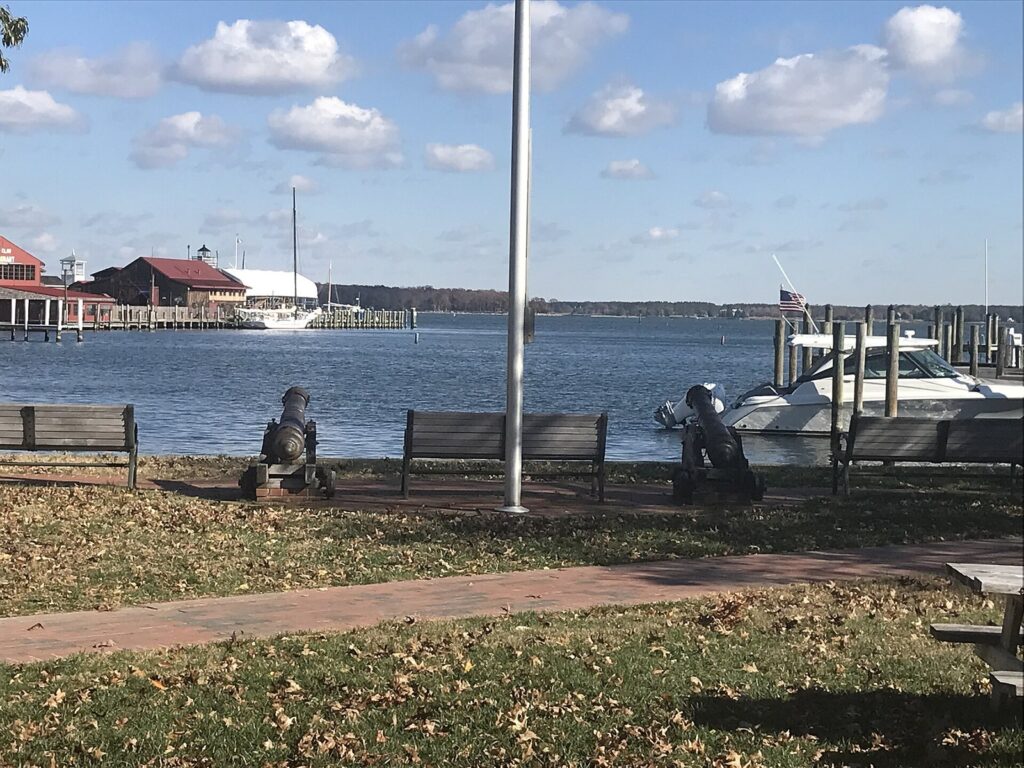
Its most famous story comes from the War of 1812. In August 1813, the tale goes, residents warned of a British night attack hung lanterns in the trees and ship masts beyond the town, so the British gunners overshot and most of the town was spared. Historians debate the details, but the story gave St. Michaels its nickname, “the town that fooled the British,” and the cannons in the harborfront park recall it. On Mulberry Street, the Cannonball House is said to have taken a hit through its roof that night.
Talbot County is also where Frederick Douglass was born into slavery in 1818. As a teenager he was sent to St. Michaels, and his experiences here shaped his account of slavery in his autobiographies. Easton, the county seat, has a statue of Douglass on the courthouse lawn. The St. Michaels Museum at St. Mary’s Square, open on weekends from May to October ($3 for adults, $1 for ages 6 to 17), tells the town’s story.
Walking Talbot Street and the harbor
St. Michaels is small enough to walk end to end in 15 minutes, and that’s the best way to see it. Talbot Street, which is also Maryland Route 33, is the main street, lined with shops, galleries, cafes and restaurants in 19th-century buildings. The harbor lies a block or two to the east, reached down side streets like Cherry Street and Mill Street.
A good loop, taking two hours with stops:
- St. Mary’s Square, the old town center, with the St. Michaels Museum and quiet streets of old houses around it.
- Mulberry Street, for the Cannonball House and more historic homes.
- Talbot Street, north through the shopping blocks, with clothing, antiques, galleries, gifts and sweets.
- The harbor, down to the waterfront park with its cannons, the town docks and the view across the Miles River.
- Navy Point, the peninsula at the harbor’s edge, home to the Chesapeake Bay Maritime Museum and the Crab Claw restaurant.
- The Old Mill, at the south end of Talbot Street, for the distillery, the brewery and other tasting rooms.
Plan it: walk the shops in the morning before the day-trippers arrive, spend the middle of the day at the museum, and save the harbor for the late afternoon light.
The Chesapeake Bay Maritime Museum
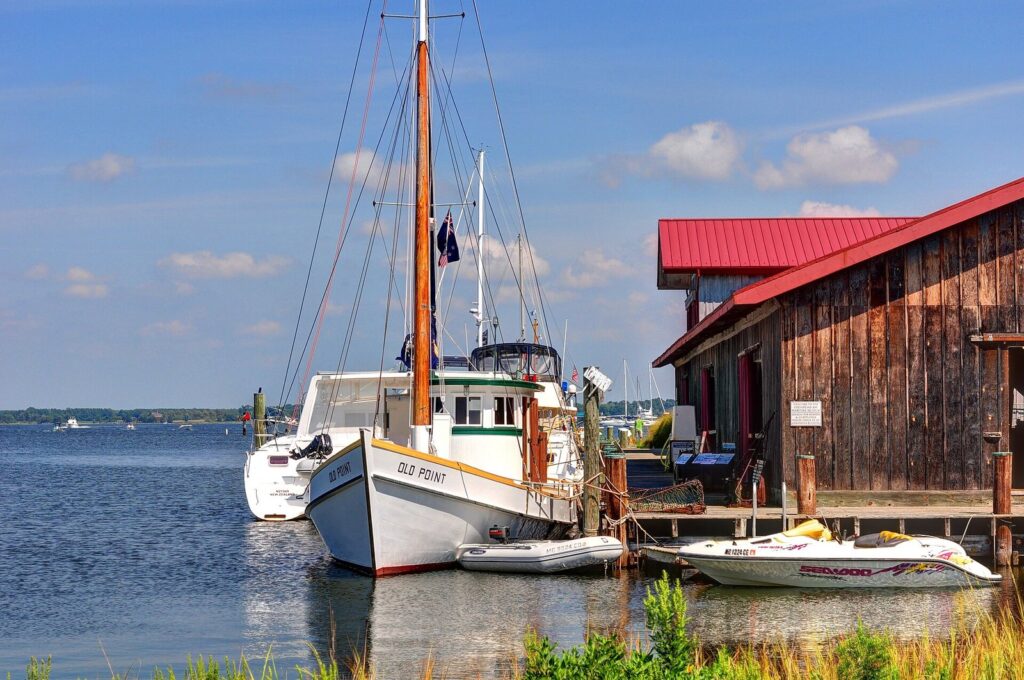
The Chesapeake Bay Maritime Museum is the reason many people come, and it’s the best introduction to the Bay anywhere. Its waterfront campus on Navy Point mixes historic buildings, floating boats and working shops, with exhibits on the watermen who harvested oysters and crabs, the boats they built and sailed, the towns they lived in, and the Bay’s changing health.
What to see
- The Hooper Strait Lighthouse: the 1879 screwpile lighthouse moved here in 1966. Climb inside to see the keeper’s quarters and the lantern room.
- The historic fleet: Chesapeake boats unique to the Bay, including skipjacks, log canoes and bugeyes, the sailing workboats the region’s watermen developed.
- The working shipyard: shipwrights restoring historic wooden vessels, often with a project you can watch from the viewing area.
- Exhibits on oystering, crabbing, decoys, waterfowling, steamboats and the Bay’s communities.
The Bay in numbers
It helps to know what the museum is about. The Chesapeake is the largest estuary in the United States: about 200 miles long, between 3.4 and 35 miles wide, and surprisingly shallow, averaging only about 21 feet deep. Counting its tidal rivers and creeks, it has about 11,684 miles of shoreline, and its watershed covers about 64,000 square miles across six states and Washington. That shallow, brackish water is what made it so rich in oysters and crabs, and why the boats you’ll see at the museum were built with shallow drafts and big sails.
Tickets and hours
Admission is $20 for adults online or $22 at the door, and $8 online or $10 at the door for ages 6 to 17, and a ticket is good for two days, which makes it easy to split a visit around lunch or a boat ride. The museum is open from 10 a.m. to 5 p.m. from April to October; check the museum’s hours page for winter hours and special events. Allow two to three hours, more if you’re a boat person.
Plan it: buy tickets online to save $2 each, visit in the morning, break for crabs at the Crab Claw next door, and come back in the afternoon on the same ticket.
On the water: boat tours, skipjacks and log canoes
You haven’t really seen St. Michaels until you’ve seen it from the water.
Miles River cruises
The Patriot runs 70-minute narrated cruises on the Miles River from the harbor at the maritime museum, past waterfront estates, some two centuries old, and plenty of birdlife, with evening cruises as well. The 2026 season runs through November 21. There’s a bar on board, and cruise passengers can park free in the museum’s lot, a real perk on a busy weekend.
Skipjack sails
Skipjacks are the wooden sailing workboats that dredged oysters on the Chesapeake, and they’re among the last working sailboats in North America. The H.M. Krentz, a Coast Guard-certified skipjack that carries up to 32 passengers, sails scheduled two-hour public trips from the maritime museum, with its captain explaining oystering, the boat and the Bay as you go. It’s the most authentic boat ride in town. Down on Tilghman Island, the Rebecca T. Ruark, the oldest surviving skipjack and a National Historic Landmark, stopped public sails after a 2022 incident; check whether trips have resumed before you plan around it.
Log canoe racing
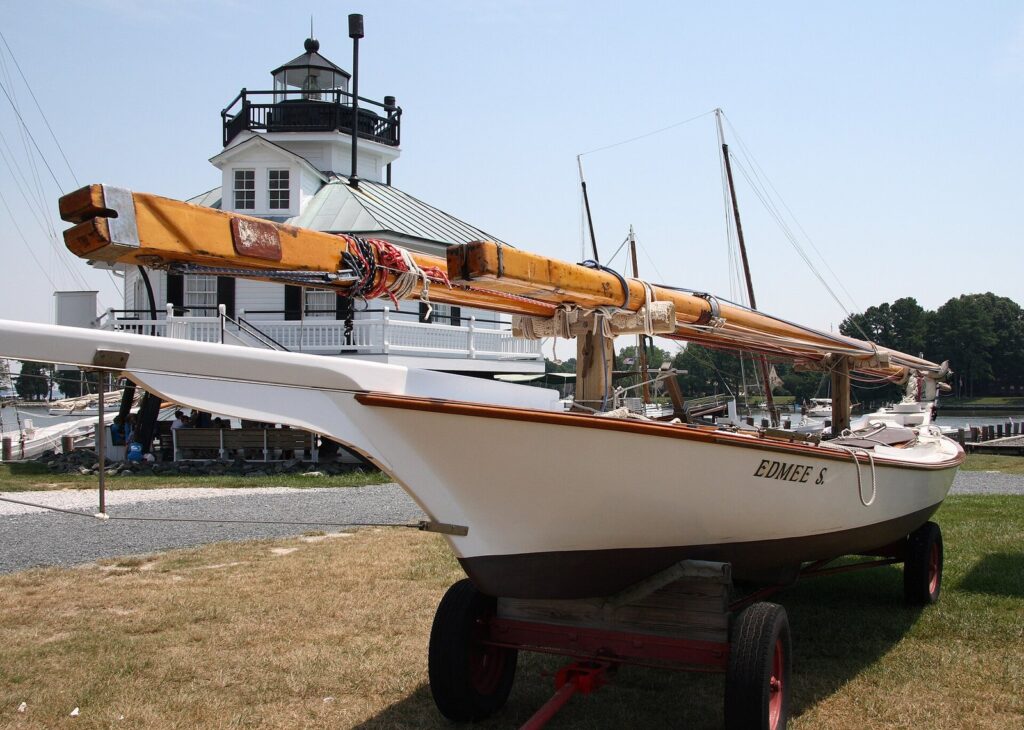
Log canoes, built from hollowed and joined logs and carrying huge sails, are a Chesapeake original, and a small fleet still races on the Miles River on summer weekends, with crew hiking out on boards to keep the boats upright. If you’re in town on a race weekend, watch from the waterfront; it’s one of the stranger and more beautiful sights on the Bay.
Paddling, fishing and crabbing
Outfitters in and around town rent kayaks and paddleboards in season, and the sheltered creeks off the Miles River are good for a morning paddle. Fishing charters run from St. Michaels and Tilghman. You can also crab off a dock with a handline and a chicken neck: in the Chesapeake, the recreational season runs from April 1 to December 15, you can keep up to two dozen male hard crabs without a license, females can’t be kept, and males must measure at least 5 inches (5 1/4 inches from July 15). A Maryland tidal fishing license covers fishing: $15 for residents and $22.50 for non-residents, or $6 and $12 for seven days.
Plan it: book the skipjack or the Patriot for late afternoon, when the light is warm and the wind usually fills in, and end the day with dinner on the harbor.
Crab houses and restaurants
Crabs on the water
The Crab Claw, on Navy Point next to the maritime museum, is St. Michaels’ classic crab house, open seasonally from March to November, with steamed blue crabs, crab cakes, oysters and a deck over the harbor. Steamed crabs are sold by the dozen at market price that depends on size and supply, so ask before you order. Local crabs are heaviest in late summer and early fall.
How to eat a steamed crab
If you’ve never picked a crab, don’t be shy about asking your server for a demonstration; everyone had to learn. The basic method: twist off the claws and legs and set them aside. Flip the crab over, pry up the apron (the tab on the belly) with a knife or your thumb, and use it to pull off the top shell. Scrape away the gray, feathery gills and the yellow-green “mustard” (some people love it). Break the body in half and pick the white meat out of the chambers with a knife or your fingers. Finally, crack the claws with the wooden mallet, gently, and pull out the claw meat. Expect to spend an hour or two, go through a stack of paper towels, and leave with spice under your fingernails.
Talbot Street and beyond
- Ava’s Pizzeria & Wine Bar on South Talbot Street: wood-fired pizza, Italian dishes and a patio.
- Talbot St. Tavern: a casual pub with crab cakes, burgers, sandwiches and local beer.
- Bistro St. Michaels at 403 South Talbot Street: French-leaning dinners in a restored house.
- Stars at the Inn at Perry Cabin: the town’s fine-dining room, on the water at the edge of town, which the inn says holds the Eastern Shore’s only Forbes ratings.
Restaurants are busiest on summer and festival weekends, and some shorten their hours or close for part of the winter, so book dinner and check hours before you drive.
Plan it: crabs at lunch on the water, a walk, then dinner on Talbot Street. If you’re driving back across the Bay Bridge the same evening, eat early.
A winery, a distillery and a brewery
The Old Mill complex at the south end of Talbot Street has turned into a tasting stop. Lyon Rum, the flagship of Windon Distilling Company, has made rum here since 2012 and runs the Golden Hour rum room on site. Eastern Shore Brewing, in the same building, calls itself the oldest continually operating brewery on Maryland’s Eastern Shore and pours flights and pints. Elsewhere in town, St. Michaels Winery’s tasting room opens daily at 11 a.m. Together they make a good rainy-afternoon plan, all within walking distance of the historic district, so nobody has to drive.
Shopping on Talbot Street
Shopping is half the reason many visitors come, and Talbot Street does it well for a town this size. The blocks through the center are lined with independent shops in old storefronts: clothing and accessories, home and coastal decor, galleries of Chesapeake art and photography, antiques, books, kitchenware, toys and fudge. Look for local specialties that make good souvenirs: decoys and decoy-themed art, maritime prints, crab-shaped everything, Old Mill rum and local beer.
Most shops open mid-morning and close by early evening, with longer hours on summer weekends and shorter ones in winter, and some close on a weekday or two out of season. For a bigger selection, Easton’s downtown has more galleries, antique shops and boutiques, and Oxford has a couple of small shops worth a browse after the ferry.
Plan it: shop in the morning, when Talbot Street is quiet, and carry bags back to the car before the museum; parking fills by late morning on busy weekends.
Where to stay in St. Michaels
St. Michaels has more places to stay than its size suggests, from a luxury resort to small B&Bs.
- The Inn at Perry Cabin: the luxury choice, a waterfront resort on the Miles River at the edge of town, with a spa, a marina and the Stars restaurant.
- Historic inns and B&Bs: Victorian houses in and around the historic district, a short walk from Talbot Street and the harbor. They’re the most atmospheric option and often have minimum stays on summer weekends.
- Waterfront hotels and marinas: rooms on the harbor itself, with views and higher rates.
- Motels and inns along Route 33: simpler rooms, lower prices and parking, a drive or long walk from the center.
- Easton: the county seat, 20 minutes or so away, has more hotels and restaurants and makes a good base for exploring the whole county.
- Vacation rentals: waterfront houses around the county, good for families and groups staying a week.
Talbot County’s room tax is just 4%, the lowest county rate in Maryland, plus the state’s 6% sales tax, about 10% in all. Summer weekends, the Waterfowl Festival in November and Christmas in St. Michaels in December book up first; midweek and winter are the easiest and cheapest.
Choosing an inn
St. Michaels’ inns and B&Bs vary more than their websites suggest. Before you book, ask how far the property is from Talbot Street and the harbor (some “St. Michaels” addresses are a drive out of town), whether breakfast is included, whether there’s parking on site, how many nights the minimum stay is on your dates, and what the cancellation terms are. Ask about stairs, too: many rooms are on the upper floors of old houses. If you’re coming for the Christmas weekend or the Waterfowl Festival, book as soon as your dates are firm.
Easton, Oxford and Tilghman Island: the Talbot County loop
St. Michaels sits in the middle of a county of small towns on the water, and a loop through three of them makes the best day trip on the Eastern Shore.
Oxford and the Oxford-Bellevue Ferry
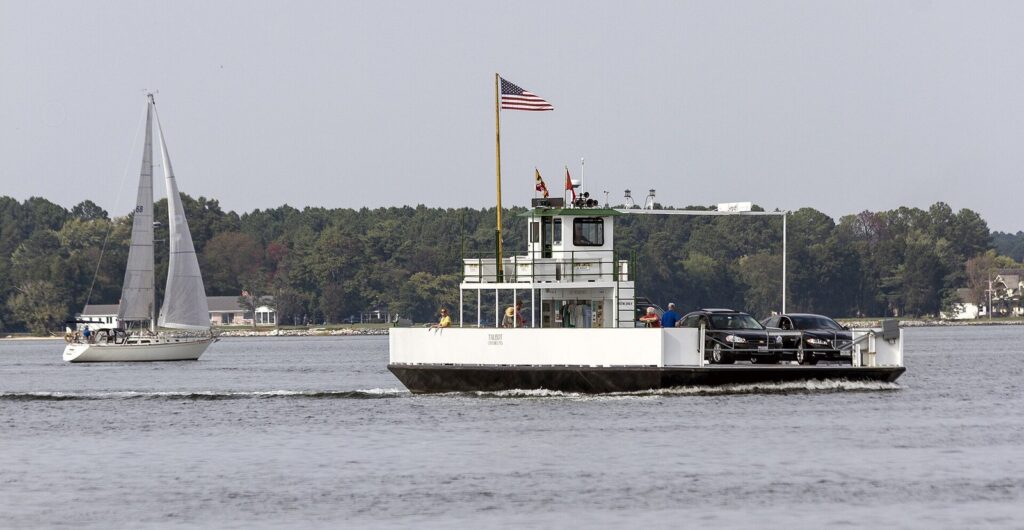
Oxford is a tiny, very old town on the Tred Avon River, a colonial port that’s now mostly quiet streets, sailboats and water views. The fun is getting there. From St. Michaels, drive south through Royal Oak to Bellevue and take the Oxford-Bellevue Ferry across the river, a crossing of under 10 minutes on a small open ferry that carries up to nine cars. Its operator bills it as the oldest privately owned ferry in America, dating from 1683. The ferry runs from mid-April to mid-November, with crossings about every 20 minutes during its daily hours, and it welcomes bikes and dogs. Check the ferry’s website for 2026 fares before you go.
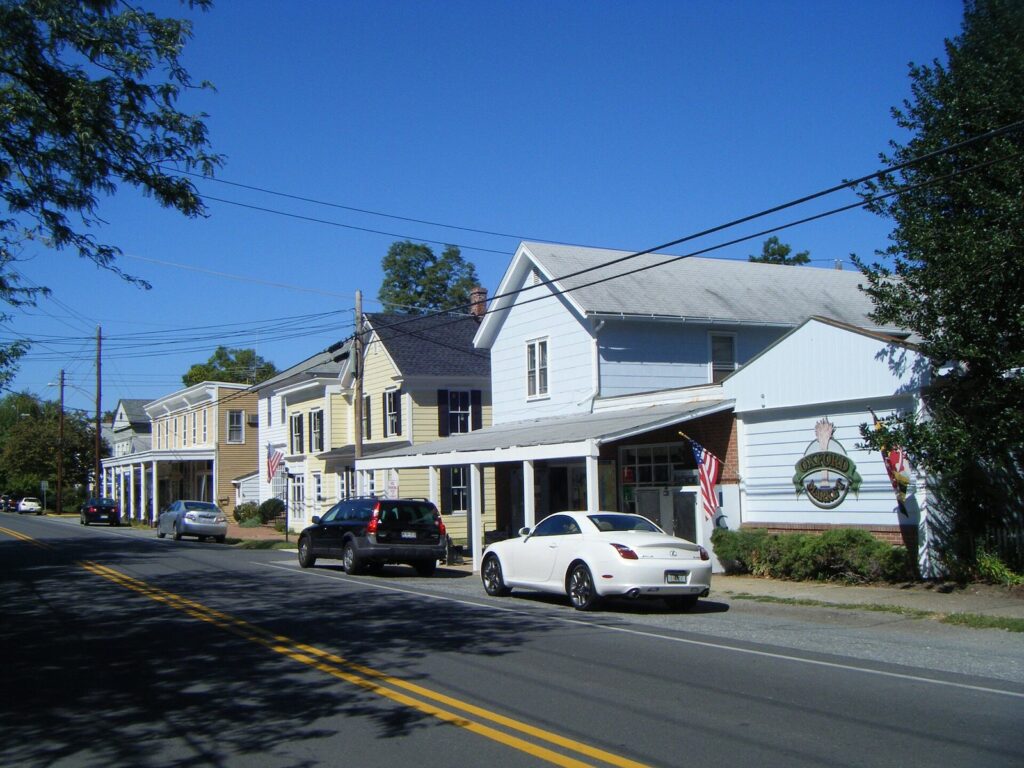
In Oxford itself, walk the short main street to the Strand along the water. One note for anyone using an older guide: the historic Robert Morris Inn, long the town’s landmark inn and restaurant, has been condemned by the town and is closed.
Easton
Easton, the county seat, has the biggest downtown in Talbot County: brick sidewalks lined with shops, restaurants and galleries around the courthouse, where a statue of Frederick Douglass stands. The Academy Art Museum is free and open Tuesday to Sunday (10 a.m. to 7 p.m. on Tuesdays and Thursdays, 10 a.m. to 4 p.m. on other days). The Third Haven Meeting House, a Quaker meetinghouse from the 1680s, is among the oldest houses of worship in the country. In November, Easton hosts the Waterfowl Festival.
Tilghman Island
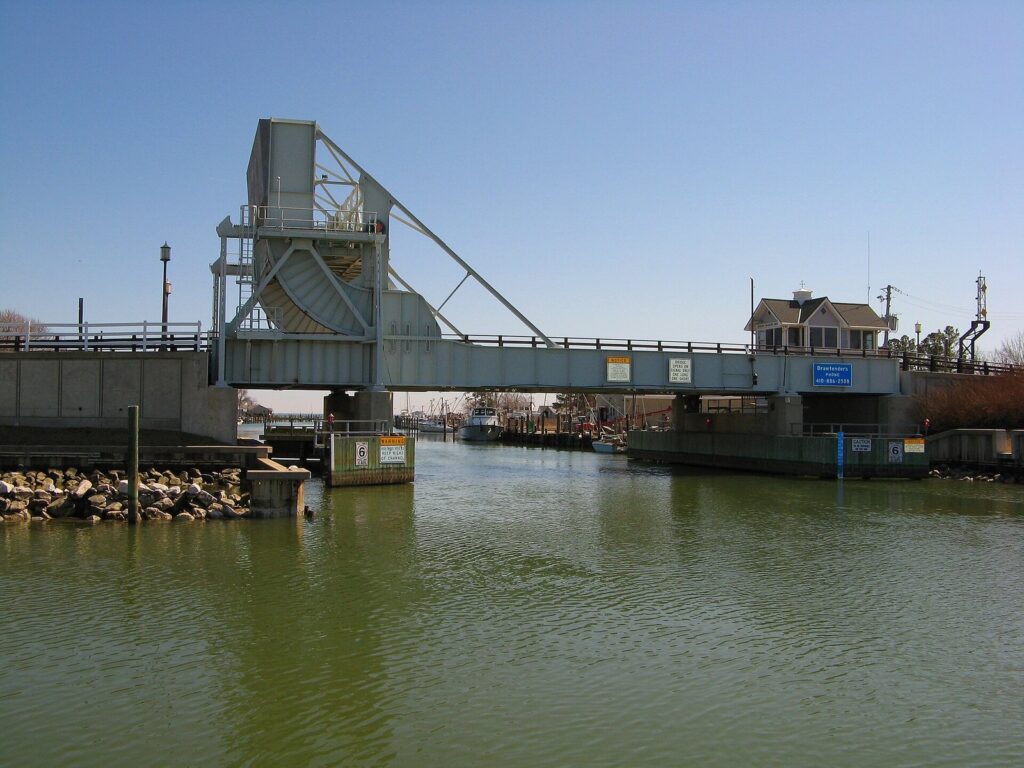
Tilghman Island, about 20 minutes west of St. Michaels at the end of Route 33, is a working waterman’s island where the Chesapeake opens up. You cross onto it over the Knapps Narrows drawbridge, which opens frequently for the workboats and pleasure boats running between the Bay and the Choptank River. Tilghman has seafood restaurants, marinas, charter fishing boats and some of the best sunsets on the Bay. Its harbor is home to skipjacks, including the Rebecca T. Ruark.
The loop in a day
Morning in St. Michaels, then drive to Bellevue for the ferry to Oxford (allow time for a wait in summer). Lunch and a walk in Oxford, then a short drive to Easton for the afternoon. Back to St. Michaels for dinner, or out to Tilghman Island for sunset. Cyclists do a version of the same loop on quiet roads, using the ferry to cross the river; it’s flat and scenic, but traffic on Route 33 can be heavy, so pick side roads where you can.
Birds, boats and nature around Talbot County
Talbot County has more shoreline than almost anywhere in Maryland, and the wildlife comes with it. Ospreys nest on channel markers and platforms from spring through summer, great blue herons stalk the shallows year-round, and bald eagles are common enough that locals barely look up. In late fall and winter, migrating waterfowl, from Canada geese and tundra swans to diving ducks, arrive by the thousands, which is the whole reason the Waterfowl Festival exists.
For a short walk in the woods and marshes, the Pickering Creek Audubon Center near Easton has trails through fields, forest and wetland; check its hours before you go. Out on the water, a kayak on one of the creeks off the Miles River at dawn is the best way to see herons, ospreys and the occasional eagle up close. Bring binoculars on the Patriot or the skipjack, and in summer, bring insect repellent for evenings near the marsh.
Events in St. Michaels and Talbot County
| Event | When | Where | What it is |
|---|---|---|---|
| Waterfowl Festival | Nov 13 to 15, 2026 (the 55th) | Easton | Wildlife art, decoys, retriever demonstrations and conservation; $25 for a three-day ticket |
| Christmas in St. Michaels | Dec 10 to 13, 2026 | St. Michaels | Tour of Homes, Breakfast with Santa, a marketplace, the Talbot Street Parade (Saturday, 10:30 a.m.) and the Lighted Boat Parade on the harbor (Saturday, 6 p.m.) |
| Log canoe racing | Summer weekends | Miles River | Historic sailing log canoes racing off St. Michaels |
The Waterfowl Festival, in its 55th year, takes over downtown Easton with art shows, decoy carvers, calling contests and dog demonstrations, and it’s one of the biggest weekends of the year for the whole county. Christmas in St. Michaels is the town’s signature holiday weekend, run by a community nonprofit: the Tour of Homes opens private houses (and includes admission to the St. Michaels Museum), and the Lighted Boat Parade sends decorated boats around the harbor after dark. Book lodging for both well ahead.
When to visit St. Michaels
| Season | What it’s like | Worth knowing |
|---|---|---|
| Spring (April to May) | Mild, quieter, gardens blooming | The maritime museum’s April to October hours begin; the Oxford ferry starts in mid-April; crab season opens April 1 |
| Summer (June to August) | Peak season: boating, crabs, busy weekends | Hot and humid; book lodging and dinner ahead; heavy Bay Bridge traffic on Fridays and Saturdays |
| Fall (September to November) | The best months: warm days, heavy crabs, festivals | Patriot cruises run to Nov 21, 2026; Waterfowl Festival Nov 13 to 15; the ferry stops in mid-November |
| Winter (December to March) | Quiet and cheap, with a big Christmas weekend | Christmas in St. Michaels Dec 10 to 13, 2026; some restaurants and the Crab Claw close for part of the season |
When to visit St. Michaels MD
For most people, late May to June and September to October are the sweet spots: everything is open, the weather is comfortable for walking and boating, and weekday crowds are light. September adds the heaviest crabs of the year. Come in December for Christmas in St. Michaels if you like holiday towns, and in November for the Waterfowl Festival in Easton.
Is St. Michaels worth visiting in July?
Yes, with planning. July is peak summer: the harbor is at its liveliest, boat tours and restaurants run full schedules and the crabs are good, but it’s hot and humid, and weekends bring crowds and Bay Bridge backups. Visit midweek if you can, cross the bridge early in the morning, book dinner ahead, and plan indoor time at the museum for the hottest part of the afternoon.
St. Michaels on a rainy day
Rain doesn’t sink a St. Michaels trip. The Chesapeake Bay Maritime Museum has plenty under cover, including exhibit buildings and the lighthouse interior, and your ticket is good for two days if you want to split it. The Old Mill’s rum room, brewery and tastings are a natural rainy afternoon, as is a long lunch on Talbot Street. On weekends from May to October, the St. Michaels Museum at St. Mary’s Square is a short, dry history stop. Easton, 20 minutes away, adds the free Academy Art Museum and a downtown of shops and cafes. Boat tours may cancel in storms, so keep a cruise flexible and rebook for the next dry evening.
Getting to St. Michaels
| From | Distance | Drive, no traffic | Route |
|---|---|---|---|
| Baltimore | 69 to 74 miles | About 1 hour 30 minutes to 1 hour 50 minutes | Over the Bay Bridge |
| Washington, DC | 78 miles | About 1 hour 30 minutes to 1 hour 55 minutes | Over the Bay Bridge |
| Wilmington, DE | 91 miles | About 1 hour 45 minutes to 2 hours 5 minutes | Through Delaware, no Bay Bridge |
| Philadelphia | 119 to 122 miles | About 2 hours 20 minutes to 2 hours 45 minutes | Through Delaware, no Bay Bridge |
| Harrisburg, PA | 153 to 154 miles | About 2 hours 50 minutes to 3 hours 30 minutes | Over the Bay Bridge |
| Richmond, VA | 187 to 190 miles | About 3 hours 15 minutes to 4 hours | Over the Bay Bridge |
| New York City | 207 to 210 miles | About 3 hours 45 minutes to 4 hours 30 minutes | Through Delaware |
The Bay Bridge
From Washington, Baltimore and Annapolis, the route crosses the Chesapeake Bay Bridge on US 50, then follows US 50 to Easton and Route 33 west to St. Michaels. The toll is charged eastbound only and is cashless: $2.50 with a Maryland E-ZPass, $4 with Pay-By-Plate or an out-of-state E-ZPass, and $6 billed by video. The Maryland Transportation Authority’s best times to travel eastbound are Friday before 9 a.m. or after 8 p.m., Saturday before 7 a.m. or after 7 p.m., and Sunday before 10 a.m. or after 7 p.m.; heading home, westbound, Sunday before 11 a.m. or after 10 p.m. is the key window. The eastbound span’s deck replacement brings overnight closures with two-way traffic on the other span until spring 2027. Longer term, the state’s Bay Crossing Study recommends replacing both spans, with a decision due in November 2026 and construction no earlier than 2032.
From Philadelphia, New York and Wilmington
From the north, you don’t need the Bay Bridge at all: drive down through Delaware on US 301 into Maryland, then pick up US 50 to Easton. It’s often the less stressful way on summer weekends.
How to get to St. Michaels from New York by train
There’s no train or bus service to St. Michaels. The practical option from New York is Amtrak to Wilmington, then a rental car for the drive of about 1 hour 45 minutes to 2 hours; or Amtrak to BWI Airport or Baltimore and a rental from there, about an hour and a half over the Bay Bridge. Once in St. Michaels, leave the car at your inn and walk.
Getting around: walking, bikes and parking
The town is walkable; everything in the historic district is within about 15 minutes on foot. Bikes are a good way to explore beyond it, on flat country roads, the ferry loop to Oxford, or a short ride along the water. Parking is the pinch point: street spaces and public lots near Talbot Street fill on summer and festival weekends, so arrive early, park once, and walk. Patriot passengers can park free in the maritime museum’s lot. For Tilghman, Oxford and Easton you’ll need a car or a long bike ride.
A day trip from Washington, Baltimore or Annapolis
If you only have one day, this plan gets the most out of it:
- Before 9 a.m.: cross the Bay Bridge eastbound ahead of the weekend traffic, and drive on through Easton to St. Michaels.
- 10 a.m.: the Chesapeake Bay Maritime Museum as it opens, starting with the lighthouse and the historic fleet.
- 12:30 p.m.: crabs or a crab cake at the Crab Claw on Navy Point.
- 2 p.m.: a walk along Talbot Street, St. Mary’s Square and the harbor.
- 3:30 p.m.: a 70-minute Patriot cruise on the Miles River, or a two-hour skipjack sail.
- 5:30 p.m.: a tasting at the Old Mill, then an early dinner in town.
- After 7 p.m.: head home, crossing the Bay Bridge westbound once the Sunday return traffic has cleared, or stay the night and do the Oxford ferry loop in the morning.
A romantic weekend in St. Michaels
St. Michaels is one of the Mid-Atlantic’s classic couples’ weekends, and it’s easy to plan.
- Friday: leave after the evening rush, or before 9 a.m. if you’re taking a day off, to beat the Bay Bridge traffic. Check into an inn in the historic district, and have a late dinner on Talbot Street.
- Saturday morning: coffee, a walk around St. Mary’s Square and the shops before the day-trippers arrive, then the maritime museum.
- Saturday afternoon: crabs on the deck at the Crab Claw, then a two-hour skipjack sail or a Miles River cruise as the light turns gold.
- Saturday evening: a rum tasting at the Old Mill and dinner at Bistro St. Michaels or Stars at the Inn at Perry Cabin.
- Sunday: the Oxford-Bellevue Ferry to Oxford for a walk on the Strand (mid-April to mid-November), then lunch in Easton before heading home, crossing the Bay Bridge before 11 a.m. or after 10 p.m. if you can.
St. Michaels with kids
St. Michaels is more of a grown-up town, but a family day works well with the right plan. The maritime museum is the anchor, at $8 for ages 6 to 17 online, with the lighthouse to climb, boats to look at and a working shipyard. The Patriot’s 70-minute cruise is short enough for young children, and crabbing off a dock with a handline and a chicken neck keeps kids busy for hours. Add ice cream on Talbot Street and a walk to the cannons by the harbor. Older kids may enjoy the ferry to Oxford and a bike ride. What you won’t find is a playground-and-arcade scene, so plan a half day to a day rather than a week.
Beyond Talbot County
St. Michaels makes a good base for more of the Eastern Shore. South across the Choptank River, Cambridge and the Blackwater National Wildlife Refuge are a short drive past Easton, and the refuge’s eagles and marshes are at their best in winter. North, Kent Island sits at the Eastern Shore end of the Bay Bridge with its seafood restaurants and water views, and Chestertown, on the Chester River, is another well-preserved colonial town. Ocean City’s beaches are about two hours east. Each is covered in its own guide; from St. Michaels, pick one for a half day rather than trying to see them all.
Practical tips
- Book ahead in season. Inns, the skipjack and dinner reservations go quickly on summer and festival weekends.
- Bring layers. It’s often cooler and windier on the water than in town, especially on evening cruises.
- Watch the ferry calendar. The Oxford-Bellevue Ferry runs mid-April to mid-November only.
- Mind the season for seafood. The Crab Claw opens March to November, and local crabs are at their best from late summer into fall.
- Getting around on foot is easy. The town is flat and compact; the maritime museum’s grounds are spread out but mostly level.
- Pets: dogs are welcome on the Oxford ferry; check with inns, restaurants and tours before you bring one.
What a St. Michaels trip costs
| Item | Cost (checked September 2026) |
|---|---|
| Bay Bridge toll, eastbound | $2.50 (Maryland E-ZPass) to $6 (video) |
| Chesapeake Bay Maritime Museum | $20 adults online, $22 at the door; $8 or $10 ages 6 to 17 |
| St. Michaels Museum at St. Mary’s Square | $3 adults, $1 ages 6 to 17 |
| Oxford-Bellevue Ferry | Check the ferry’s website for 2026 fares |
| Waterfowl Festival | $25 for a three-day ticket (2026) |
| Academy Art Museum, Easton | Free |
| Fishing license, 7 days | $6 residents, $12 non-residents |
| Lodging taxes | 4% Talbot County room tax plus 6% state sales tax |
Lodging is the big variable. Inns and B&Bs in the historic district and the Inn at Perry Cabin sit at the top of the range, especially on summer and festival weekends, while motels on Route 33 and hotels in Easton cost less. Midweek and winter bring the lowest rates.
What to skip
Skip the Friday-afternoon Bay Bridge crossing. Leave before 9 a.m. or after 8 p.m., or come midweek.
Skip planning a stay or dinner at the Robert Morris Inn in Oxford. It’s been condemned and is closed.
Skip the ferry loop in winter. The Oxford-Bellevue Ferry runs only from mid-April to mid-November.
Skip paying door prices at the museum. Buy online and save $2 a ticket, and use the two-day validity.
Skip packing a swimsuit for a beach day. St. Michaels is a harbor town without a swimming beach.
Skip a summer Saturday if you hate crowds. A Tuesday in September is a different, better town.
St. Michaels FAQ
Is St. Michaels MD worth visiting?
Yes. It’s a walkable harbor town with the Chesapeake Bay Maritime Museum ($20 for adults online), Miles River cruises and skipjack sails, crab houses on the water and Talbot Street’s shops and inns, about 90 minutes from Washington and Baltimore. It’s best as an overnight combined with Oxford’s ferry, Easton and Tilghman Island. Skip it for beaches or nightlife.
When to visit St. Michaels MD?
Late May to June and September to October are the best times: everything is open, the weather is comfortable and weekdays are quiet. September brings the heaviest crabs. November has Easton’s Waterfowl Festival (November 13 to 15, 2026) and December has Christmas in St. Michaels (December 10 to 13, 2026). Summer weekends are the busiest and hottest.
Is St. Michaels MD worth visiting in July?
Yes, if you plan around heat and crowds. July brings full boat-tour schedules, lively harbor evenings and good crabs, but also humidity, busy weekends and Bay Bridge backups. Come midweek, cross the bridge early, book dinner ahead and spend the hottest hours inside the maritime museum or on a late-afternoon cruise.
How to get to St. Michaels MD from NYC?
Drive about 207 to 210 miles, roughly 3 hours 45 minutes to 4 hours 30 minutes without traffic, down the New Jersey Turnpike and through Delaware, then west to Easton and St. Michaels, avoiding the Bay Bridge. By train, take Amtrak to Wilmington and rent a car for the last 1 hour 45 minutes to 2 hours; there’s no bus or train to St. Michaels itself.
Does St. Michaels MD have a beach?
No. St. Michaels is a harbor town on the Miles River with waterfront parks, docks and marinas, but no public swimming beach. Some inns and rentals have private waterfront. For sand and surf, Ocean City is about two hours away; on the Bay, Sandy Point State Park at the western end of the Bay Bridge is the nearest big swimming beach.
Is St. Michaels MD worth visiting as a tourist?
Yes, especially if you enjoy history, boats and food. The maritime museum is one of the best on the East Coast, the town is easy to explore on foot, and the Talbot County loop to Oxford, Easton and Tilghman adds a full second day. Expect a quiet evening scene and higher prices on summer and festival weekends.
How long do you need in St. Michaels?
One full day covers the maritime museum, Talbot Street, the harbor and a boat ride. Two days let you add the Oxford-Bellevue Ferry, Easton and a sunset on Tilghman Island, and they’re what most visitors from Washington and Baltimore find most relaxing. A long weekend suits couples who want slow mornings at an inn.
What is St. Michaels MD known for?
St. Michaels is known for the Chesapeake Bay Maritime Museum and its Hooper Strait Lighthouse, its harbor on the Miles River, skipjack sails and log canoe racing, crab houses like the Crab Claw, the War of 1812 legend of “the town that fooled the British,” Frederick Douglass’s youth in Talbot County, and inns that make it a favorite romantic weekend from Washington and Baltimore.
Sources and verification
Every price, date and rule on this page was checked on September 23, 2026 against the organizations listed below. The guide is compiled from those sources; it doesn’t claim first-hand visits.
- Chesapeake Bay Maritime Museum: hours and tickets, plus its Patriot Cruises page
- Talbot County tourism, including its Oxford-Bellevue Ferry listing and restaurant guide
- Oxford-Bellevue Ferry
- Waterfowl Festival and Christmas in St. Michaels
- Maryland Transportation Authority: Bay Bridge best times to travel, plus toll tables and the deck replacement page
- Maryland crabbing regulations and fishing-license fees
We also used the St. Michaels Museum at St. Mary’s Square, the Academy Art Museum, the H.M. Krentz, Lyon Rum and Eastern Shore Brewing, St. Michaels Winery, restaurants’ and inns’ own sites, local news reports on the Robert Morris Inn and the Rebecca T. Ruark, the Bay Crossing Study, Maryland’s Department of Legislative Services county tax tables and routed drive-time estimates, which are free-flow figures before traffic.
Maryland Tourism Guide is an independent publication. It is not affiliated with Visit Maryland or any agency or business named here, and no one paid to be included.
Photo credits
- Hooper Strait Lighthouse (featured image): photo by Fletcher6, Wikimedia Commons (CC BY 3.0)
- Harbor cannons: photo by TwoScarsUp, Wikimedia Commons (CC BY-SA 4.0)
- Chesapeake Bay Maritime Museum: photo by miketnorton, Wikimedia Commons (CC BY 2.0)
- Log canoe Edmee S.: photo by Acroterion, Wikimedia Commons (CC BY-SA 4.0)
- Oxford-Bellevue Ferry: photo by Acroterion, Wikimedia Commons (CC BY-SA 4.0)
- Oxford shops: photo by Wikipedian1234, Wikimedia Commons (CC BY-SA 3.0)
- Knapps Narrows drawbridge: photo by Chris_Doig (talk) (Uploads), Wikimedia Commons (public domain)